Counting open bottle levels without guessing
Every bar has a method for open bottles. Almost none of them is a measurement.
Book a 15-minute demo See how it works
15 minutes, screen share, no install. A guided walkthrough of the software and straight answers on what it costs.
The four ways venues estimate an open bottle
- Tenths. The bartender calls it a six or a seven. Fast, and it rounds to whatever number that person habitually reaches for.
- Thumb widths against the label. Consistent per person, inconsistent between people, and useless across a staff change.
- Eyeballing. Quickest and least repeatable, and worst on dark glass where the liquid line is hard to see at all.
- Weighing. More rigorous, but it still rests on an assumed empty bottle weight and an assumed density, and it is slow across a full back bar.
All four produce a figure. None produces the same figure twice from two different people.
Why the error matters more than it looks
Open bottles are usually the majority of the products on a working back bar, and a large share of the value. Suppose your estimates are off by ten percent of a bottle on average. You might expect those errors to cancel out, but they do not, because people round in a personal and repeated direction. The residue lands in your variance report as movement you cannot explain.
The damage is not the missing ounces. It is that the report becomes unusable, so genuine losses hide inside the margin of error indefinitely.
Measuring instead
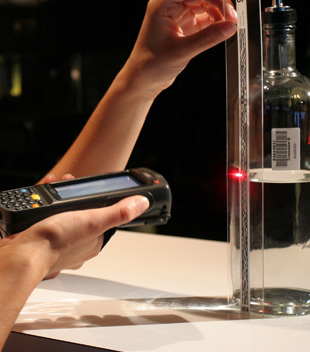
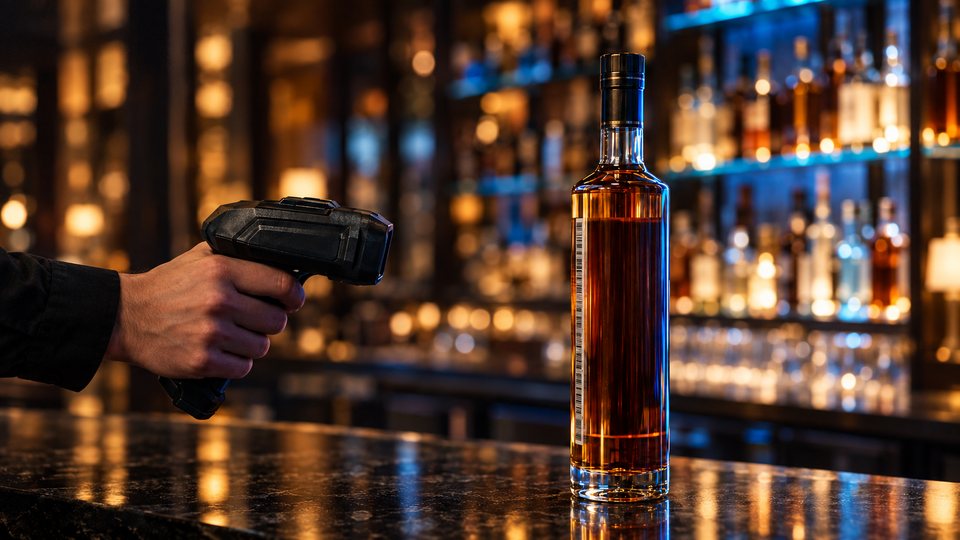
Scannabar prints a bar code running down the height of the bottle. The handheld reads it at the liquid line, which turns the open bottle into a measured quantity rather than a judgement call. One scan, no arithmetic at the bar, and the same answer regardless of who is holding the scanner.
You can watch it happen on the Scannabar channel, or ask for it during the demo.
What accuracy does downstream
Once partials are measured, usage is real, so pour cost is real, so variance points at something. Venues counting by estimate commonly run 20 to 30 percent shrinkage; venues on a measured count typically sit at 1 to 3 percent, with beverage cost falling 25 to 50 percent within weeks of the first report anyone trusts.
Speed, including the partials
About 15 minutes for roughly 120 bottles, one person. The open bottles are not a separate exercise tacked onto the end; they are scanned in the same pass as the sealed stock.
Spirits, liqueurs and wine
Spirits and liqueurs are measured on the bottle, whatever the shape. Wine is organised differently, by cellar, cooler, bin and bottle position, because a wine list is managed by location as much as by product.
Where it runs
Counting is done on a rugged handheld from Zebra or Motorola. The back office is an installed Windows application — Windows, 8 GB of RAM, a 100 GB SSD — hosted on your own dedicated cloud instance or on a Scannabar server. Sales come in from your point-of-sale system by CSV, by XML, or through a direct API written to the POS vendor’s published specification.
What operators say
Scannabar has saved us in excess of $15,000 per month.
Jan Harrold, Owner, The Club at Firestone, Orlando, Florida
We were very impressed with the accuracy of the system and the speed at which the inventory could be completed.
Murari Nambiar, Comptroller, Sailfish Club of Florida, Palm Beach, Florida
Questions operators ask
How do you count a partially full bottle accurately?
By measuring it rather than judging it. Scannabar prints a bar code down the height of the bottle; the handheld reads it at the liquid line, so the level is recorded the same way for every bottle and every member of staff.
Is weighing bottles accurate enough?
Weighing replaces one estimate with another, because it depends on an assumed empty weight and an assumed density for the product. It is better than eyeballing and slower than scanning.
Does it work on any bottle shape?
The measurement is referenced to the individual bottle, so tall spirits, squat liqueurs and wine bottles are each handled on their own terms.
How long does it take?
About 15 minutes for roughly 120 bottles, one person, with the open bottles included rather than treated as a separate chore.
What about wine?
Wine is tracked by cellar, cooler, bin and bottle position, which suits a wine programme better than a flat product count.
Book a 15-minute demo See how it works
15 minutes, screen share, no install. A guided walkthrough of the software and straight answers on what it costs.
Related: Liquor inventory · Wine inventory · Alcohol inventory tracker
Scannabar has measured beverage inventory for bars, hotels, clubs and restaurants since 1998. Head office: 2001 University Street, Suite 1700, Montréal, Québec H3A 2A6. Call 1-800-939-8960 or email sales@scannabar.com.