Beer, keg and dry goods inventory software
Beer and dry goods are where a beverage cost number quietly goes wrong. Packaged stock gets counted last by whoever is still standing, kegs get estimated from memory, and mixers and consumables often never get counted at all. Scannabar puts bottled and canned beer, keg stock and dry goods on the same system as your liquor and wine, so one count covers the whole cellar and one report shows the whole variance.
Keg stock, tracked in and out
Scannabar tracks kegs as full and empty units by outlet, so you know what is in the cellar, what is on tap, what is waiting for pickup and what you are owed in deposits. Delivery in, empty out, reconciled against purchases. It is stock control on one of your highest-value case-level items, and it is the part most venues still run on a clipboard.
Scannabar does not meter the volume left inside a tapped keg. If pour-level measurement on draught is a requirement for you, we will say so on the call rather than after you have signed.
Bottles and cans without a second system
Packaged beer counts on the same pass as your spirits. No separate sheet, no second spreadsheet, no reconciling two systems that disagree.
Every item is counted at item level, so a case that went out the back door shows up as a variance against sales rather than disappearing into a rounded cellar estimate.
Dry goods, mixers and consumables
Mixers, syrups, garnishes, glassware and paper. Low unit value, high unit volume, and collectively a real line on your cost of goods. Counting them on the same system is what makes your beverage cost number complete rather than approximately right.
One count, one variance report
The reason to run beer and dry goods on the same system as liquor is not tidiness. It is that partial coverage produces partial variance, and partial variance is how a 25% loss survives a monthly inventory. Full coverage is what gets a venue to 1-3%.
How fast it goes
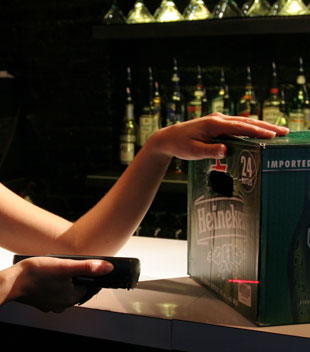
120 bottles in about 15 minutes sets the pace for the whole cellar walk. Counts that used to eat a Sunday get done before the first delivery. The count runs on a rugged Zebra or Motorola handheld built for cellars and cold rooms, not a phone in a case.
Where your sales data comes from
Sales data comes across by CSV, by XML, or through a direct API connection built to your POS vendor's published specification, so packaged beer usage reconciles against what you actually sold.
The numbers
| 1-3% | shrinkage after Scannabar, down from 20-30% |
| 25-50% | lower beverage cost, within weeks |
| One system | liquor, wine, beer and dry goods together |
| Since 1998 | 28 years in hotels, bars and clubs |
Questions operators ask
Does Scannabar measure what is left in a tapped keg?
No. Kegs are tracked as full or empty units. Scannabar does not meter partial keg volume, and we would rather tell you that now than in month two.
How are keg deposits handled?
Empties are tracked by outlet as they come back, so what you are owed in deposits is a number in the system rather than a guess at the end of the quarter.
How granular is dry goods tracking?
Item level, the same as packaged beer. Mixers, syrups, garnishes, glassware and paper can all be counted and reconciled.
Does it run on the same handheld as the liquor count?
Yes. One device, one pass through the cellar, one variance report covering liquor, wine, beer and dry goods.
The rest of your cellar
Beer and dry goods sit alongside liquor measured bottle by bottle and wine tracked to bin and bottle position.
Count your cellar in 15 minutes
Book a demo and we will walk you through how keg stock, packaged beer and dry goods are counted and reported.
Book a 15-minute demo See how it works
Talk to a person: 1-800-939-8960. Montréal, Canada. Operating since 1998.
Guides: Alcohol inventory tracker · How to manage bar inventory · How to do a bar inventory count