How to do a bar inventory count in 15 minutes
A bar inventory count has exactly one job: produce a number you can reconcile against sales. Not a tidy sheet, not a rough feel for what is short. A number solid enough that when it disagrees with your POS, you go looking for a reason instead of blaming the count.
Book a 15-minute demo See how it works
15 minutes, screen share, no install. A guided walkthrough of the software and straight answers on what it costs.
What the count actually has to produce
Most bars can tell you how many bottles are on the shelf. Far fewer can tell you how much liquor is on the shelf, and that is the figure your beverage cost depends on. The count has to end with a quantity per product, per outlet, accurate enough to subtract from opening stock plus purchases and land on a usage figure you trust.
If the count is soft, every report downstream is soft. Variance, pour cost, reorder points and shrinkage all inherit the error.
The manual method, honestly
Two people, a clipboard and a printed sheet. One reads, one writes. Full bottles are easy. Then you reach the open ones and start estimating in tenths: that Bombay looks like a six, the Grand Marnier is maybe a three. Some operators use thumb widths against the label, some eyeball it, some weigh bottles and subtract an assumed empty weight.
All four are estimates, and they are the majority of the value sitting on a busy back bar. A count that takes half a night and still rests on guesswork is expensive twice over.
Why estimated levels break the variance report before it starts
Work it through with your own numbers. Suppose a bar carries 120 open bottles and your estimates are off by an average of ten percent of a bottle in either direction. Errors do not reliably cancel: staff round to comfortable fractions, and they round the same way every week. You are left with a variance figure that moves for reasons that have nothing to do with pouring.
The practical consequence is that nobody trusts the report, so nobody acts on it, so the count becomes a compliance exercise. Shrinkage of 20 to 30 percent is normal in venues that count this way. Venues running a measured count typically sit at 1 to 3 percent.
The measured method
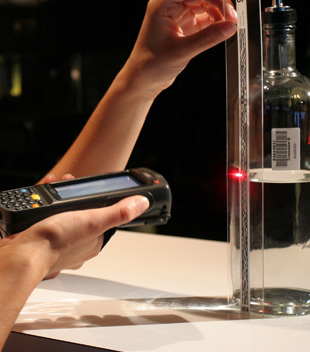
Scannabar puts a bar code along the height of the bottle. Scanning it reads the level of the liquid rather than asking a person to judge it, so an open bottle is recorded the same way a full one is: measured, not estimated. The same bartender counting the same shelf twice gets the same answer.
Step by step: 120 bottles, about 15 minutes, one person
- Close out sales for the period so the POS figures you will reconcile against are final.
- Work one outlet at a time and always in the same order. Speed comes from a fixed route, not from hurrying.
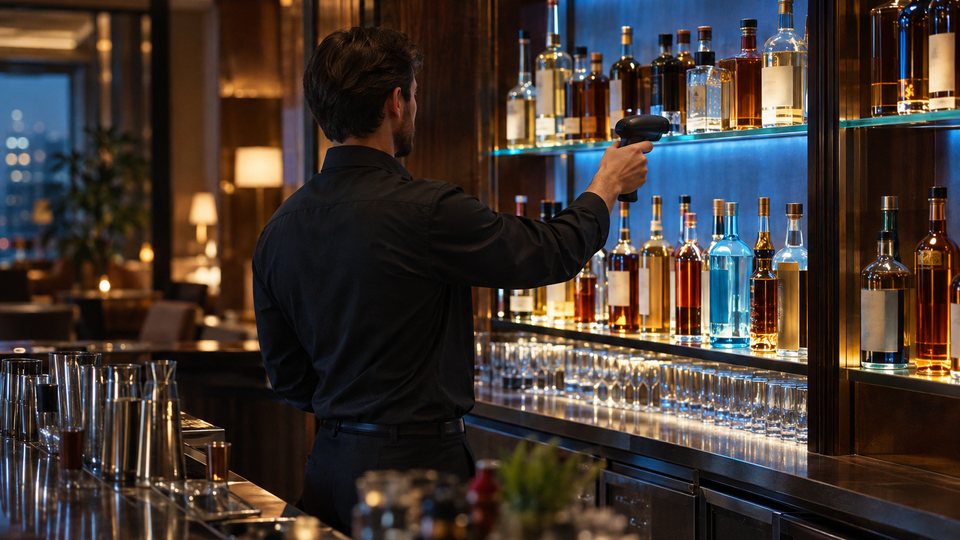
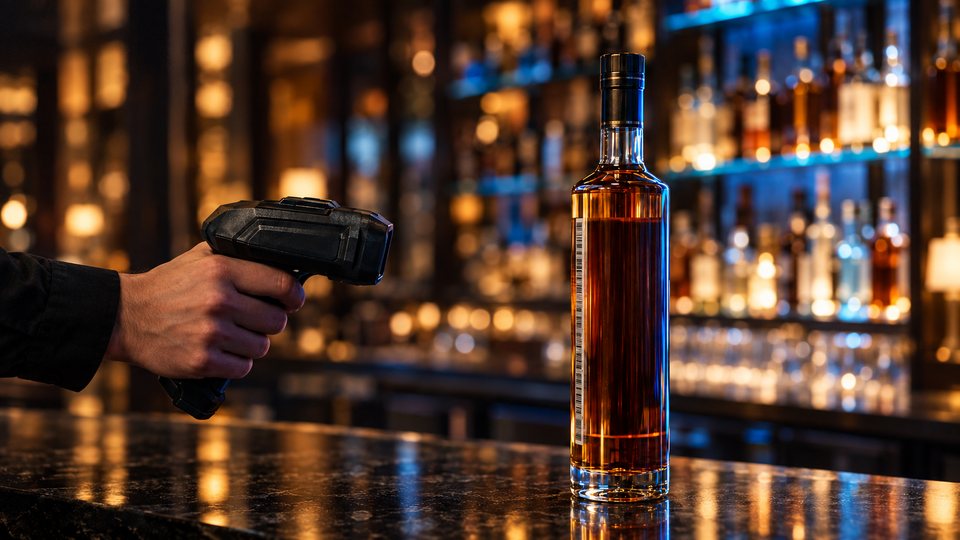
- Scan the shelf. Each bottle is one scan, open or full. There is no writing and no arithmetic at the bar.
- Move to storeroom and cellar stock, which is mostly sealed units and goes quickly.
- Upload to the back office and let it pull usage from the POS.
- Read the variance in the morning, by outlet, by shift and by product.
One person, one pass, roughly a quarter of an hour for a bar of that size.
How often to count
A full count weekly. A short daily spot count on the ten or fifteen products that carry the most cost, which in most venues is premium vodka, gin, tequila and cognac. Weekly full counts keep the investigation window small enough to be useful; a daily spot check on high-cost lines catches the fast problems before they compound.
What the count tells you the next morning
Variance by outlet tells you where. Variance by shift narrows it to who was working. Variance by product tells you what kind of problem it is: a single spirit running short points at over-pouring or free drinks, while a broad shortfall across a category more often points at receiving, breakage or transfers that never got recorded.
That is the difference between knowing you lost money and knowing where to look.
What operators say
Scannabar has saved us in excess of $15,000 per month.
Jan Harrold, Owner, The Club at Firestone, Orlando, Florida
We were very impressed with the accuracy of the system and the speed at which the inventory could be completed.
Murari Nambiar, Comptroller, Sailfish Club of Florida, Palm Beach, Florida
Questions operators ask
How long does a bar inventory count take?
With a measured system, about 15 minutes for roughly 120 bottles, done by one person. A manual count of the same bar, with two people estimating partial bottles on a sheet, typically runs a large part of an evening.
How often should we count?
A full count weekly, plus a short daily spot count on your highest-cost spirits. Weekly is frequent enough to tie a variance back to a specific shift while people still remember it. Quarterly counting tells you that you lost money, not who or when.
Do we still need to count full bottles?
Yes, but full bottles were never the hard part. The accuracy problem lives in the open bottles on the shelf, and that is what measuring solves.
Can the count be reconciled against our POS sales?
Yes. Usage comes in from your point-of-sale system by CSV, by XML, or through a direct API written to the POS vendor's published specification, and the variance report compares what was poured against what was sold.
What do staff carry during the count?
A rugged handheld scanner from Zebra or Motorola. The back office software is an installed Windows application, running either on your own dedicated cloud instance or on a Scannabar server.
See it on your own products
The demo is a guided walkthrough of the software and the variance report, run over a screen share. Nothing to install to watch it.
Book a 15-minute demo See how it works
15 minutes, screen share, no install. A guided walkthrough of the software and straight answers on what it costs.
Related: Liquor inventory · Counting open bottle levels · How to manage bar inventory
Scannabar has measured beverage inventory for bars, hotels, clubs and restaurants since 1998. Head office: 2001 University Street, Suite 1700, Montréal, Québec H3A 2A6. Call 1-800-939-8960 or email sales@scannabar.com.