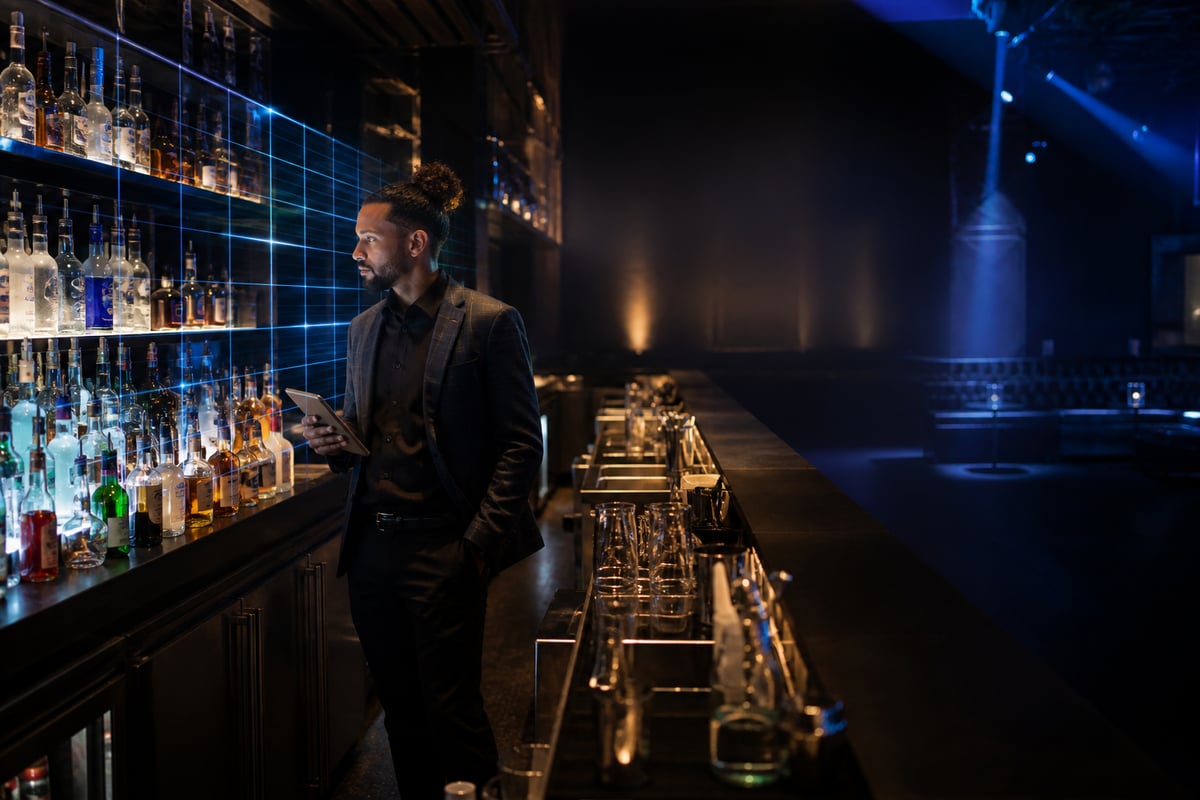
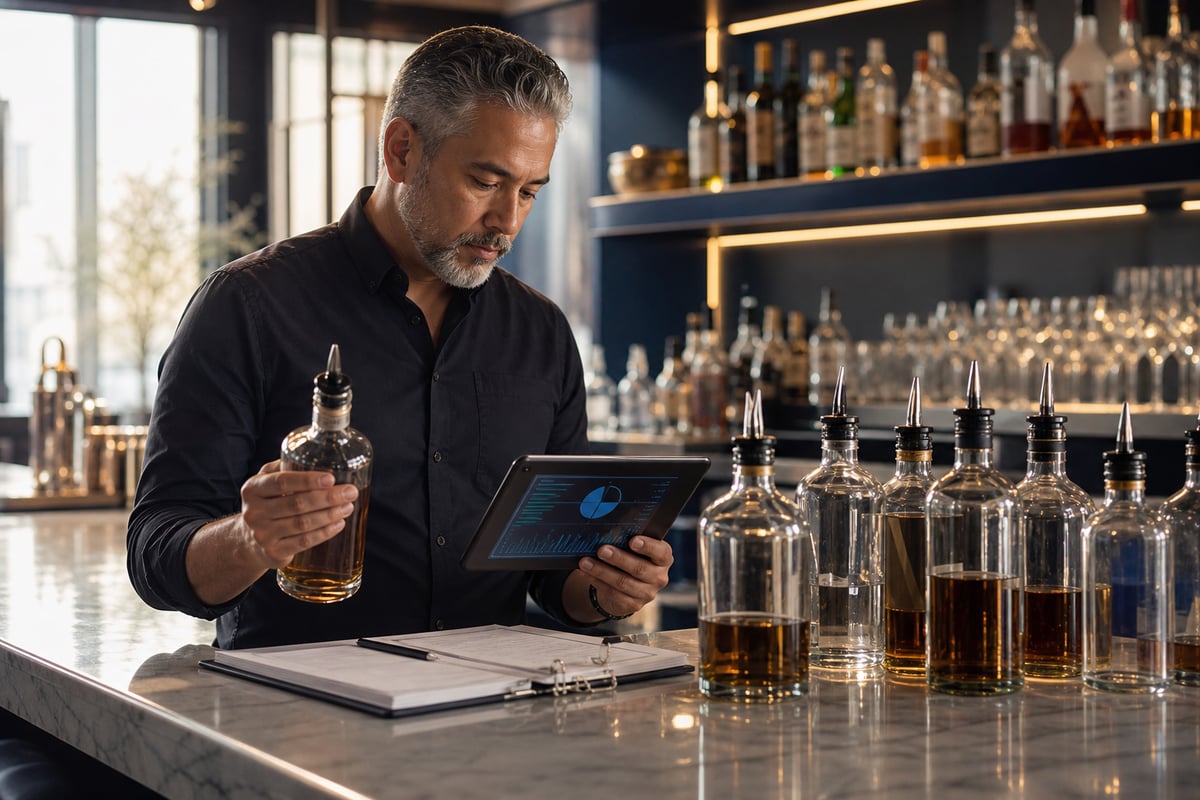
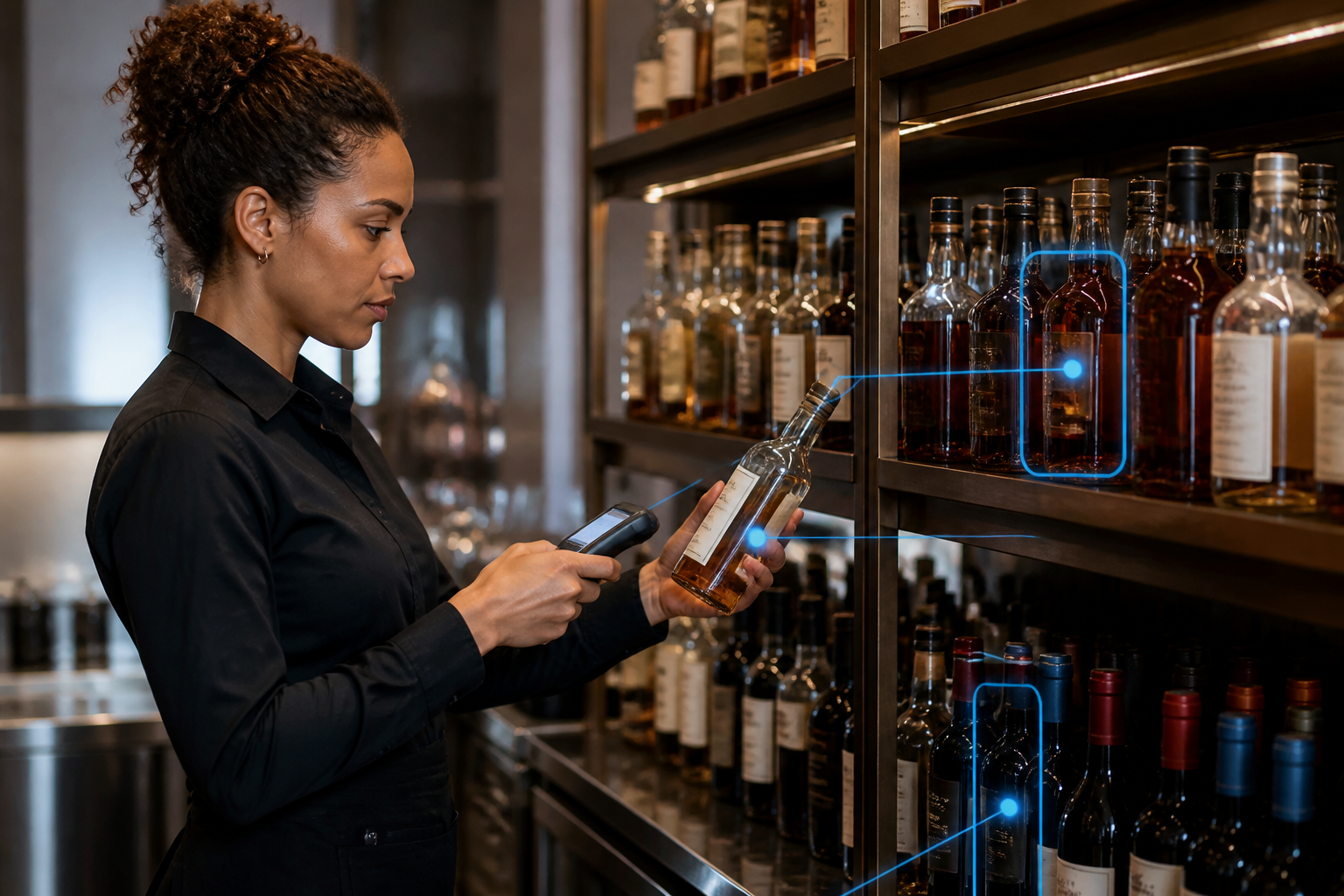
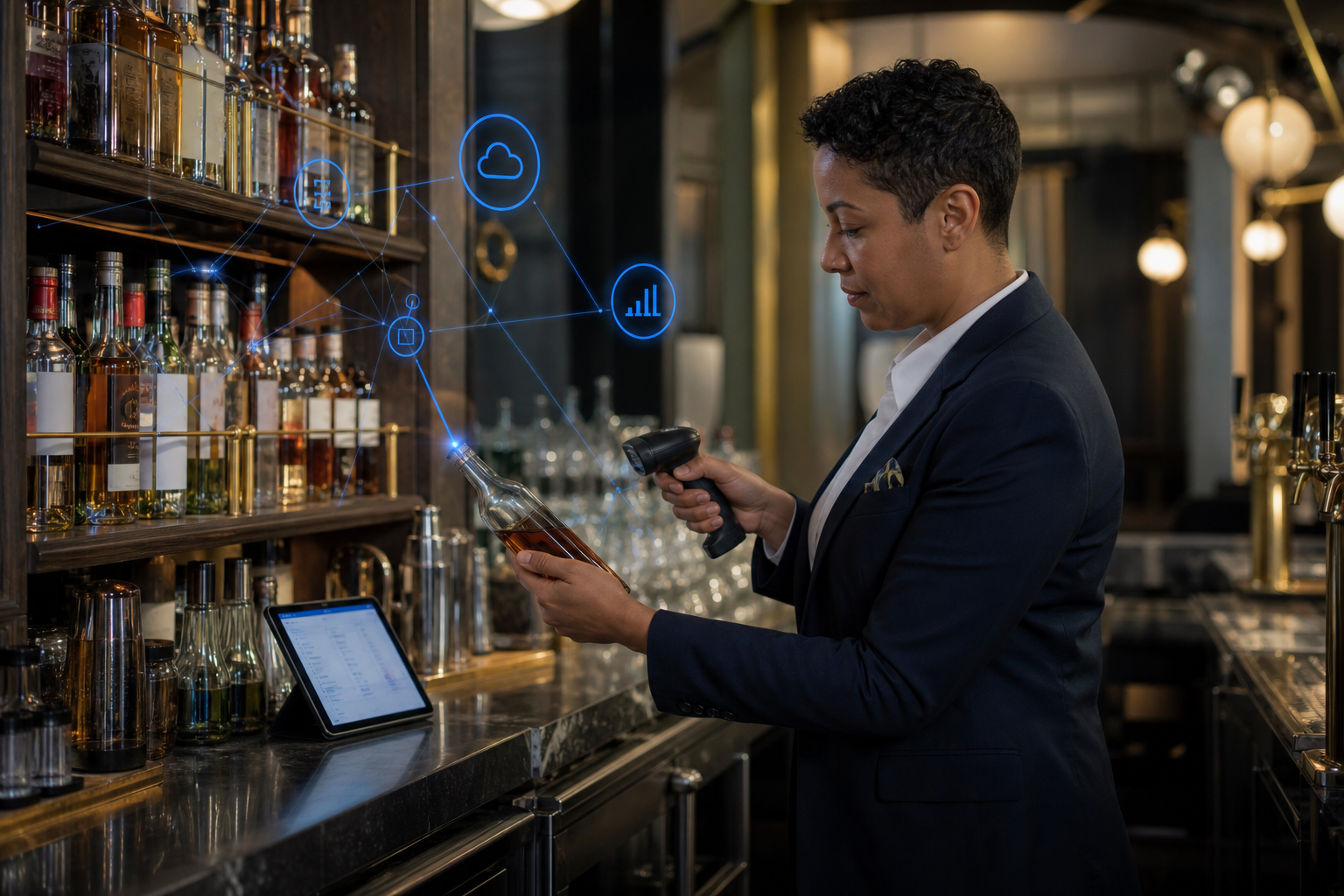
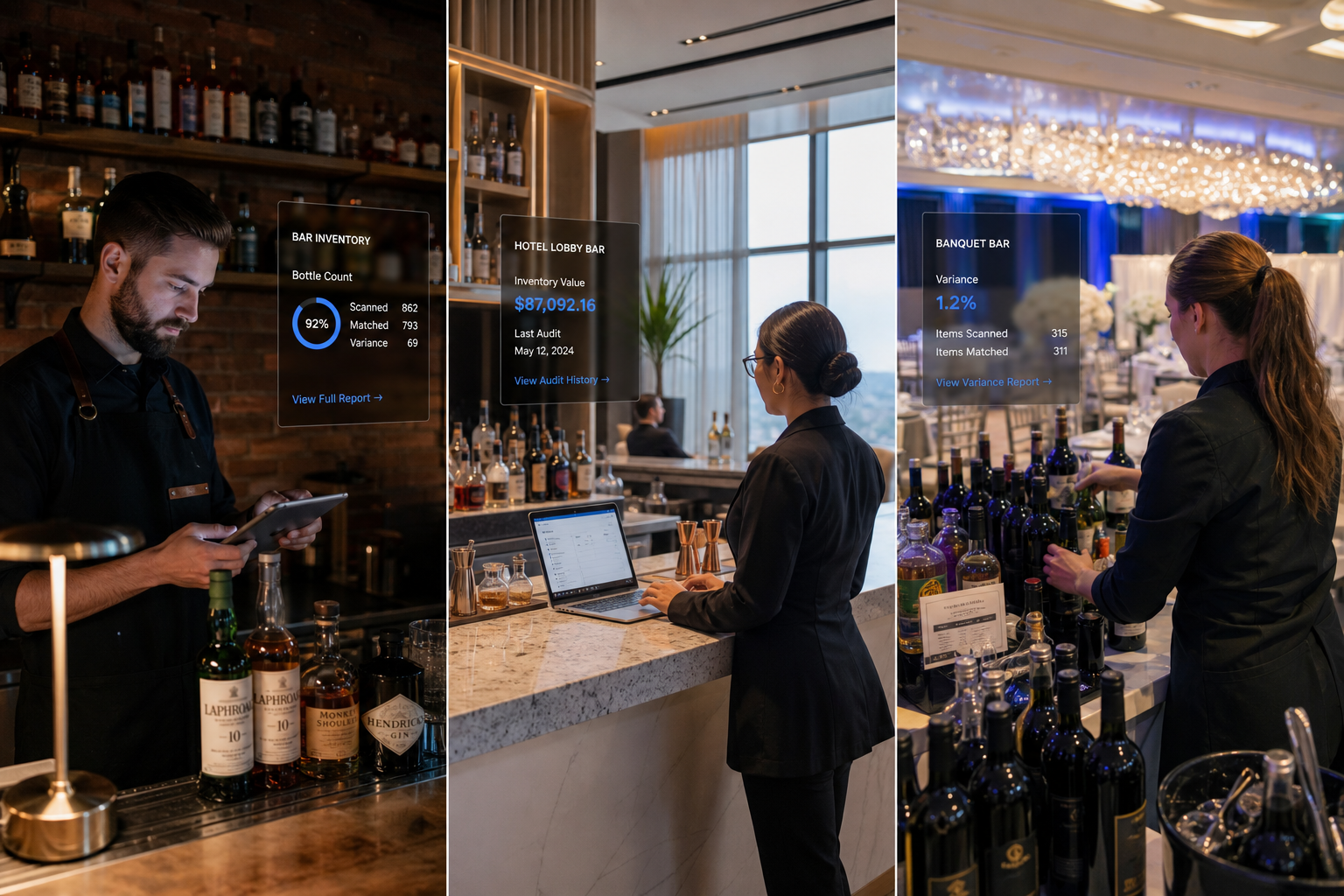
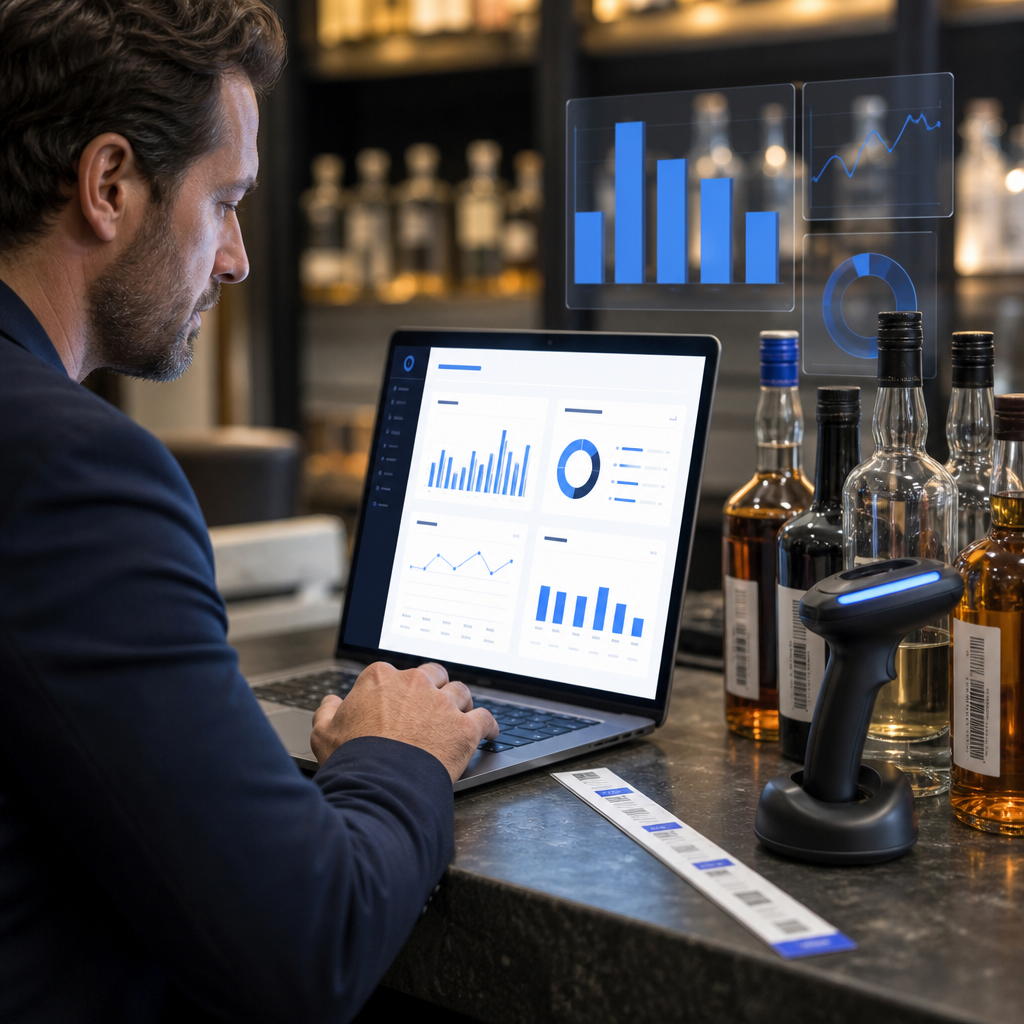
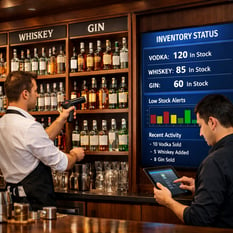
A full room does not guarantee a profitable bar. If the main station runs out of a fast-moving spirit while another station has excess stock, service slows and the next order may never happen. If bottles move between stations without a record, the morning count becomes harder to explain.
This guide gives bar and nightclub managers a repeatable event-night stock plan. Scannabar helps bring measured inventory and usage reporting into that plan, while your team remains responsible for documenting what moves during service.
Prepare each station for the night ahead.
Key Takeaways: Nightclub Event Inventory
Plan each station around its own expected sales mix rather than dividing the same stock evenly across the venue.
Keep a reserve near the floor and assign one clear process for documenting replenishment and inter-bar transfers.
Record opening stock, movements, sales, and closing stock to make event-night variance easier to investigate.
Review discrepancies before assuming theft; an unlogged transfer, breakage, or POS mapping error can also explain a gap.
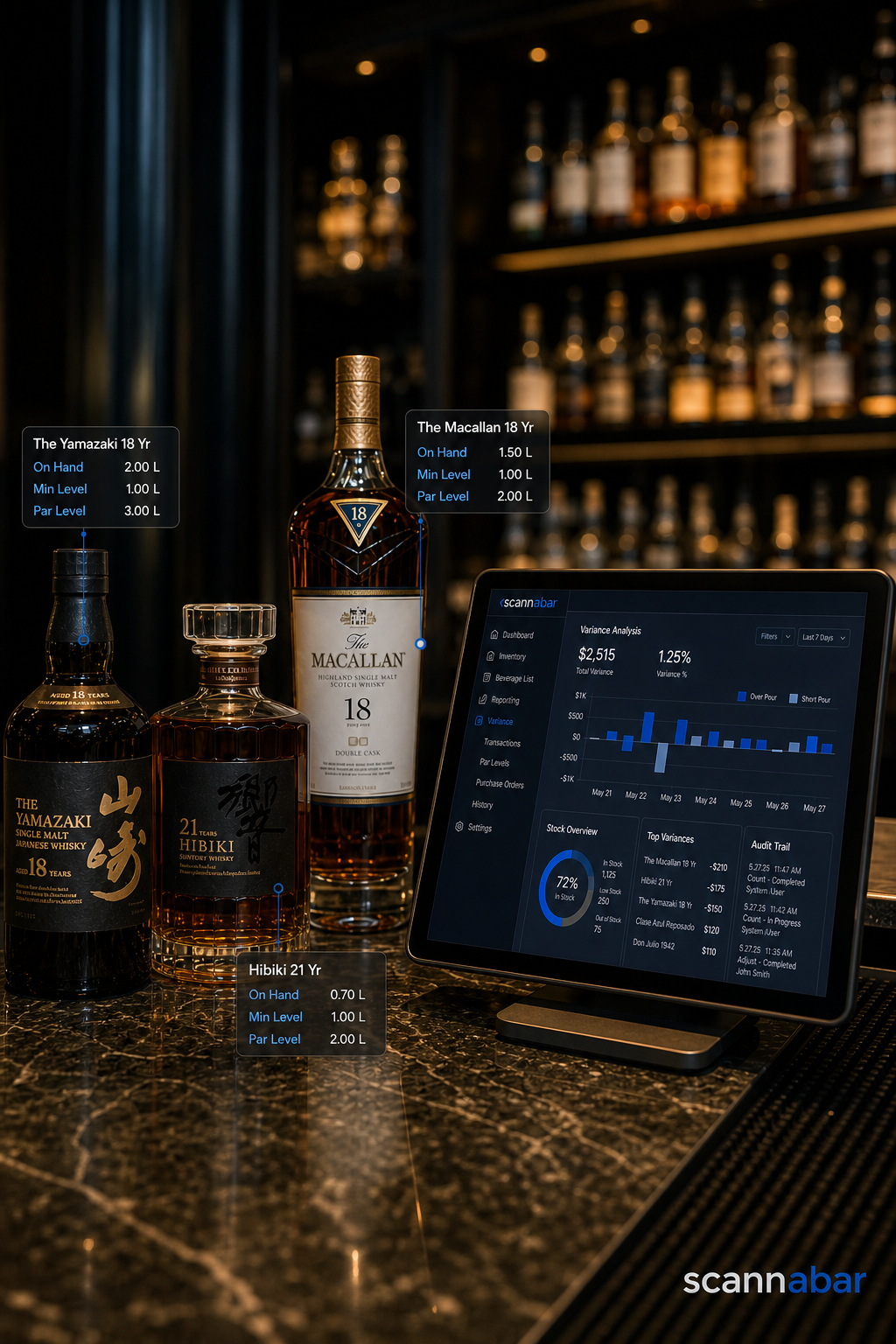
Scannabar supports barcode-based counts and inventory reporting that help managers compare usage across count periods.
Why a Packed Night Can Still Lose Beverage Revenue
Demand shifts rapidly at a nightclub. An unexpected rush at one station can leave a bartender looking for a replacement bottle while stock sits elsewhere. An undocumented pull from storage then makes the closing count look like a loss. The visible cost is delayed service; the less visible cost is a variance you cannot assign to a cause.
Suppose an event starts with 12 bottles of a spirit at one station, receives four more, and closes with five. Eleven bottle-equivalents were used or moved. That is an accounting example, not a loss figure: compare it with recorded transfers, measured partial bottles, and sales and pour practices before drawing conclusions.
Build an Event-Specific Stock Plan Before Doors Open
Start with comparable events: similar attendance, service hours, and drink mix. The National Restaurant Association recommends using inventory reporting to track usage trends and waste. Review product velocity in your POS system, then set a starting par level and a separate replenishment reserve for each station. Keep the assumptions visible so the closing team can say what changed.
Set Par Levels by Station
A main bar serving straightforward mixed drinks may need a different spirit mix from a quieter lounge. Use each station’s sales history rather than a building-wide average. If a station used 18 bottles of a particular SKU during a similar event, a starting par of 20 is one possible planning assumption, not a universal formula. Adjust it for expected demand and the ease of replenishment.
Reserve Stock for Rapid Replenishment
Stage reserve stock by SKU in a known location and give barbacks a simple transfer log. Each pull should show the item, quantity, source, destination, and time. This is a team procedure, not a claim that Scannabar automatically records every transfer. Good documentation lets the physical count tell a clearer story.
Track Stock Movement While the Room Is Busy
During service, the transfer process has to be simple enough to survive a rush. One person can record pulls at the storage point while floor staff focus on guests. Spot-check high-value or fast-moving SKUs during a lull, especially when replenishment differs from the pre-event plan.
Scannabar’s barcode-enabled inventory approach supports faster stock checks and usage visibility. Use those counts alongside the team’s movement log rather than treating a count alone as proof of where a bottle went.
Reconcile the Night Before Planning the Next Event
Reconcile event stock while the details are fresh.
Count each station and the reserve after service, ideally before new deliveries or transfers change the picture. Compare opening inventory plus receipts and transfers in, less transfers out and closing inventory, with expected usage from sales. Document breakage, comps, and other known exceptions separately.
Scannabar’s variance reporting helps identify products whose measured usage deserves a closer look. The question is not whom to blame first. It is whether the discrepancy reflects an unrecorded movement, a POS mismatch, a counting error, waste, or theft. A consistent review also protects staff from unsupported accusations.
Turn One Event’s Data into a Better Next Shift
Compare which products ran short, which sat untouched, and which showed unexplained variance. Update par levels for the next similar event and discuss exceptions with the staff who worked the shift. Over several events, those comparisons can make purchasing and station placement more precise.
Scannabar’s inventory planning and usage insights give managers a better starting point than memory alone. The transfer log and POS records add the operational detail needed to act on that information.
FAQs About Nightclub Event Inventory
When should a nightclub count stock for an event?
Count before service and again after close, before new stock changes the totals. This isolates the event’s movement so you can compare actual usage with sales and documented exceptions.
How should a nightclub set event-night par levels?
Use comparable event sales by station and SKU, then allow for expected demand and replenishment time. Review what ran short or remained untouched after the event and adjust the next plan.
Does Scannabar replace an event transfer log?
No. Scannabar supports inventory counts and usage analysis, while a documented transfer process supplies the context for bottles moved between storage and stations. Together they make variance easier to interpret.
What should managers investigate when inventory and POS sales disagree?
Check transfers, comps, breakage, partial-bottle measurements, and POS item mapping before deciding whether product was lost. Scannabar’s inventory reporting helps narrow the items that need review; the manager establishes the cause.
Your hotel's bar program probably generates strong top-line revenue. But if you have not looked closely at beverage cost control, a significant share of that revenue is walking out the door through variance: the gap between what your records say you should have and what you actually count on the shelf.
For a hotel bar doing $1 million in annual beverage sales, a 20% variance means $200,000 disappearing every year. Scannabar gives hotel operators the tools to close that gap, tracking every bottle from receiving to final pour.
Beverage variance hides inside busy nights, transfer slips nobody reconciles, and bottles that vanish between stockrooms. Left unchecked, it compounds week after week. This guide walks you through six practical steps to measure, reduce, and manage variance across your bars, banquet operations, and service outlets.
Quick Guide: How to Reduce Beverage Variance in 6 Easy Steps
Define how you will measure beverage variance: Pick one formula, apply it consistently, and make sure every outlet uses the same math.
Standardize recipes and pour sizes: Lock in exact ingredient amounts so that every drink carries a predictable cost.
Tighten receiving, transfers, and write-off logs: Record every bottle that enters, moves between outlets, or leaves your inventory.
Count high-risk inventory every week: Focus weekly counts on spirits, premium wines, and fast-moving products where losses concentrate.
Review variance by item, outlet, and shift: Break the data down so the number points you to a specific location, product, or time window.
Act on the cause, not just the number: Use Scannabar's variance reports to trace each discrepancy back to a correctable root cause.
How to Reduce Beverage Variance Across Your Hotel Bar Operations
1. Define how you will measure beverage variance
You cannot fix a problem you have not defined. Beverage variance is the difference between theoretical consumption (what your POS system says you sold, plus documented waste) and actual consumption (what a physical count reveals you used). Some properties express it as a percentage of cost, others as a dollar figure per period. Pick one and make sure every outlet uses the same formula.
Start by confirming that your POS rings are mapped to specific SKUs and portion sizes. If a "vodka soda" in the lobby bar rings up at 1.5 oz but the banquet team pours 2 oz for the same drink code, your variance is baked in before anyone even miscounts a bottle.
Agree on a reporting period. Weekly reporting catches problems while the responsible shift is still on the schedule. Monthly reporting buries causes under four weeks of compounding activity. A weekly inventory rhythm keeps the data actionable.
2. Standardize recipes and pour sizes
A recipe card is not a suggestion. It is the financial blueprint for every drink leaving your bar. For a deeper look at how drink recipes affect profitability, the math is straightforward. When recipes are vague or left to bartender discretion, pour cost swings from shift to shift, and that swing shows up directly as variance.
Document every cocktail, wine-by-the-glass portion, and draft beer yield. Include the exact quantity of each ingredient in ounces or milliliters, the expected number of servings per bottle, and the target cost per drink.
Post recipe cards at every station and train new hires on them during their first shift. Consider using jiggers or measured pourers for your highest-volume spirits. A standardized 1.5 oz pour on your top-ten spirits alone can move your pour cost by two to three percentage points.
3. Tighten receiving, transfers, and write-off logs
Variance often starts at the loading dock, not behind the bar. If a delivery arrives short and nobody catches it, your opening inventory is already wrong. Every bottle entering the property needs a verified receipt: someone checks the order against the invoice, counts the cases, and signs off.
Inter-outlet transfers are the next weak link. When the banquet team pulls two cases of vodka from the main bar for a Saturday event, that movement must be logged in writing or through your inventory system. Unlogged transfers make one outlet look short and another look over-stocked, making it impossible to isolate where variance originates.
Write-offs for breakage, spoilage, and complimentary pours require the same discipline. An unrecorded comp bottle is invisible shrinkage. A simple daily log with a reason code, the product, and a manager's initials is enough to keep these losses visible.
4. Count high-risk inventory every week
Full monthly inventories have their place, but they do not catch problems fast enough. By the time you discover a variance at month-end, the staff involved may have rotated off the schedule. The trail is cold.
Identify your top 20 highest-value and fastest-moving items. These typically represent 80% of your beverage cost. Count them every week. Scannabar measures the level in every open bottle using barcode scanning technology, so a single person can count 120 bottles in roughly 15 minutes. That speed makes weekly counts practical rather than aspirational.
Rotate a full count of your remaining inventory on a monthly cycle. This layered approach catches high-impact losses weekly while still covering your entire catalog periodically.
5. Review variance by item, outlet, and shift
A single, property-wide variance number is almost useless. If your hotel runs a lobby bar, a pool bar, a restaurant bar, and banquet service, a blended number hides where the problem lives.
Break variance down by individual product first. Is it concentrated in premium spirits, house-brand vodka, or draft beer? Then look at it by outlet. The pool bar might run tight while the banquet prep area runs loose.
Finally, compare variance by shift or by counting period. A spike that correlates with a specific team tells you where to focus your coaching.
This layered analysis turns a vague cost problem into a specific operational finding you can act on this week, not next quarter.
6. Act on the cause, not just the number
Variance is a symptom, not a diagnosis. A 12% variance on a premium tequila could mean over-pouring, unrecorded comps, a receiving error, or theft. The number alone does not tell you which one.
Cross-reference your variance data with POS sales, transfer logs, write-off records, and shift schedules. If usage exceeds sales and there are no documented transfers or write-offs, the gap is unexplained loss. If usage aligns with sales but both exceed what the recipes predict, you likely have a portioning problem.
Frame the conversation with your bar staff around accountability, not blame. When your team knows the system tracks every ounce, the goal is to help them prove they poured correctly, not to catch them in the act.
Scannabar's approach to cost reduction is built around that principle. That distinction is the difference between a culture of accountability and a climate of suspicion.
What Causes Beverage Variance in Hotel Bars?
Beverage variance in hotel bars traces back to five primary sources: over-pouring, unrecorded transfers between outlets, receiving errors, undocumented write-offs, and theft. Hotels face additional exposure because beverages move between multiple cost centers, including bars, restaurants, banquets, room service, and minibars. Managing wine inventory and spirits under a single system reduces the blind spots that create variance.
Over-pouring is the most common source. Without measured pours, bartenders tend to pour heavy, especially during high-volume shifts. According to FSM.How's guide to beverage control, average pour costs in hotel bars range from 18% to 24%, and even small deviations from standard pour sizes erode those margins fast.
The difference between a 1.5 oz pour and a 2 oz pour costs you roughly four to five missing servings per standard 750 ml bottle. That is money walking out the door on every pour.
Unrecorded transfers are uniquely problematic in hotels. A banquet manager who borrows six bottles of wine from the restaurant bar for a last-minute event may not log the transfer. That creates a phantom shortage in one outlet and a surplus in another. Neither figure reflects reality until someone reconciles them.
How Often Should a Hotel Review Beverage Variance?
Weekly variance reviews produce the fastest operational improvements. When you review variance every week, the data connects to recent shifts, specific staff, and identifiable events. You can ask your bar manager, "What happened with the Ketel One on Wednesday?" and get a meaningful answer.
Monthly reviews are too slow for high-risk items. By week four, the context around a mid-month spike is gone. However, a monthly review cycle works well for slower-moving products like specialty liqueurs, wines stored in the cellar, and dry goods.
The best approach layers both frequencies. Count and review your top 20 items weekly. Run a complete inventory and variance analysis monthly. Use the weekly data to coach staff and adjust operations in near-real time, and use the monthly data to evaluate trends, purchasing efficiency, and overall program health.
How Scannabar Helps You Reduce Beverage Variance
Scannabar provides the most precise bottle-level tracking available, following every container in your hotel from the moment it arrives to the moment it is fully depleted. The system uses barcode scanning and bottle-level measurement to record the exact contents of each container, eliminating the estimation and rounding errors that plague manual counts.
Because Scannabar integrates with your POS and property management systems, it automatically compares what you sold against what you used. The resulting variance reports break down discrepancies by product, outlet, and time period, so your food and beverage director can pinpoint exactly where losses occur.
Hotels running Scannabar routinely operate at 1%–3% shrinkage, down from the 20%–25% industry average. You can read more about lowering beverage costs in hotel environments.
The system measures 120 bottles in about 15 minutes, making weekly counts feasible even for properties with multiple bars and banquet outlets. That frequency is what turns data into action: a variance you find this week still belongs to a shift you can address.
Ready to close the gap between what you sell and what you pour? See how Scannabar works or call 1-800-939-8960 to talk to a person who has been doing this since 1998.
FAQs About Beverage Variance
What is a good beverage variance percentage for a hotel bar?
A well-controlled hotel bar should target variance below 3%. Many properties without systematic tracking run between 20% and 25%. Scannabar helps hotels close that gap by providing bottle-level measurement and automated variance reports that highlight discrepancies before they compound.
Can beverage variance be completely eliminated?
Zero variance is not a realistic goal. Small amounts of loss from evaporation, breakage, and legitimate complimentary pours are unavoidable. The objective is to document those acceptable losses and reduce unexplained variance to a minimum. With consistent weekly counting and standardized recipes, most hotels can hold unexplained variance below 2%.
How does over-pouring affect beverage variance?
Over-pouring is the largest single contributor to variance in most hotel bars. A bartender who pours 2 oz instead of a standard 1.5 oz gives away 33% more product on every drink. Across a busy weekend, that adds up to several bottles of unrecovered cost. Scannabar tracks pour-level usage so you can spot over-pouring patterns by product and by shift.
What role do inter-outlet transfers play in hotel beverage variance?
Transfers between bars, banquet areas, and restaurants are a frequent source of unexplained variance in hotels. When a transfer is not logged, one outlet shows a shortage and another shows a surplus. Neither number is accurate. A documented transfer process, supported by your inventory system, ensures that product movement is visible across every cost center.
How does Scannabar integrate with hotel POS systems?
Scannabar connects with your POS through CSV, XML, or a direct API built to your POS vendor's published specification. This integration allows the system to match sales data against physical counts automatically. The result is a variance report that compares what you rang in with what you actually used, broken down by outlet and product.
Most bar operators know shrinkage exists. Fewer know how much profit it drains every week, or how long their counting method delays the moment they catch it. For a bar generating $500,000 in annual beverage revenue, a shrinkage rate of 20% to 25% translates to $100,000 to $125,000 walking out the door every year.
This guide breaks down what purpose-built bar inventory software should do, where generic tools fall short for hotels and multi-location hospitality groups, and how to evaluate monthly costs against the real return: faster counts, earlier variance alerts, and tighter liquor control across every bar you operate.
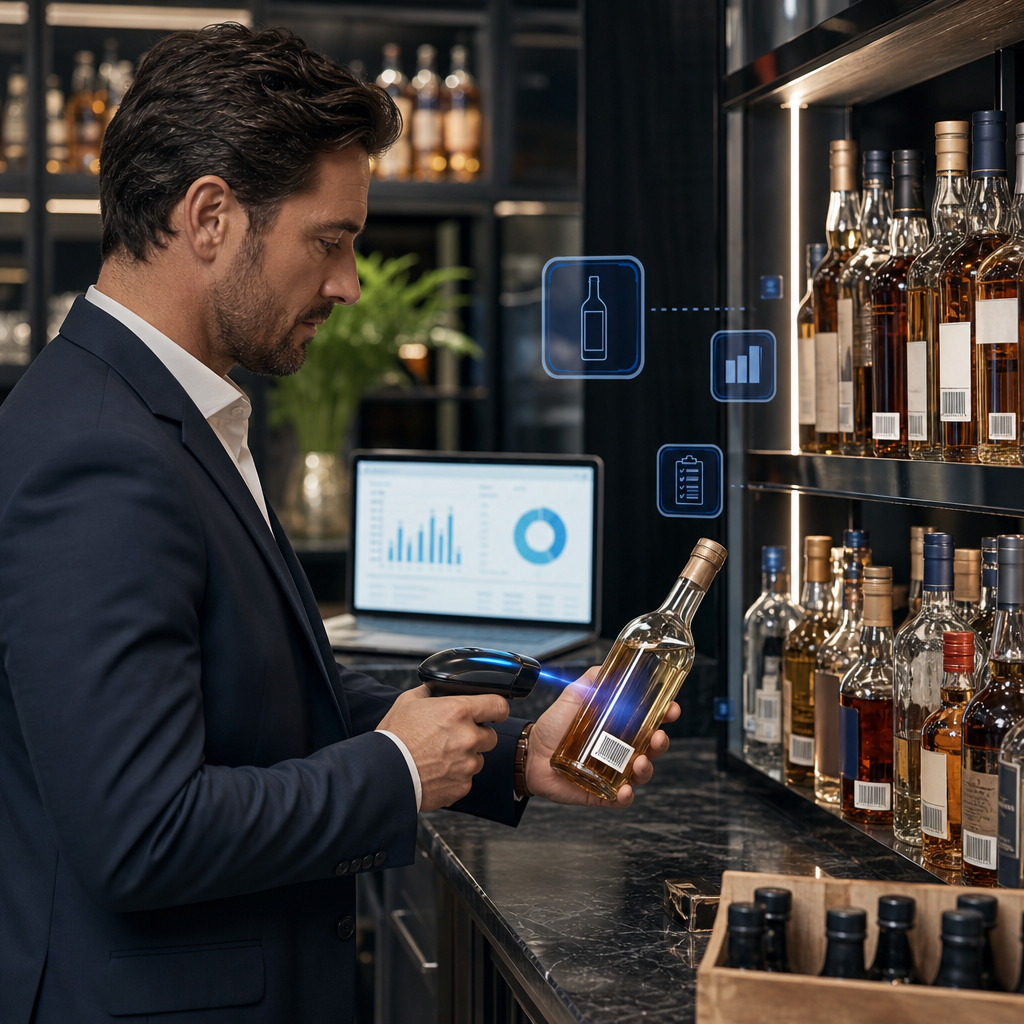
Serialized bottle tracking gives hotel and bar teams a faster way to count inventory and catch variance earlier.
Key Takeaways: Bar Inventory Software for Hotels and Hospitality Groups
Generic inventory tools miss bottle-level tracking, leaving variance undetected until thousands of dollars have already disappeared.
Serialized bottle tracking ties every ounce to a specific location, shift, and bartender for precise accountability.
POS integration closes the loop between what you sold and what you poured, exposing heavy pours and theft in real time.
Scannabar reduces shrinkage to 1% to 3% from industry averages near 25%, with clients reporting 25% to 50% beverage cost reductions.
Evaluating monthly software cost requires measuring labor savings, variance reduction, and faster decision-making alongside the subscription price.
Why Generic Inventory Tools Miss the Real Cost of Liquor Variance
Standard inventory platforms track quantities at the SKU level. They can tell you that you have 14 bottles of a particular bourbon on hand. They cannot tell you that three of those bottles are 60% depleted, one has been open for six weeks, and another has moved to the banquet prep area without a transfer record.
That gap matters because liquor variance hides in the details. A bottle that goes unaccounted for at a single-unit bar is a nuisance. A bottle that goes unaccounted for across 12 hotel bars, two banquet stations, and a rooftop lounge is a systemic blind spot that compounds every week you fail to catch it.
How Slow Counts Delay Variance Detection
Counting by hand is still the default at most bars. The math is brutal. A well-stocked bar carrying 80 to 120 open bottles takes 45 minutes to an hour to count by hand. Multiply that across multiple bars in a hotel property, and you are looking at a full shift dedicated to counting rather than serving.
The bigger problem is frequency. When counting takes that long, operators push it to once a month or once a quarter. That delay means variance builds silently. heavy pours, spillage, theft, and breakage accumulate for weeks before anyone sees the numbers.
By the time a monthly count reveals a $4,000 discrepancy, the damage is done. You have no way to trace which shift, which bartender, or which bar station contributed to the loss. The money is gone. The behavior that caused it has been repeating unchecked for 30 days.
Why Bars, Hotels, and Multi-Location Groups Need Different Controls
A standalone neighborhood bar and a 300-room hotel with four beverage outlets have fundamentally different control requirements. The bar owner needs speed and accuracy for a single location. The hotel F&B director needs centralized visibility across bars, banquet stations, minibars, and poolside service points, each with different par levels, different product mixes, and different staff rotations.
Multi-location hospitality groups add another layer. They need standardized processes across properties so that variance data is comparable, purchasing is aggregated, and a new bar manager in Miami follows the same counting protocol as the veteran in Nashville. Generic tools rarely offer that kind of operational standardization.
Bars, hotels, and multi-location groups need different inventory controls, but they all need accurate variance visibility.
What Bar Inventory Software Should Include
Not every platform calling itself bar inventory management software delivers the controls that hospitality operators need. The features below separate purpose-built hospitality tools from adapted warehouse or retail inventory systems.
What Serialized Bottle-Level Tracking Changes
Serialized tracking assigns a unique identity to every bottle the moment it enters your building. This approach is what makes liquor inventory precise at the bottle level.
When that bottle is scanned during receiving, the software creates a profile containing brand, volume, cost, and dimensional data. From that point forward, every measurement and every transfer is logged against that specific bottle.
If a bottle disappears from a service well between Tuesday's close and Wednesday's open, the system flags exactly which bottle is missing and where it was last recorded. That specificity separates precise liquor control from general-purpose inventory management.
Scannabar builds its entire system around this principle. Each bottle receives a bar-coded tracking label at receiving, and the software monitors its contents from the first pour to the final drop. The result is perpetual inventory that tracks every ounce, not just every case.
Why POS Integration Matters for Liquor Control
Inventory data without sales data is only half the picture. You know what you had and what you have now, but you do not know what should have been consumed based on actual register activity.
POS integration closes that gap. The software compares theoretical consumption (what your recipes say you should have poured) against actual consumption (what the count shows). The difference is your variance, and it points you exactly where to look.
A bar running 5% variance on well vodka might seem acceptable until you calculate the dollars. On a product moving 15 bottles a week at $18 per bottle, that variance costs roughly $700 a year on one SKU. Multiply across your full product line and the total adds up fast.
Scannabar integrates with POS platforms including Aloha, Micros, and InfoGenesis, creating a closed-loop system where counts, sales, and variance reports feed from the same data source.
POS integration helps operators compare sales data with actual usage so variance shows up faster.
How Barcode and Bottle-Based Counts Reduce Labor
Speed is not a luxury when you are managing inventory across multiple bars. Barcode scanning eliminates the clipboard-and-calculator process that eats hours every count cycle. Instead of reading labels, estimating fill levels, and writing numbers on a spreadsheet, your staff scans each bottle and lets the software calculate contents automatically.
Scannabar's system measures the contents of 120 bottles in roughly 15 minutes. A property running four bars can complete a full-property count during a single shift, which means you can count daily or after every shift without pulling staff away from revenue-generating work.
That frequency changes everything. Daily counts catch variance within 24 hours instead of 30 days. Weekly counts give you trend data that exposes patterns such as a particular bartender consistently running higher variance on premium spirits during Friday night shifts.
How Scannabar Fits Hospitality Operations
Scannabar was built for hospitality operators. It was not adapted from a warehouse platform or bolted onto a POS system as an afterthought. The system serves bars, restaurants, hotels, nightclubs, golf and country clubs, and cruise ships across the U.S. and Canada.
How Scannabar Supports Bar Operators
For independent bar owners and managers, Scannabar delivers bottle-level tracking without the overhead of enterprise software. The hand-held scanning unit is simple enough that any staff member can perform a count after minimal training.
The system flags missing bottles, calculates variance, and generates reports that show you exactly where your dollars are going. You can read more about how inventory tracking improves profitability across bar operations.
The practical result is a culture of accountability that protects both your profits and your staff. When bartenders know that every bottle is individually tracked, heavy pours and unrecorded drinks decline without you needing to stand behind the bar watching every pour. Staff members are protected from false accusations because the data is precise and defensible.
How Scannabar Supports Hotel Beverage Teams
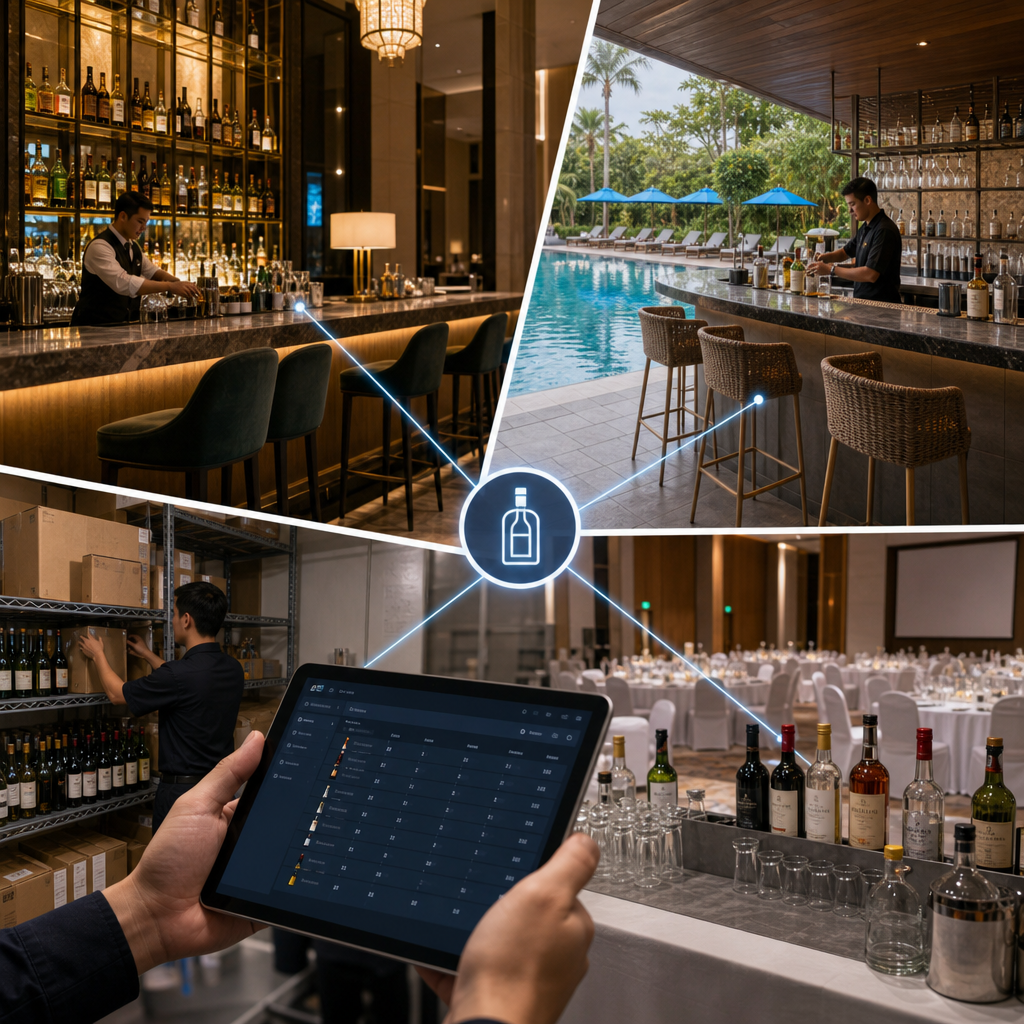
Hotels present unique inventory challenges. A single property may operate a lobby bar, a rooftop lounge, a pool bar, a restaurant bar, and multiple banquet and event stations. Product moves between these locations constantly, and each outlet may carry a different product mix with different par levels.
Scannabar handles multi-outlet properties with a single system. Inventory transfers between bars are tracked on the portable hand-held device, so the F&B director always knows which bottles are at which location. The system works at fixed bars, portable bars, and outdoor event stations, giving hotel teams centralized visibility from one process.
Properties operating under brands like Ritz Carlton, Hyatt, Sheraton, and Intercontinental already rely on Scannabar for this kind of hotel-wide liquor control.
How Scannabar Supports Multi-Location Groups
Hospitality groups managing multiple properties need two things generic tools rarely deliver: standardized counting processes and cross-location performance comparison. If every location counts differently, your variance data is not comparable and your purchasing decisions are based on inconsistent information.
Scannabar standardizes the entire process. Every location uses the same scanning hardware, the same software, and the same measurement methodology. That means a 3% shrinkage reading at your Nashville property and a 7% reading at your Miami property are directly comparable, and you can investigate the difference immediately.
Aggregated purchasing data across locations also strengthens your position at the distributor table. When you can show a supplier exact consumption volumes across 10 or 20 properties, you are negotiating from hard numbers, not estimates.
How to Compare Monthly Software Costs the Right Way
Price comparison is where most buyers go wrong first. They line up monthly subscription fees on a spreadsheet and pick the lowest number. That approach ignores the biggest cost of all: what each platform fails to catch.
What to Measure Beyond Subscription Price
Start with labor. How many hours does your team currently spend counting inventory each month? Multiply those hours by your loaded labor rate. If a platform cuts counting time by 75%, that labor savings alone may cover the subscription several times over.
Next, measure variance detection speed. A system that catches a $200-per-week loss in the first week saves you $800 compared to a system that catches it at the end of the month. Over a year, faster detection on just a handful of products can represent thousands of dollars.
Then look at integration costs. Some platforms charge separately for POS integration, for additional locations, or for report customization. Scannabar includes software support and upgrades at no additional charge, with no yearly or monthly licensing fees beyond the initial system cost. That pricing structure eliminates the hidden costs that inflate the total expense of subscription-based alternatives.
How Faster Counts and Earlier Alerts Affect ROI
If your current counting method takes 8 hours per month across all locations and a barcode-based system reduces that to 2 hours, you recover 6 hours of labor every month. At $25 per hour loaded, that is $150 in direct monthly savings.
Many Scannabar clients report reducing shrinkage to 1% to 3% from previous levels near 25%. For a bar doing $500,000 in annual beverage sales, dropping from 25% to 3% recovers $110,000 per year. A more conservative improvement to 10% still recovers $75,000.
The ROI timeline for most operators is weeks, not months. According to the National Restaurant Association's 2025 cost analysis, keeping beverage cost ratios in check remains a top priority across the industry.
Scannabar clients generally see a 25% to 50% reduction in beverage costs within the first few weeks. That rapid payback should anchor your cost comparison, not the subscription line item.
What Questions to Ask Before Choosing a Bar Inventory Platform
Before signing a contract, put each vendor through questions that reveal whether their platform was built for hospitality or adapted from another industry.
Does the System Track Individual Bottles or Only SKU Quantities?
SKU-level tracking tells you totals. Bottle-level tracking tells you where every ounce went. If you need to identify a missing bottle at a specific bar station, only serialized tracking delivers that answer.
How Does the System Measure Partial Bottles?
Estimating fill levels by eye introduces the same human error you are trying to eliminate. Look for calibrated measurement tools, whether that is a bar-coded ruler, a scale, or another precision method.
What POS Systems Does the Platform Integrate With?
Confirm that your current POS is supported natively. A third-party middleware layer adds cost, extra configuration, and potential points of failure.
Can the System Handle Multi-Location Operations?
Ask how variance data is standardized across properties. Can you compare shrinkage rates between locations using the same methodology? Can you aggregate purchasing data for distributor negotiations?
What Is the Total Cost of Ownership?
Ask about licensing fees, per-location charges, integration fees, and upgrade pricing. Some platforms advertise low subscriptions but add charges for features that should be standard. Scannabar includes support, upgrades, and toll-free customer service 7 days a week at no extra charge.
How Quickly Can Staff Learn the System?
A system that requires days of training slows your rollout and increases labor costs. Scannabar's hand-held device is simple enough that staff can begin performing counts within a single shift.
In Conclusion: How to Choose Bar Inventory Software That Protects Your Margins
The real cost of bar inventory is not the software subscription. It is the money you lose every week that your current system fails to detect. Variance, heavy pours, missing bottles, and delayed counts create a cascade of hidden costs that compound across every bar and every location you operate.
Purpose-built bar inventory software with serialized bottle tracking, POS integration, and barcode-based counts closes the gap between what you think you are losing and what you are actually losing.
Scannabar delivers that level of control for independent bars, hotel properties, and multi-location groups. The track record speaks for itself: shrinkage reduced to 1% to 3%, beverage costs cut by 25% to 50% within weeks of implementation.
The question is not whether you can afford to invest in better liquor control. It is whether you can afford to keep making decisions with delayed inventory data.
FAQs About Bar Inventory Software
What is bar inventory software and why do hospitality operators need it?
Bar inventory software automates the process of counting, tracking, and analyzing your beverage stock. It replaces hand counts with barcode scanning and digital measurement, giving you accurate data on what you have, what you sold, and what went missing. Scannabar tracks every bottle individually from receiving to depletion, so operators catch variance within hours instead of weeks.
How does POS integration improve liquor inventory control?
POS integration compares what your register says you sold against what your physical inventory shows you actually poured. The difference is your variance, and it points directly to heavy pours, theft, or waste. Scannabar connects with POS platforms like Aloha, Micros, and InfoGenesis to create a closed-loop system that flags discrepancies automatically.
Can bar inventory software work across multiple hotel bars and banquet stations?
Yes. Purpose-built hospitality inventory systems handle multi-outlet properties by tracking bottles across fixed bars, portable bars, and event stations. Scannabar manages transfers between locations on a portable hand-held device, giving F&B directors centralized visibility into every outlet from one system.
How long does a full bar inventory count take with scanning technology?
With barcode-based scanning, a bar stocked with 80 to 120 bottles takes roughly 15 minutes to count. That speed allows operators to count after every shift or daily, catching variance far earlier than monthly hand-counts. Scannabar processes all calculations automatically during the scan, so reports are ready the moment you finish.
What should I look for when comparing bar inventory software pricing?
Look beyond the monthly subscription. Factor in labor savings from faster counts, revenue recovered through earlier variance detection, and hidden costs such as per-location charges, integration fees, and support contracts. Scannabar includes toll-free support, software upgrades, and ongoing service at no additional charge, with no recurring monthly or yearly licensing fees.
How does serialized bottle tracking differ from standard SKU-level inventory?
SKU-level tracking tells you how many bottles of a product you have on hand. Serialized tracking assigns a unique identity to each individual bottle and monitors its contents through every scan. Scannabar's serialized approach means you know exactly which bottle is missing and exactly where it was last recorded, giving you accountability at the individual bottle level.
Barcode liquor inventory for hotel bars matters because beverage profit disappears fast when your team cannot see exactly what was received, transferred, poured, and left on the shelf. For a hotel bar generating $800,000 in annual beverage sales, a 20% shrinkage rate can mean $160,000 slipping out of the business through waste, theft, and count errors.
Barcode liquor inventory gives you a way to measure what older counting methods miss. Instead of relying on clipboard notes and delayed reconciliations, your team records bottle-level movement with Barcode Scanning Technology and turns those scans into Real-Time Data your managers can use the same day.
In this guide, you will see how barcode liquor inventory works in hotel bars, why it improves Accuracy and Accountability, and how Scannabar helps hospitality teams tighten beverage control in 2026.
Key Takeaways: Barcode Liquor Inventory for Hotel Bars
Hotel bars lose 20% to 25% of liquor profits to shrinkage when inventory relies on estimation instead of measurement.
Barcode scanning tracks every bottle individually, creating a verifiable audit trail from delivery through depletion.
Automated inventory counts cut counting time dramatically, freeing staff to focus on guest service and revenue.
Real-time variance reports expose over-pouring, theft, and ordering gaps before they compound into larger losses.
Scannabar gives hotel operators precise bottle-level tracking and actionable reporting built specifically for hospitality operations.
Why Hotel Bars Need Better Liquor Inventory Control in 2026
Where Hotel Beverage Programs Lose Money
Shrinkage in a hotel bar hits from multiple directions at once: over-pouring, spillage, miscounted transfers between storage and service areas, and outright theft. A hotel property often runs several outlets, from the lobby lounge to banquet stations. Each outlet introduces another layer of product movement that older counting methods struggle to capture.
The financial damage adds up fast. For a hotel generating $500,000 in annual beverage sales, a 25% shrinkage rate means $125,000 in lost product and unrealized revenue. Yet many properties still write it off as an unavoidable cost of doing business.
According to a CBRE Hotels Research report published in October 2025, beverage revenues at hotel banquets declined by 2.0% year-over-year, even as food revenues grew. When revenue is flat, every percentage point of shrinkage hurts more. Tighter inventory controls protect margins that pricing increases alone cannot recover.
Why Hotel Operations Make Inventory Harder
Hotels face inventory complications that most standalone restaurants never encounter. Staff rotate across shifts and departments. Product moves between locked storage rooms, satellite bars, banquet staging areas, and sometimes off-site event locations. A single bottle of premium vodka might pass through three sets of hands before it reaches the guest.
Seasonal occupancy swings create another problem. A resort property may double its beverage volume during peak season and cut it in half during the off-months. Par levels set for one period rarely hold for the next, and manual recalculations introduce errors that cascade through purchasing, storage, and financial reporting.
High staff turnover compounds both issues. When new bartenders or barbacks join mid-season, they inherit processes that may never have been documented. Without a system that enforces consistency, every personnel change introduces fresh opportunities for counting mistakes and accountability gaps.
How Barcode Liquor Inventory Works in a Hotel Bar
What Gets Tracked at the Bottle Level
A barcode-based liquor inventory system assigns a unique tracking label to each bottle when it arrives at your receiving dock. Staff scan that label along with the bottle's UPC code, and the software creates a profile containing brand, volume, dimensions, and cost. Every subsequent scan updates the bottle's status in real time.
Content measurement separates barcode inventory from simple item tracking. A calibrated, bar-coded ruler placed against a bottle determines how much liquid remains, measured to the ounce. You know not just that a bottle of bourbon is "open" but that it holds 14.2 ounces at the end of a Tuesday night shift.
This bottle-level data feeds into a perpetual inventory record that reflects current stock across every outlet, storage room, and banquet station in the hotel. You no longer have to wait until month-end to discover that three bottles of premium tequila went unaccounted for during a weekend event.
How Barcode Data Improves Accountability
When every bottle carries a unique identifier and every scan generates a time-stamped record, your team operates inside a closed-loop system. If a bottle goes missing between the storeroom and the pool bar, the data shows when it was last scanned, where it was, and who handled the transfer.
That level of visibility changes behavior. Bartenders and barbacks who know that each pour is measurable and each bottle is traceable tend to follow standardized recipes more consistently. The point is not surveillance. The system builds a culture of accountability where accurate pours become the default, not the exception.
Accountability also protects honest staff. When inventory discrepancies arise, managers can investigate using objective data rather than suspicion. An employee who consistently records accurate counts and handles transfers by the book has a verifiable record that speaks for itself.
What Hotel Operators Gain from Barcode Scanning
Faster Automated Inventory Counts With Better Accuracy
Traditional hotel bar counts consume hours of management time. A bar manager counting 200 bottles by hand might spend three to four hours on a single outlet. Multiply that across a lobby bar, a rooftop lounge, a pool bar, and two banquet stations, and you have burned an entire shift on a task that still produces rough estimates.
Barcode scanning collapses that timeline. With a handheld scanner, a trained staff member can measure the contents of approximately 120 bottles in about 15 minutes. The software processes each scan instantly, updating inventory values and flagging anomalies without requiring a separate data-entry step.
Speed matters. Accuracy is where the real payoff lands. Eliminating visual estimation removes the 1% to 3% error margin that plagues hand counts. For a hotel with $1,000,000 in annual beverage purchases, that margin of error represents $10,000 to $30,000 in inventory inaccuracies every year.
Better Purchasing and Par-Level Decisions
Accurate, up-to-date inventory data transforms purchasing from a blind guess into a structured process. When your system shows real-time stock levels across every outlet, you can set par levels that reflect actual consumption patterns rather than gut estimates from last quarter.
That precision prevents two costly mistakes at once. Over-ordering ties up capital in bottles that sit on shelves, age past their prime, and occupy storage space you cannot afford to waste. Under-ordering leads to stockouts that disappoint guests and push bartenders toward off-menu substitutions that throw off your pour cost targets.
Automated reorder alerts add another layer of protection. When stock on a high-velocity SKU drops below its par level, the system flags it before you run dry. Over time, aggregated purchasing data also gives your F&B director the numbers to negotiate volume pricing with distributors.
How Scannabar Supports Hotel Bar Inventory Management
Barcode Scanning Technology Built for Hospitality
Scannabar was built from the ground up for bars, hotels, nightclubs, and restaurants. The system uses wireless, handheld scanners paired with proprietary software that tracks every ounce of wine, liquor, and beer across your entire property. Whether you operate two outlets or twenty, one Scannabar system handles them all.
Setup is straightforward. When a bottle arrives, your team applies a small bar-coded tracking label, scans it alongside the bottle's UPC code, and the software builds a complete profile. From that point on, each scan with the calibrated bar-coded ruler records the exact liquid level in every container, updating your central inventory in real time.
Scannabar's clients include properties operating under banners like Ritz Carlton, Hyatt, and Sheraton. The system scales to handle multi-outlet hotel operations without requiring specialized IT staff. Teams are typically operational within a single shift.
Reporting That Helps Teams Act Faster
Data sitting in a spreadsheet nobody opens is worthless. Your team needs numbers they can read and respond to the same day. Scannabar generates variance reports, usage summaries, and cost-of-goods analyses that translate raw scan data into actionable numbers.
When a variance report shows that your rooftop bar consumed 18% more vodka than POS sales justify, your bar manager knows exactly where to look and what questions to ask.
Scannabar clients have reported reducing shrinkage to 1% to 3%, down from the 20% to 25% they experienced before implementation. Operators generally see a 25% to 50% reduction in beverage costs within weeks. Those are reported outcomes, not projections.
Reporting also supports the broader F&B strategy. When you can see which spirits move fastest and which outlets generate the most waste, your purchasing and staffing decisions improve. Scannabar turns bottle-level scans into property-level intelligence.
In Conclusion: How Hotel Bars Can Modernize Inventory in 2026
Hotel bars that still count by hand in 2026 are choosing to accept shrinkage, error, and inefficiency that barcode technology has already solved. The math is plain: 20% to 25% of your liquor revenue disappearing into untracked pours, miscounted transfers, and undocumented losses is not a cost of doing business. It is a problem with a fix.
Barcode-based inventory gives your team the speed, accuracy, and accountability that older methods cannot deliver. Scannabar provides that capability in a system built specifically for hospitality operators, backed by reported outcomes that include shrinkage reductions to as low as 1% and beverage cost savings of 25% to 50%.
If your hotel still relies on delayed counts and partial visibility, now is the time to tighten beverage control. Scannabar gives you Barcode Scanning Technology, Real-Time Visibility, and Actionable Insights that help your team count faster, investigate variances sooner, and protect margin across every outlet.
The business case is already there. The next step is putting a better system in place and using it consistently.
FAQs About Barcode Liquor Inventory for Hotel Bars
What is barcode liquor inventory and how does it work in a hotel bar?
Barcode liquor inventory uses a unique label on each bottle so a handheld scanner can record its identity and liquid level with every count. The Scannabar system pairs that label with a calibrated bar-coded ruler to measure contents to the ounce, giving hotel bars real-time visibility into every bottle across every outlet.
How does barcode scanning reduce hotel beverage shrinkage?
Every scan creates a time-stamped, bottle-specific record that links product movement to individual staff members and locations. Scannabar clients have reported shrinkage dropping to 1% to 3%, down from the 20% to 25% range common at properties relying on manual processes.
Can a barcode inventory system handle multiple hotel bar outlets?
Yes. A single Scannabar system tracks inventory across lobby bars, pool bars, rooftop lounges, banquet stations, and storage rooms simultaneously. Each outlet maintains its own stock profile while feeding data into one centralized dashboard for property-wide reporting.
How long does a barcode inventory count take compared to a manual count?
A trained staff member can scan and measure approximately 120 bottles in about 15 minutes using Scannabar. A manual count of the same number of bottles, with visual fill-level estimates, typically takes three to four hours and produces far less accurate results.
Does barcode inventory integrate with hotel POS and property management systems?
Scannabar integrates with point-of-sale systems and property management platforms, enabling closed-loop tracking that compares what was sold to what was actually consumed. That integration helps F&B directors pinpoint variances that would otherwise go undetected between manual count cycles.
What kind of reporting does a barcode liquor inventory system provide?
Scannabar generates variance reports, usage summaries, and cost-of-goods analyses that break down performance by outlet, product category, or individual SKU. These reports help hotel teams identify over-pouring patterns, flag missing bottles, and make purchasing decisions based on measured data rather than estimates.
Discover how strategic bar inventory management can unlock hidden cash, reduce waste by up to 30%, and transform your establishment's financial health.
The Hidden Cash Drain in Your Bar Inventory
Walk into any busy bar's storage area, and you'll likely find thousands of dollars sitting idle on shelves—cash that could be working for your business instead of gathering dust. Many bar owners don't realize that overstocking inventory is one of the most significant yet overlooked drains on their cash flow. Every bottle of premium spirits, case of beer, and specialty mixer represents capital that's tied up and unavailable for other critical business needs like payroll, marketing, or equipment maintenance.
The problem becomes even more pronounced when you consider spoilage, breakage, and product degradation. Wines can oxidize, craft beers have limited shelf lives, and fresh ingredients for craft cocktails can spoil before they're ever used. Industry studies show that bars lose an average of 20-30% of their inventory to waste, theft, and over-pouring. When you combine these losses with the opportunity cost of tied-up capital, the financial impact becomes staggering.
The key to unlocking this hidden cash lies in understanding the difference between being well-stocked and being overstocked. A well-managed bar maintains just enough inventory to meet customer demand without interruption, while an overstocked bar ties up unnecessary capital in products that sit idle. By implementing strategic par levels—the minimum amount of each product you need on hand to operate efficiently—you can dramatically improve your cash flow while ensuring your customers never face an empty glass.
Building Your Foundation with Par Level Systems
Setting ideal par levels begins with understanding your bar's unique sales patterns and customer preferences. Start by conducting a thorough analysis of your sales data over the past three to six months. Identify your fast-moving products—those bottles that fly off the shelf during peak hours—and your slow-moving items that take weeks to sell. This baseline data becomes the foundation for your entire inventory management system. For fast-moving spirits like well vodka or popular whiskeys, you might set a par level of four bottles, knowing you'll sell through them within a week. For specialty liqueurs used only in specific cocktails, one bottle might suffice.
The formula for calculating par levels is straightforward but requires honest assessment: Par Level = (Average Daily Usage × Lead Time) + Safety Stock. Lead time represents how long it takes from ordering to receiving your products, while safety stock is your buffer against unexpected demand spikes or delivery delays. For example, if you sell an average of two bottles of tequila per day, have a three-day lead time, and want one extra bottle as safety stock, your par level would be seven bottles. This ensures you never run out while avoiding excessive inventory.
Remember that par levels aren't set in stone—they should flex with your business cycles. A beach bar might need higher par levels for light beers and white wine during summer months, while a downtown cocktail lounge might stock up on bourbon and craft spirits before the holiday party season. Review and adjust your par levels quarterly, or more frequently if you notice significant changes in customer preferences or sales patterns. Document these levels clearly and make them accessible to your entire team, ensuring everyone understands the targets they're working toward.
Leveraging Technology to Automate Inventory Tracking
Manual inventory counting is time-consuming, error-prone, and often incomplete—challenges that modern bar management technology can solve. Today's inventory management systems use barcode scanning, mobile apps, and cloud-based platforms to track every bottle from delivery to pour. These systems automatically calculate variance, flag discrepancies, and generate purchase orders when stock levels fall below your established par levels. What once took hours of clipboard work can now be accomplished in minutes with greater accuracy.
The real power of inventory technology lies in its ability to provide real-time visibility into your stock levels and consumption patterns. Advanced systems integrate directly with your point-of-sale (POS) system, automatically deducting inventory as drinks are sold. This creates a perpetual inventory system that shows you exactly what's on hand at any moment, eliminating the need for constant physical counts. When combined with recipe management features, these systems can even predict exactly when you'll need to reorder based on upcoming reservations and historical sales data.
Implementation doesn't have to be overwhelming or expensive. Start by digitizing your most valuable and fast-moving inventory items first—premium spirits and popular brands that represent the bulk of your revenue. As your team becomes comfortable with the technology, expand to include your full inventory. Many modern systems offer mobile apps that allow bartenders to report low stock levels instantly, triggering alerts to managers before items run out completely. This proactive approach prevents stockouts during busy service while keeping your inventory lean and your cash flow healthy.
Turning Data into Dollars with Strategic Purchasing
Once you have accurate par levels and reliable tracking systems in place, you can transform your purchasing strategy from reactive to strategic. Instead of ordering based on gut feelings or supplier recommendations, you'll make data-driven decisions that optimize both inventory levels and cash flow. Analyze your purchase history to identify opportunities for volume discounts on fast-moving items, but only when the savings exceed the cost of holding extra inventory. A 10% discount on a case of vodka you'll sell in three days is valuable; the same discount on a slow-moving amaretto might tie up cash for months.
Develop strong relationships with multiple suppliers to create flexibility in your ordering process. Having backup suppliers ensures you can maintain par levels even when primary vendors face shortages or delays. Negotiate payment terms that favor your cash flow—net 30 or net 45 terms are preferable to COD, as they allow you to sell the product before paying for it. Some suppliers offer early payment discounts; run the numbers to determine if the discount percentage exceeds what you'd earn by keeping that cash working in your business.
Consider implementing a just-in-time (JIT) ordering approach for your fastest-moving products, particularly draft beer and house wines. Work with local distributors who can deliver multiple times per week, allowing you to maintain lower par levels without risking stockouts. This approach requires reliable suppliers and strong communication, but the cash flow benefits are substantial. For specialty and slow-moving items, order less frequently but with greater precision—these products should earn their shelf space by turning over within reasonable timeframes, typically 30-45 days for spirits and even faster for perishables.
Creating a Culture of Accountability Among Your Team
The most sophisticated inventory system in the world won't improve your cash flow if your team doesn't understand or follow it. Creating a culture of accountability starts with education—help your bartenders and servers understand how inventory management directly impacts their livelihoods. When inventory is properly controlled, the business has more resources for competitive wages, better equipment, and growth opportunities. When inventory management is lax, everyone suffers through reduced hours, deferred maintenance, and financial instability.
Establish clear protocols for inventory handling and make them part of your training program. Every team member should know the proper procedures for receiving deliveries, storing products, conducting counts, and reporting shortages. Assign specific inventory responsibilities to individual team members, rotating duties to prevent complacency and reduce theft opportunities. Weekly mini-counts of high-value items, conducted by rotating staff members, catch discrepancies quickly while demonstrating management's commitment to inventory accuracy.
Recognition and incentives can transform inventory management from a dreaded chore into a source of pride. Celebrate teams or shifts that maintain excellent inventory accuracy and minimal waste. Consider implementing a bonus structure tied to inventory performance—when shrinkage stays below 5% or when inventory turnover improves, share the savings with the team. This creates direct alignment between employee behavior and business outcomes. Regular team meetings to review inventory metrics, discuss challenges, and brainstorm solutions keep everyone engaged and invested in the process. Remember, your inventory system is only as strong as the people executing it daily—invest in them, and they'll protect your bottom line.
Discover how modern bar managers are cutting inventory time from hours to just 15 minutes while maintaining accuracy and reducing liquor costs.
Why Traditional Bar Inventory Methods Are Costing You Time and Money
Every bar manager knows the dreaded feeling of inventory night. What should be a routine business task turns into a 3-4 hour ordeal of counting bottles, scribbling notes on clipboards, and second-guessing your math. Traditional manual inventory methods aren't just tedious—they're actively costing your business money in ways that might not be immediately obvious.
The most apparent cost is labor. When you're paying staff to spend hours counting bottles after closing, those wages add up quickly. But the hidden costs are even more damaging: the counting errors that lead to over-ordering, the theft that goes undetected because discrepancies get chalked up to 'human error,' and the missed opportunities to identify which products are actually profitable versus which are gathering dust on your shelves.
Manual counting is also inherently inconsistent. Different staff members use different estimation methods for partial bottles—one bartender's 'three-quarters full' might be another's 'half full.' This lack of standardization makes it nearly impossible to track actual pour costs or identify variance patterns. When your inventory data is unreliable, every business decision you make based on that data becomes a gamble.
The Smart System: How to Set Up Your Bar for Lightning-Fast Counts
The secret to 15-minute inventory isn't about counting faster—it's about organizing smarter. The foundation of rapid inventory begins with strategic bottle placement and consistent organization. Start by arranging your bar so that similar products are grouped together: all vodkas in one section, whiskeys in another, and so on. This might seem basic, but many bars have products scattered across multiple locations, forcing counters to hunt and potentially double-count or miss items entirely.
Next, implement a standardized shelving system where each product has a designated home. Label shelf edges with product names or SKU numbers so anyone conducting inventory knows exactly what should be in each spot. This visual system does double duty: it speeds up counting and immediately highlights when products are in the wrong place or running low.
Consider adopting the 'par level' approach used in professional kitchens. Establish minimum and maximum stock levels for each product based on your sales velocity. When these par levels are clearly marked in your inventory system, you're not just counting—you're making informed purchasing decisions in real-time. This prep work transforms inventory from a passive counting exercise into an active management tool that directly impacts your bottom line.
Mastering the Art of Speed Counting Full and Partial Bottles
Once your bar is organized, the actual counting technique becomes crucial. For full bottles, the fastest approach is the 'scan and verify' method. Instead of touching each bottle, train your eye to quickly count rows and columns, then multiply. A shelf with 4 rows of 6 bottles? That's 24 bottles in seconds. Only handle bottles when verification is needed or when recording serial numbers for high-end spirits.
Partial bottles require a different strategy. The key is standardization and speed over perfection. Most modern inventory systems use a simple scale: full, 3/4, 1/2, 1/4, or empty. Train all staff to use the same visual markers—for instance, when liquid is at the bottom of the label, it's roughly 1/4 full. This standardized approach might not be perfect to the ounce, but it's consistent, which is far more valuable for tracking trends and identifying variance over time.
Implement a two-person team approach for maximum efficiency. One person counts while the other records, creating a rhythm that prevents the stop-start pattern of solo counting. The counter calls out 'Grey Goose, 2 full, 1 half' and immediately moves to the next product while the recorder enters the data. This assembly-line method can reduce counting time by 40-50% compared to solo efforts while actually improving accuracy through the built-in verification of having two sets of eyes on the process.
Technology Tools That Turn Hours into Minutes
While good organization and technique can dramatically speed up inventory, technology is the real game-changer that makes 15-minute inventory possible. Barcode-based inventory systems have revolutionized the process by eliminating manual data entry—the slowest part of traditional inventory. With a simple smartphone or tablet equipped with a barcode scanner app, you scan each bottle's barcode, estimate the fill level, and move on. The system automatically logs the product name, size, and quantity, updating your inventory database in real-time.
Modern bar inventory apps do much more than just record counts. They automatically calculate your current inventory value, compare it against your POS sales data to identify variance, and can even generate purchase orders based on your par levels. Systems like BinWise, Partender, and AccuBar have intuitive interfaces designed specifically for the bar environment, with features like voice-to-text entry for partial amounts and offline mode for when you're in a basement bar with poor connectivity.
The most advanced systems integrate weight-based bottle sensors that continuously track inventory without any manual counting at all. While these require more upfront investment, they provide real-time inventory data and can detect theft or over-pouring as it happens. For high-volume venues, the ROI on these systems often pays for itself within months through reduced shrinkage alone. Even if full automation isn't in your budget, a basic barcode scanner system typically costs less than $100 to get started and will immediately slash your inventory time while improving accuracy.
From Chaos to Control: Real Results from Bars That Made the Switch
The proof is in the numbers. Consider the case of The Copper Still, a mid-sized cocktail bar in Portland that was spending approximately 4 hours every Monday conducting inventory with two staff members—that's 8 labor hours per week. After implementing a barcode-based system and reorganizing their back bar, they reduced inventory time to just 20 minutes with a single person. That's a savings of over 7.5 labor hours weekly, which at $15/hour translates to more than $5,800 in annual labor savings alone.
But the financial benefits extend far beyond labor costs. The Rusty Anchor, a beach-front bar in Florida, discovered they were losing approximately 15% of their inventory to undetected shrinkage—a combination of over-pouring, spillage, and theft. After switching to weekly 15-minute inventories using a mobile app, they could identify variance patterns quickly and address them immediately. Within three months, they reduced shrinkage to under 5%, recovering thousands in lost revenue monthly.
Perhaps most importantly, these bars report that frequent, fast inventory counts have transformed their purchasing decisions and cash flow management. Instead of large monthly orders based on vague estimates, they now order precisely what they need based on actual consumption data. This has reduced their tied-up capital in excess inventory by 30-40%, freeing up cash for other business needs. Bar managers consistently report that the detailed data from modern inventory systems has given them insights they never had before—like discovering that their premium gin actually sells faster than the well gin they were heavily stocking, or identifying slow-moving products that were taking up valuable shelf space. When inventory takes just 15 minutes, you can do it weekly or even multiple times per week, giving you the agile, data-driven control that separates thriving bars from struggling ones.
Discover how automated beverage audits can eliminate costly liquor losses, reduce manual counting hours by up to 90%, and give your bar or restaurant unprecedented control over every pour.
The Hidden Costs of Manual Liquor Inventory Management
Manual liquor inventory control remains one of the most time-consuming and error-prone tasks in bar management. Many bar owners underestimate the true financial impact of traditional counting methods, which often require staff to spend hours each week physically counting bottles, measuring levels, and manually recording data on spreadsheets. This labor-intensive process not only diverts valuable employee time away from customer service but also introduces numerous opportunities for human error that can directly affect your bar profit margins.
The hidden costs extend far beyond wasted labor hours. Manual inventory systems create gaps in visibility that allow shrinkage, over-pouring, and theft to go undetected for weeks or even months. Industry research shows that bars using manual tracking methods typically experience beverage cost percentages 3-5% higher than those with automated systems. For a bar generating $500,000 in annual beverage sales, this difference translates to $15,000-$25,000 in lost profit—money that could otherwise contribute directly to your bottom line.
Additionally, manual processes often lead to inconsistent data collection, making it nearly impossible to identify trends, track pour costs accurately, or make informed purchasing decisions. Without real-time insights into which products are moving quickly and which are sitting on shelves, bars miss opportunities for beverage cost reduction through strategic menu engineering and optimized ordering. The delayed feedback loop means problems are discovered after significant losses have already occurred, rather than being prevented proactively.
How Automated Beverage Audit Systems Transform Bar Operations
Automated beverage audit systems revolutionize liquor inventory control by replacing manual counting with intelligent technology that tracks every bottle from delivery to disposal. Bar inventory software equipped with automation capabilities uses various methods—including wireless pour spouts, weight sensors, and barcode scanning—to capture real-time data on consumption patterns, pour accuracy, and stock levels. This transformation eliminates the guesswork from inventory management and provides bar managers with instant visibility into their most valuable asset: their liquor inventory.
The operational benefits are immediate and measurable. Bars implementing automated systems typically reduce inventory counting time by 85-90%, freeing up staff to focus on revenue-generating activities like customer engagement and upselling. What once took an entire evening can now be completed in 15-20 minutes, with far greater accuracy. These systems automatically calculate variance between theoretical and actual usage, flagging discrepancies that warrant investigation and helping managers identify whether losses stem from over-pouring, theft, spillage, or data entry errors.
Beyond time savings, automated audits provide unprecedented analytical capabilities that directly improve bar profit margins. Advanced bar inventory software generates detailed reports on product velocity, pour cost percentages by beverage category, and profitability by drink recipe. This granular data empowers bar managers to make strategic decisions about pricing adjustments, menu optimization, and staff training needs. Many operators discover that certain signature cocktails they believed were profitable are actually losing money due to inconsistent recipe execution—insights that would remain hidden without automated tracking.
The integration capabilities of modern automated systems create additional value by connecting inventory data with point-of-sale systems, accounting software, and supplier platforms. This connectivity eliminates duplicate data entry, ensures consistency across business systems, and enables automated reordering when stock levels reach predetermined thresholds. The result is a streamlined operation where inventory management becomes a strategic advantage rather than an administrative burden.
Key Features to Look for in Liquor Inventory Automation Technology
When evaluating bar inventory software for automated beverage audits, prioritize solutions that offer comprehensive tracking across all inventory stages. The most effective systems provide multiple data capture methods—including barcode scanning, RFID technology, and smart pour spouts—allowing you to choose the approach that best fits your operation's size and budget. Look for platforms that can track inventory at the bottle level rather than just product categories, as this granularity is essential for identifying specific sources of loss and maintaining tight liquor inventory control.
Real-time reporting capabilities are non-negotiable for meaningful beverage cost reduction. The system should generate instant variance reports that compare theoretical usage based on POS sales against actual consumption measured by the tracking technology. Advanced solutions offer customizable dashboards that display key performance indicators like pour cost percentage, inventory turnover rates, and potential loss by product or bartender. Mobile accessibility is equally important, enabling managers to check inventory levels, receive alerts, and review reports from anywhere rather than being tethered to a back-office computer.
Integration features significantly amplify the value of automated inventory systems. Ensure the software connects seamlessly with your existing point-of-sale system to automatically match sales data with consumption patterns. Supplier integration streamlines the ordering process by sending purchase orders directly to distributors and automatically updating inventory when deliveries are received. Accounting system integration eliminates manual data transfer and ensures your financial records accurately reflect inventory values. The more integrated your systems, the less time your team spends on administrative tasks and the more accurate your overall business intelligence becomes.
User-friendliness should never be overlooked when selecting automation technology. The most feature-rich system provides little value if your staff finds it too complex to use consistently. Look for intuitive interfaces with minimal training requirements, clear visual indicators for tasks requiring attention, and responsive customer support. Cloud-based solutions offer advantages in terms of automatic updates, data backup, and multi-location management for operators with multiple venues. Finally, consider scalability—choose a platform that can grow with your business, accommodating additional locations, expanded product catalogs, and evolving reporting needs without requiring a complete system replacement.
Preventing Shrinkage and Theft with Real-Time Beverage Tracking
Shrinkage and theft represent the most significant threats to bar profit margins, with industry estimates suggesting that 20-30% of revenue loss in bars stems from these issues. Real-time beverage tracking through automated systems creates an accountability framework that dramatically reduces both intentional theft and unintentional losses. When bartenders know that every pour is being monitored and automatically compared against POS transactions, behavior naturally becomes more conscientious. The mere presence of tracking technology serves as a powerful deterrent to intentional theft while simultaneously highlighting training gaps that lead to accidental over-pouring or incorrect recipe execution.
Automated liquor inventory control systems detect shrinkage patterns that would be impossible to identify through manual counting methods. For example, if a bottle of premium vodka shows 15 ounces missing but POS records indicate only 8 ounces sold, the system immediately flags this 7-ounce variance for investigation. Over time, these systems can correlate discrepancies with specific shifts, bartenders, or time periods, helping managers pinpoint exactly when and where losses are occurring. This level of granular visibility transforms inventory management from reactive damage control into proactive loss prevention.
The psychological impact of transparency should not be underestimated. When staff understand that automated tracking provides complete visibility into consumption patterns, several positive behavioral changes typically occur. Bartenders become more precise with measurements, following recipes more consistently and using jiggers rather than free-pouring. Comp drinks and employee beverages are properly recorded rather than poured off-the-books. After-hours access becomes more controlled, as managers can see exactly which products were accessed outside normal operating hours. These cultural shifts contribute to beverage cost reduction that extends beyond the immediate impact of the technology itself.
Real-time alerts add another layer of protection against shrinkage and theft. Advanced bar inventory software can be configured to notify managers immediately when specific conditions occur—such as a bottle being opened after closing time, consumption rates that deviate significantly from historical patterns, or inventory levels that drop below expected thresholds. This instant notification enables rapid response before small issues escalate into significant losses. Some systems even incorporate video surveillance integration, allowing managers to review security footage corresponding to flagged inventory events, creating an audit trail that supports accountability and, when necessary, disciplinary action.
Implementing Automated Audits: Best Practices for Hospitality Businesses
Successful implementation of automated beverage audits begins with thorough preparation and clear communication with your team. Before deploying any bar inventory software, conduct a comprehensive physical inventory to establish accurate baseline data. Document your current processes, identify specific pain points you aim to address, and set measurable goals for improvement—whether that's reducing inventory time by a specific percentage, decreasing beverage cost by two points, or eliminating monthly variances above a certain threshold. This preparation ensures everyone understands the purpose behind the change and provides benchmarks against which to measure success.
Staff buy-in is critical to successful adoption of liquor inventory control technology. Many bartenders and managers initially resist automated systems due to concerns about increased oversight or fear that technology might eliminate jobs. Address these concerns proactively by emphasizing how automation eliminates tedious manual counting, provides staff with better tools to succeed, and ultimately creates a more profitable operation that supports job security. Involve key team members in the selection process, soliciting their input on features and usability. When staff feel they've contributed to the decision, they become advocates rather than resistors during implementation.
Comprehensive training ensures your team can maximize the system's capabilities from day one. Schedule hands-on training sessions for all staff who will interact with the technology, from bartenders who may need to scan bottles to managers who will analyze reports. Focus on the 'why' behind procedures, not just the 'how'—when staff understand that consistent bottle scanning enables accurate tracking that protects everyone from false accusations, compliance improves dramatically. Create quick-reference guides for common tasks and designate 'super users' who receive advanced training and can support their colleagues during the transition period.
Take a phased approach rather than attempting to automate everything simultaneously. Many successful implementations begin by automating tracking for only the highest-value spirits—premium whiskeys, high-end tequilas, and craft cocktail ingredients that represent the greatest financial exposure. Once staff become comfortable with the technology and processes, gradually expand to include additional product categories. This staged approach reduces overwhelm, allows for process refinement based on real-world experience, and creates early wins that build momentum for broader adoption.
Continuous optimization is essential for long-term success with automated beverage audits. Schedule regular reviews of the data your bar inventory software generates, looking for trends, anomalies, and opportunities for improvement. Use variance reports to identify training needs—if a particular bartender consistently shows higher-than-average pour costs, they may benefit from recipe reinforcement rather than disciplinary action. Leverage consumption data to inform purchasing decisions, negotiating better prices on high-velocity products and eliminating slow-moving inventory that ties up capital. As your comfort with the technology grows, explore advanced features like recipe costing, predictive ordering, and integration with additional business systems. The goal is not simply to implement technology but to create a culture of continuous improvement where data-driven decisions become the norm, systematically improving your bar profit margins over time.
Discover proven strategies to eliminate costly over-pouring and protect your bar's profit margins while maintaining exceptional guest experiences.
Why Over-Pouring Is Draining Your Bottom Line
Over-pouring represents one of the most significant yet overlooked contributors to bar shrinkage, quietly eroding profit margins with every generous pour. Industry studies reveal that bars typically lose between 20-25% of their liquor inventory to bar shrinkage, with over-pouring accounting for a substantial portion of these losses. When bartenders consistently pour even a quarter-ounce more than the standard serving size, the financial impact compounds rapidly across hundreds of drinks each week.
The mathematics of over-pouring are sobering. A single bartender pouring just one extra ounce per drink across 100 cocktails per shift translates to more than 12 bottles of premium spirits given away each month. For a busy establishment, this can represent thousands of dollars in lost revenue annually. Unlike liquor theft, which is intentional, over-pouring often stems from good intentions—bartenders wanting to impress customers or lacking proper training on standard pour sizes.
Beyond the direct cost of wasted inventory, over-pouring creates pricing inconsistencies that damage your business model. When customers receive varying drink strengths across visits or bartenders, it undermines your brand consistency and makes it impossible to accurately forecast costs. These inventory blind spots prevent managers from identifying true problem areas, as the data becomes unreliable. Understanding the full scope of over-pouring's impact is the essential first step toward implementing effective solutions.
Precision Pour Spouts and Measurement Tools That Work
Precision pour spouts have evolved into sophisticated tools that eliminate guesswork while maintaining the speed bartenders need during peak service. Modern measured pour spouts automatically dispense exact quantities—typically 1 ounce, 1.5 ounces, or custom amounts—with a simple inverted pour motion. Unlike free-pouring, which relies on counting or timing, these devices ensure consistency across every drink regardless of experience level or rush-hour pressure.
Jiggers remain the gold standard for accuracy in craft cocktail programs where precision directly impacts flavor profiles. Double-sided jiggers with clearly marked measurements allow bartenders to portion multiple ingredients quickly while maintaining recipe integrity. For establishments prioritizing both speed and accuracy, ball-bearing measured pourers offer a middle ground, using gravity-controlled mechanisms that dispense precise amounts without electronic components that require maintenance or battery changes.
Smart pour spouts with RFID technology represent the cutting edge of portion control, integrating directly with inventory management systems to track every ounce dispensed. These devices record which bottle was used, how much was poured, and can even be linked to POS systems to verify that pours match sales. While the initial investment is higher, the data generated helps identify patterns of over-pouring and provides accountability that quickly pays for itself through reduced bar shrinkage.
Implementation requires selecting tools that match your establishment's service style and volume. High-volume nightclubs benefit from speed pourers that maintain consistency during rapid-fire service, while upscale cocktail bars may prefer the precision and presentation of quality jiggers. The key is choosing measurement tools your staff will actually use consistently, making portion control a natural part of their workflow rather than an obstacle.
Training Techniques That Create Consistent Bartenders
Comprehensive training programs form the foundation of preventing over-pouring, transforming portion control from a policy into a practiced skill. New bartenders should complete hands-on exercises pouring water into measured containers, repeating the process until they can consistently hit target volumes within a quarter-ounce. This muscle memory training helps staff understand what proper portions look and feel like, creating an internal calibration they can rely on during busy shifts.
Recipe standardization workshops ensure every team member prepares drinks identically, eliminating the personal interpretation that leads to inconsistent pours. Create laminated recipe cards with exact measurements for house cocktails, including the specific glassware, ice, and garnishes required. Conduct regular taste-testing sessions where bartenders sample their own creations alongside properly measured versions, helping them recognize when drinks are over or under-poured by flavor alone.
Ongoing education about the business impact of over-pouring helps bartenders understand that portion control protects jobs and enables competitive wages. Share concrete examples: 'When we reduce bar shrinkage by 5%, we can invest that money in staff bonuses and updated equipment.' This shifts the narrative from management restricting generosity to the team collectively protecting the business that supports them. Bartenders who understand the economics become partners in loss prevention rather than feeling policed.
Positive reinforcement programs reward consistency and accuracy, creating motivation beyond simple compliance. Implement friendly competitions where bartenders test their free-pour accuracy, with prizes for those who come closest to standard measurements. Recognize staff members who maintain excellent pour costs in team meetings, celebrating their skill rather than only addressing problems. This approach builds a culture where precision is a source of professional pride.
Technology Solutions for Real-Time Inventory Tracking
Modern inventory management systems have transformed how bars identify and address bar shrinkage by providing unprecedented visibility into consumption patterns. Cloud-based platforms integrate with smart pour spouts, POS systems, and regular inventory counts to create a complete picture of every ounce flowing through your establishment. These systems automatically flag discrepancies when poured amounts don't match sales data, highlighting potential over-pouring or liquor theft before losses accumulate.
Real-time tracking dashboards give managers instant access to pour cost percentages, variance reports, and trending data across shifts and individual bartenders. Rather than waiting for monthly inventory to reveal problems, operators can identify concerning patterns within days and intervene immediately. The system might reveal that Wednesday night shifts consistently show higher shrinkage, prompting a review of staffing or training needs for that specific time period.
Automated alerts notify management when bottles are opened, when usage exceeds projected amounts based on sales, or when inventory falls below par levels. This eliminates the inventory blind spots that allow consistent over-pouring to go unnoticed for months. Advanced systems use artificial intelligence to establish baseline consumption patterns for each product, then flag anomalies that deserve investigation—such as premium vodka usage spiking without corresponding sales increases.
Integration capabilities connect inventory platforms with accounting software, purchasing systems, and labor management tools to provide holistic operational insights. Managers can analyze the relationship between staffing levels, sales volume, and shrinkage rates to optimize scheduling. The data generated becomes invaluable for forecasting, allowing more accurate ordering that reduces both overstock waste and emergency shortages that disrupt service.
Creating an Accountability Culture Without Sacrificing Hospitality
Building accountability around portion control requires balancing oversight with the trust and autonomy that hospitality professionals need to deliver exceptional service. The goal is creating transparency where bartenders understand they're being evaluated on consistency, not micromanaged on every pour. Clearly communicate that monitoring systems exist to identify training opportunities and systemic issues, not to catch individuals in mistakes that warrant punishment.
Establish clear standards with documented policies that define exact pour sizes for each drink category, explaining the reasoning behind these specifications. When bartenders understand that standard pours are calculated to deliver optimal flavor profiles while maintaining profitability, compliance feels less arbitrary. Include these standards in employee handbooks, training materials, and laminated quick-reference guides at each station so expectations are always accessible.
Regular performance reviews should include pour cost metrics alongside customer service evaluations, normalizing discussions about inventory management as part of professional excellence. Present the data constructively: 'Your customer ratings are excellent, and I notice your pour costs are running slightly high. Let's review a few techniques that might help.' This approach frames consistency as a skill to develop rather than a rule being broken, maintaining dignity while driving improvement.
Empower bartenders with decision-making authority for genuinely exceptional circumstances while maintaining overall accountability. Create clear guidelines for when complimentary drinks are appropriate—such as service recovery situations—with a simple documentation system. This allows staff to exercise hospitality judgment while ensuring that intentional generosity is tracked separately from over-pouring. The result is a culture where bartenders feel trusted to take care of guests while understanding that standard operations require precision that protects everyone's livelihood.
Discover how modern bar inventory software can slash your operational costs by up to 30% while eliminating waste, preventing theft, and optimizing your beverage program's profitability.
The Hidden Profit Drains in Your Bar Operations
Every bar owner knows the feeling—inventory that doesn't match sales reports, bottles that seem to disappear faster than they should, and profit margins that never quite reach their potential. The culprit behind these frustrations often lies in manual inventory counts, a time-consuming process that leaves your business vulnerable to costly errors and inefficiencies.
Manual inventory counts are inherently flawed. When your staff spends hours each week counting bottles by hand, they're not just wasting time—they're introducing human error into critical business data. A miscount here, a forgotten bottle there, and suddenly your inventory reports are unreliable. This lack of accuracy creates a domino effect: you can't identify theft, you can't track waste, and you can't make informed purchasing decisions.
The real hidden costs go beyond simple miscounts. Consider the labor hours spent on manual inventory—time your staff could spend serving customers and generating revenue. Factor in the overordering that happens when you lack real-time data, the spoilage from products sitting too long on shelves, and the revenue lost to undetected overpouring. These profit drains can easily cost bar operations 20-30% of their potential beverage revenue, yet they remain invisible without proper bar inventory software in place.
Bar operations efficiency isn't just about working harder; it's about working smarter. Modern liquor inventory apps have transformed how successful bars manage their most valuable assets, turning what was once a dreaded weekly chore into an automated, accurate system that works around the clock to protect your bottom line.
Real-Time Tracking Eliminates Guesswork and Overpouring
One of the most significant advantages of bar inventory software is its ability to provide real-time visibility into every bottle behind your bar. Unlike manual inventory counts that offer only periodic snapshots of your stock levels, modern systems track each pour as it happens. This immediate data access transforms how you manage your bar operations efficiency, allowing you to spot problems before they become profit killers.
Overpouring is a silent profit assassin that costs bars thousands of dollars annually. When bartenders estimate pours by eye rather than following strict measurements, even slight variations add up quickly. A quarter-ounce overpour on premium spirits might seem negligible, but multiply that by hundreds of drinks per night, and you're looking at substantial revenue loss. Bar inventory software integrates with your POS system to flag discrepancies between what should have been poured and what was actually consumed, immediately highlighting problem areas.
Real-time tracking also eliminates the guesswork from stock management. Instead of wondering if you have enough of a popular item for the weekend rush, you can check your liquor inventory app instantly and make informed decisions. This visibility extends to recipe costing as well—you'll know the exact cost of every cocktail you serve, enabling you to price drinks appropriately and maintain healthy margins. When you replace estimates with exact data, you replace uncertainty with confidence.
The psychological impact on staff behavior shouldn't be underestimated either. When your team knows that every pour is tracked automatically, accountability increases naturally. There's no need for accusatory conversations or constant supervision—the system itself promotes better practices. Bartenders become more conscious of their measurements, reducing both accidental waste and intentional overpouring for friends, all while maintaining the speed and quality of service your customers expect.
Automated Alerts That Stop Theft and Shrinkage Before They Happen
Theft and shrinkage represent two of the most painful profit drains in the bar industry, yet they're notoriously difficult to detect with manual inventory counts. By the time you discover bottles are missing during your weekly or monthly count, the damage is done—and identifying the culprit becomes nearly impossible. Bar inventory software changes this equation entirely by implementing automated alerts that catch suspicious activity in real-time.
Modern liquor inventory apps monitor usage patterns for every product in your bar, establishing baselines for normal consumption. When activity deviates from these patterns—such as a bottle showing significant depletion without corresponding sales, or inventory levels dropping during closed hours—the system immediately flags these anomalies. These automated alerts allow managers to investigate issues within hours rather than weeks, dramatically increasing the chances of identifying and addressing theft before it becomes a systemic problem.
The sophistication of these systems extends to detecting subtle forms of shrinkage that manual methods would never catch. For example, if a bartender consistently records premium liquor sales but inventory shows well liquor being depleted instead (a common scheme known as 'pocket pours'), bar inventory software will identify the discrepancy between expected and actual usage. Similarly, if draft beer waste exceeds normal parameters, the system alerts you to potential line cleaning issues, keg quality problems, or unauthorized consumption.
Perhaps most valuable is the deterrent effect. When employees know that every bottle is tracked automatically and discrepancies trigger immediate alerts, the opportunity and temptation for theft diminish significantly. This isn't about creating a culture of distrust—it's about implementing systems that protect both your business and your honest employees. With automated monitoring in place, you can focus on building a positive work environment rather than constantly worrying about inventory shrinkage, all while reducing losses by as much as 15-20% in the first year alone.
Data-Driven Purchasing Decisions That Maximize Your Bottom Line
Manual inventory counts might tell you what's on your shelves, but they don't tell you what that information means for your purchasing strategy. Bar inventory software transforms raw data into actionable insights, enabling you to make purchasing decisions based on actual consumption patterns, seasonal trends, and profitability metrics rather than gut feelings and guesswork.
One of the most powerful features of modern liquor inventory apps is their ability to analyze sales velocity for every product you carry. Instead of reordering the same quantities week after week, the software identifies which items are moving quickly and which are gathering dust. This intelligence prevents both overstocking (which ties up capital and risks spoilage) and understocking (which leads to lost sales and disappointed customers). By optimizing your par levels based on real data, you can reduce inventory carrying costs while ensuring you never run out of customer favorites.
The financial impact of data-driven purchasing extends to vendor negotiations as well. When you know exactly how much of each product you use over specific time periods, you can confidently negotiate better prices on high-volume items and establish more favorable payment terms. Bar inventory software also helps you identify opportunities to swap slow-moving premium products for better-performing alternatives, or to adjust your menu to feature high-margin items that customers actually want to buy.
Seasonal planning becomes dramatically more accurate with historical data at your fingertips. Your bar inventory software tracks consumption patterns across months and years, revealing trends that would be invisible with manual inventory counts. You'll know exactly how much rosé to stock for summer, which whiskeys to feature during fall, and how holiday parties impact champagne sales. This predictive capability eliminates emergency orders at unfavorable prices and ensures your capital is always invested in inventory that will generate returns quickly. The result is a leaner, more profitable operation that responds intelligently to market demand rather than reacting blindly to supply fluctuations.
Measuring ROI: What Bar Owners Can Expect in Year One
Investing in bar inventory software requires upfront capital and implementation effort, so it's natural to question whether the benefits justify the costs. The good news is that most bar operations see measurable returns within the first few months, with many achieving full ROI in less than a year. Understanding the specific financial impacts helps you set realistic expectations and properly evaluate the investment.
The most immediate return comes from reduced shrinkage and theft. Industry data shows that bars using manual inventory counts typically experience beverage costs between 28-35% of sales, while those implementing comprehensive bar inventory software can reduce this to 20-25%. For a bar generating $500,000 in annual beverage revenue, reducing beverage cost by just 5 percentage points means saving $25,000 per year. When you add the elimination of overpouring (typically worth 2-3% of sales) and reduced waste from better stock rotation, the financial impact compounds quickly.
Labor savings represent another significant ROI component. Manual inventory counts consume 5-10 hours per week in most establishments—time that costs you both in direct wages and opportunity cost. A liquor inventory app reduces this to 1-2 hours per week, freeing up management time for revenue-generating activities like staff training, customer engagement, and business development. Over a year, this efficiency gain alone can justify the software investment, while simultaneously improving bar operations efficiency across all areas of your business.
The long-term value extends beyond immediate cost savings to strategic advantages that compound over time. Better purchasing decisions reduce carrying costs and improve cash flow. Accurate recipe costing enables optimal menu pricing that protects margins without sacrificing competitiveness. Data-driven insights help you identify trending products and capitalize on opportunities faster than competitors still using manual methods. Most bar owners report that after one year of using bar inventory software, they can't imagine returning to manual inventory counts—the visibility, control, and profitability improvements become indispensable to their operation. When you consider that the typical investment pays for itself in 6-12 months while delivering ongoing benefits year after year, the question isn't whether you can afford to implement bar inventory software—it's whether you can afford not to.
Discover proven strategies to reduce liquor loss and protect your bar's profits from the hidden threat that costs the industry billions annually.
Understanding the True Cost of Liquor Shrinkage in Your Bar
Liquor shrinkage represents one of the most insidious profit killers in the hospitality industry, costing bars and restaurants an estimated 20-25% of their total liquor inventory annually. This translates to billions of dollars in lost revenue across the industry, with individual establishments losing anywhere from $15,000 to over $100,000 per year depending on their size and volume. What makes this problem particularly dangerous is its invisibility—most bar owners don't realize the extent of their losses until they conduct a thorough audit or implement precise tracking systems.
The true cost extends far beyond the immediate value of lost inventory. When liquor disappears from your shelves through over-pouring, theft, or administrative errors, you're not just losing the wholesale cost of that bottle. You're losing the potential profit margin, which typically ranges from 200-400% in the bar industry. A $30 bottle of premium vodka that goes missing represents approximately $120-150 in lost revenue when you factor in the retail value of the drinks that could have been poured. Multiply this across dozens or hundreds of bottles annually, and the impact on your bottom line becomes staggering.
Perhaps even more concerning is how liquor shrinkage masks other operational inefficiencies and creates a culture of accountability gaps. When losses are normalized or accepted as 'just part of the business,' it signals to staff that precision and responsibility aren't priorities. This mindset can permeate other areas of operations, affecting everything from food costs to labor efficiency. Understanding the full scope of liquor shrinkage—both financial and cultural—is the first step toward implementing effective solutions that protect your profitability and create a more disciplined operational environment.
Smart Inventory Management Systems That Stop Loss Before It Happens
Traditional inventory methods—clipboard counts conducted weekly or monthly—create massive blind spots where shrinkage can thrive undetected. By the time you discover discrepancies, the trail has gone cold, making it nearly impossible to identify when, how, or by whom the loss occurred. Modern inventory management systems flip this reactive approach on its head by implementing bottle-level tracking that monitors every pour in real-time. These systems use weight sensors, pour spouts with flow meters, or RFID technology to track precisely how much product leaves each bottle, comparing actual pours against POS transactions to instantly flag discrepancies.
The power of precise bottle-level tracking lies in its ability to create an unbroken chain of accountability. When every ounce is monitored, several common loss scenarios become immediately visible: over-pouring that exceeds recipe specifications, drinks poured without corresponding sales transactions, inventory that disappears during non-business hours, and systematic patterns that suggest targeted theft. This granular visibility transforms inventory management from a periodic audit into a continuous monitoring system that catches problems within hours rather than weeks. Bar owners using these systems report catching issues they never knew existed, from bartenders consistently pouring heavy handed drinks to after-hours access that was quietly draining high-value bottles.
Beyond detection, smart inventory systems provide predictive analytics that help prevent losses before they occur. By establishing baseline pour patterns and usage rates for each product, these systems can alert managers to anomalies that warrant investigation—a sudden spike in premium whiskey usage during a slow Tuesday shift, for example, or consumption rates that deviate from historical norms. This proactive approach allows you to address potential issues immediately rather than discovering them during your end-of-month inventory count when the damage has already been done. The most sophisticated systems even integrate with your POS and scheduling software to cross-reference sales data with staff schedules, pinpointing exactly which shifts and which employees correlate with loss patterns.
Staff Training and Accountability Measures That Actually Work
Technology alone cannot solve liquor shrinkage—the human element requires equal attention through comprehensive training and clear accountability structures. The foundation starts with proper bartender training on standardized recipes and pour techniques. Many bartenders develop their pouring style through trial and error or by mimicking other bartenders, leading to inconsistent measurements that can easily result in 25-30% over-pouring on every drink. Implementing mandatory training with jiggers or measured pour spouts, followed by regular testing to ensure accuracy, eliminates the excuse of unintentional over-pouring. When bartenders understand that a standard pour is exactly 1.5 ounces—not 'about' 1.5 ounces—and have the tools and practice to execute it consistently, one of the largest sources of shrinkage dramatically decreases.
Accountability measures must be both transparent and consistently enforced to be effective. Start by clearly communicating your shrinkage standards and expectations during onboarding, making it explicit that inventory accuracy is a core job responsibility. Implement individual bartender accountability by assigning specific stations or bottles and reconciling their inventory against their sales at the end of each shift. This real-time accountability, rather than collective responsibility for the entire bar's inventory, makes it impossible for losses to hide in the crowd. Display performance metrics visibly—some bars post pour accuracy percentages in the back of house, celebrating those who maintain precision while addressing those who consistently fall short. This transparency creates healthy peer pressure and makes inventory management a shared priority rather than solely a management concern.
The most successful accountability programs pair monitoring with positive reinforcement rather than relying solely on punitive measures. Consider implementing incentive programs that reward bartenders who maintain pour accuracy above 95% or shifts that end with zero discrepancies between inventory and sales. This carrot approach, combined with the stick of progressive discipline for repeated violations, creates motivation to maintain standards without fostering a hostile work environment. Regular refresher training sessions, particularly after any inventory discrepancies are discovered, demonstrate your commitment to education and improvement rather than mere punishment. When staff understand that accountability measures exist to protect the business that employs them—and that precision is both expected and rewarded—they become partners in shrinkage prevention rather than adversaries to be monitored.
Technology Solutions for Real-Time Pour Control and Monitoring
The technological revolution in pour control has introduced solutions that range from simple to sophisticated, allowing bars of any size to find systems that match their needs and budget. At the entry level, measured pour spouts replace standard spouts and physically limit each pour to a predetermined amount—typically 1 or 1.5 ounces—making over-pouring mechanically impossible. These inexpensive devices provide immediate shrinkage reduction, though they lack data collection capabilities and can't detect theft or drinks poured without sales. Mid-tier solutions include wireless pour spouts that communicate with software to track every pour's volume, timestamp, and the bottle it came from, creating a comprehensive data trail without requiring bartenders to change their workflow significantly.
Advanced systems integrate multiple technologies to create comprehensive monitoring ecosystems. Smart bottle systems use weight sensors on shelves that continuously monitor each bottle's weight, automatically detecting when product leaves the bottle and calculating the exact amount poured. These systems integrate directly with POS terminals to match each pour against corresponding sales transactions in real-time, triggering immediate alerts when discrepancies occur. Some platforms incorporate video surveillance that automatically records footage whenever a bottle is accessed, providing visual evidence that can be reviewed if irregularities are detected. The most cutting-edge solutions employ artificial intelligence to analyze patterns, learning what normal usage looks like for your specific establishment and flagging anomalies that human managers might miss in the flood of data.
The key to successful technology implementation lies in choosing systems that match your operational reality and ensuring proper integration with your existing infrastructure. A high-volume nightclub with twenty bartenders serving thousands of customers needs different solutions than an intimate cocktail bar with three staff members focusing on craft beverages. Consider factors like ease of use—systems that slow down service or require complex procedures won't be consistently used by staff—and the quality of reporting and analytics provided. The best technology translates raw data into actionable insights, highlighting which products have the highest loss rates, which shifts show anomalies, and providing trend analysis that helps you understand whether your shrinkage is improving or worsening over time. Implementation should include thorough staff training and a rollout period where you focus on education rather than enforcement, giving your team time to adapt to new workflows while you refine your systems and processes.
Creating a Culture of Transparency and Profit Protection
Sustainable shrinkage reduction requires more than systems and procedures—it demands a fundamental shift in your bar's culture toward transparency and shared responsibility for profitability. This cultural transformation starts at the top, with ownership and management openly discussing the reality of liquor loss, its impact on the business, and why addressing it matters for everyone's job security and earning potential. When staff understand that shrinkage directly affects whether the business can provide raises, invest in improvements, or even remain open, they're more likely to view prevention measures as protective rather than punitive. Share aggregate data about shrinkage rates and celebrate improvements collectively, making profit protection a team goal rather than a management obsession.
Transparency extends to your policies, procedures, and enforcement. Clearly document your expectations regarding pour accuracy, inventory procedures, and consequences for violations, making sure every staff member receives and acknowledges this information. Conduct regular audits and share results openly, explaining not just what was found but why it matters and what steps will be taken to address issues. When problems are discovered, address them promptly and consistently—selective enforcement breeds resentment and signals that rules don't actually matter. This consistency builds trust that the systems exist for legitimate business reasons rather than as tools for arbitrary discipline, encouraging staff cooperation rather than creative circumvention.
The ultimate goal is fostering a culture where everyone acts as a stakeholder in the business's financial health. This happens when bartenders take pride in their precision, when staff members feel comfortable reporting concerns about potential theft or policy violations, and when the entire team understands how their individual actions aggregate into collective success or failure. Consider implementing profit-sharing or bonus structures tied partially to shrinkage rates, giving staff direct financial incentive to maintain accuracy and prevent losses. Create regular forums where staff can provide feedback on inventory systems and suggest improvements, demonstrating that their input matters and that management is open to refinement. When your bar's culture evolves to treat every ounce of liquor as valuable and worth protecting, technology and procedures become enablers of existing values rather than external impositions fighting against the current. This cultural foundation makes all other shrinkage prevention measures exponentially more effective and sustainable over the long term.