Liquor Inventory Experts

Barcode Liquor Inventory for Hotel Bars in 2026

Barcode liquor inventory for hotel bars matters because beverage profit disappears fast when your team cannot see exactly what was received, transferred, poured, and left on the shelf. For a hotel bar generating $800,000 in annual beverage sales, a 20% shrinkage rate can mean $160,000 slipping out of the business through waste, theft, and count errors.

Barcode liquor inventory gives you a way to measure what older counting methods miss. Instead of relying on clipboard notes and delayed reconciliations, your team records bottle-level movement with Barcode Scanning Technology and turns those scans into Real-Time Data your managers can use the same day.

In this guide, you will see how barcode liquor inventory works in hotel bars, why it improves Accuracy and Accountability, and how Scannabar helps hospitality teams tighten beverage control in 2026.
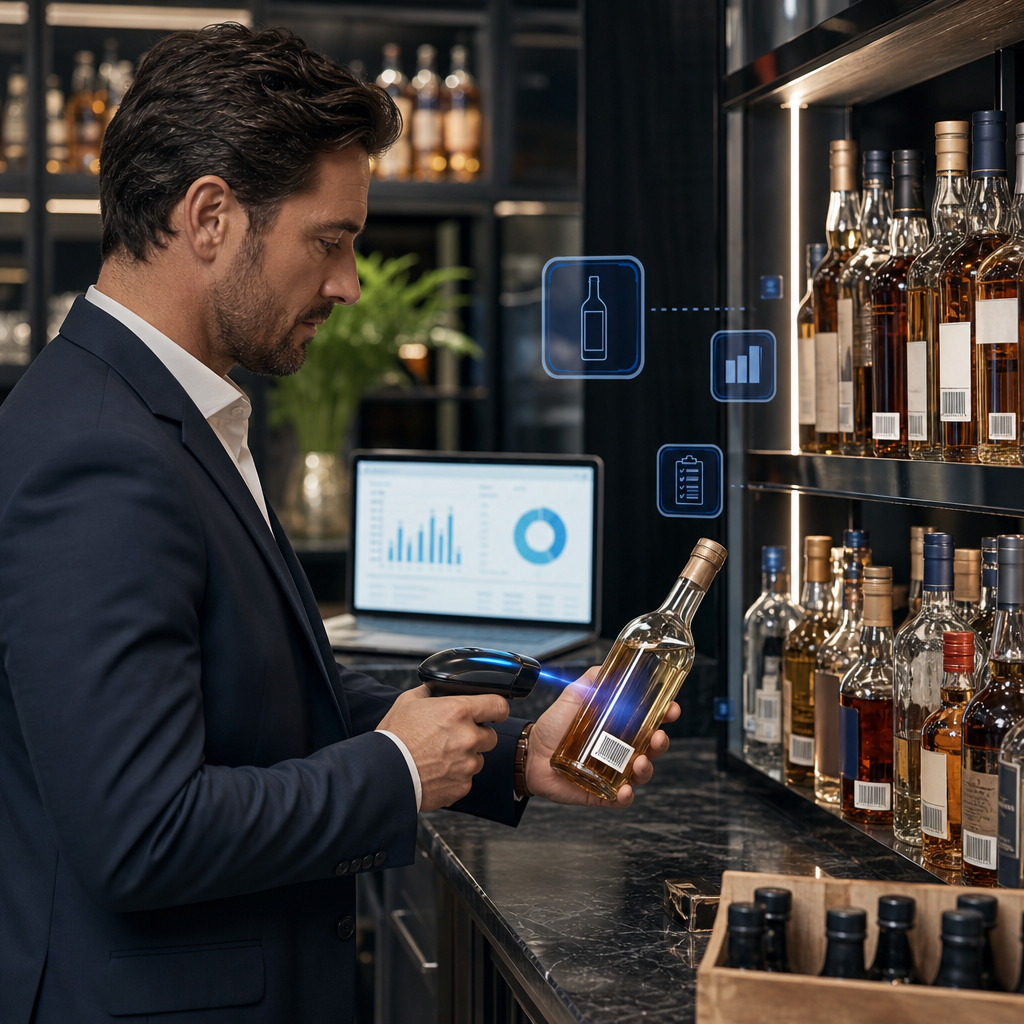
Hotel bar manager using handheld barcode scanning technology to scan liquor bottles in a hotel bar inventory setting

Key Takeaways: Barcode Liquor Inventory for Hotel Bars

  • Hotel bars lose 20% to 25% of liquor profits to shrinkage when inventory relies on estimation instead of measurement.
  • Barcode scanning tracks every bottle individually, creating a verifiable audit trail from delivery through depletion.
  • Automated inventory counts cut counting time dramatically, freeing staff to focus on guest service and revenue.
  • Real-time variance reports expose over-pouring, theft, and ordering gaps before they compound into larger losses.
  • Scannabar gives hotel operators precise bottle-level tracking and actionable reporting built specifically for hospitality operations.

Why Hotel Bars Need Better Liquor Inventory Control in 2026

Where Hotel Beverage Programs Lose Money

Shrinkage in a hotel bar hits from multiple directions at once: over-pouring, spillage, miscounted transfers between storage and service areas, and outright theft. A hotel property often runs several outlets, from the lobby lounge to banquet stations. Each outlet introduces another layer of product movement that older counting methods struggle to capture.

The financial damage adds up fast. For a hotel generating $500,000 in annual beverage sales, a 25% shrinkage rate means $125,000 in lost product and unrealized revenue. Yet many properties still write it off as an unavoidable cost of doing business.

According to a CBRE Hotels Research report published in October 2025, beverage revenues at hotel banquets declined by 2.0% year-over-year, even as food revenues grew. When revenue is flat, every percentage point of shrinkage hurts more. Tighter inventory controls protect margins that pricing increases alone cannot recover.

Why Hotel Operations Make Inventory Harder

Hotels face inventory complications that most standalone restaurants never encounter. Staff rotate across shifts and departments. Product moves between locked storage rooms, satellite bars, banquet staging areas, and sometimes off-site event locations. A single bottle of premium vodka might pass through three sets of hands before it reaches the guest.

Seasonal occupancy swings create another problem. A resort property may double its beverage volume during peak season and cut it in half during the off-months. Par levels set for one period rarely hold for the next, and manual recalculations introduce errors that cascade through purchasing, storage, and financial reporting.

High staff turnover compounds both issues. When new bartenders or barbacks join mid-season, they inherit processes that may never have been documented. Without a system that enforces consistency, every personnel change introduces fresh opportunities for counting mistakes and accountability gaps.

How Barcode Liquor Inventory Works in a Hotel Bar
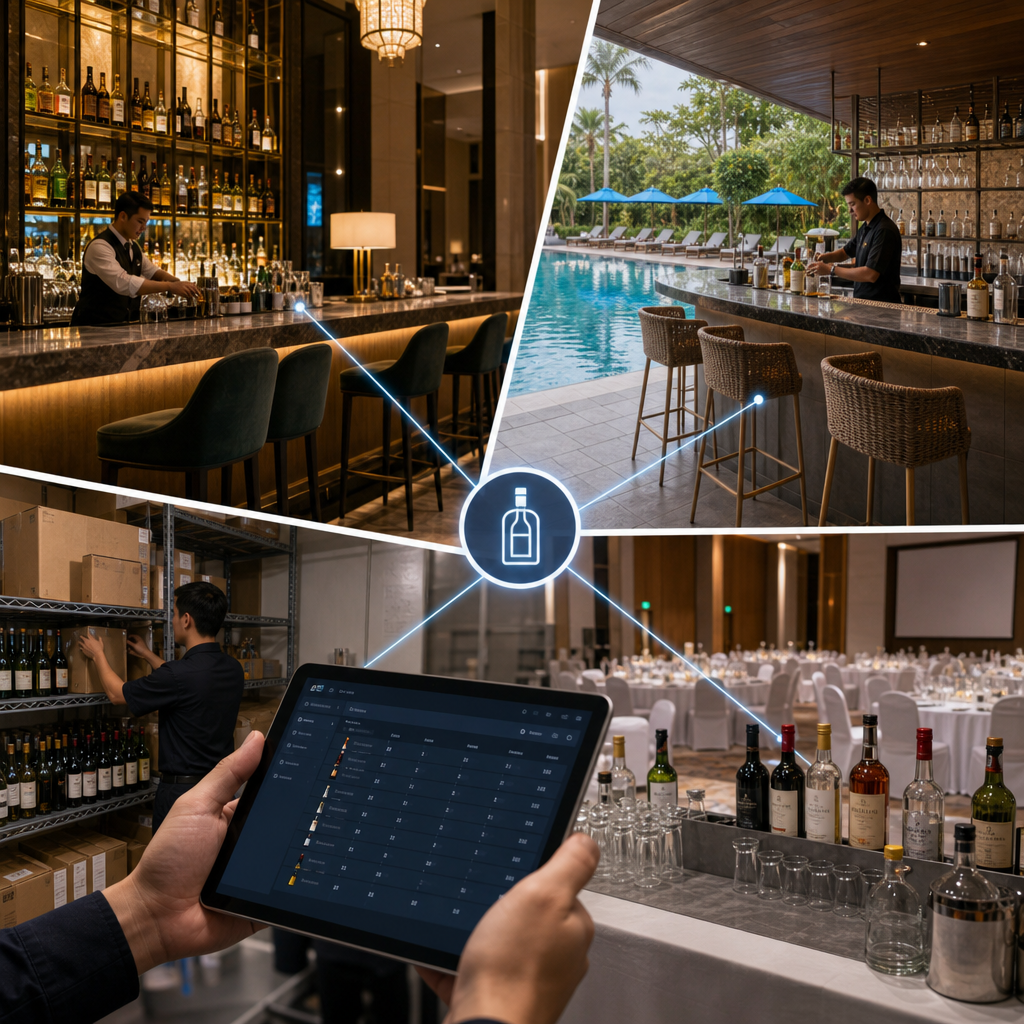
Multiple hotel bar outlets connected by digital inventory tracking overlays

What Gets Tracked at the Bottle Level

A barcode-based liquor inventory system assigns a unique tracking label to each bottle when it arrives at your receiving dock. Staff scan that label along with the bottle's UPC code, and the software creates a profile containing brand, volume, dimensions, and cost. Every subsequent scan updates the bottle's status in real time.

Content measurement separates barcode inventory from simple item tracking. A calibrated, bar-coded ruler placed against a bottle determines how much liquid remains, measured to the ounce. You know not just that a bottle of bourbon is "open" but that it holds 14.2 ounces at the end of a Tuesday night shift.

This bottle-level data feeds into a perpetual inventory record that reflects current stock across every outlet, storage room, and banquet station in the hotel. You no longer have to wait until month-end to discover that three bottles of premium tequila went unaccounted for during a weekend event.

How Barcode Data Improves Accountability

When every bottle carries a unique identifier and every scan generates a time-stamped record, your team operates inside a closed-loop system. If a bottle goes missing between the storeroom and the pool bar, the data shows when it was last scanned, where it was, and who handled the transfer.

That level of visibility changes behavior. Bartenders and barbacks who know that each pour is measurable and each bottle is traceable tend to follow standardized recipes more consistently. The point is not surveillance. The system builds a culture of accountability where accurate pours become the default, not the exception.

Accountability also protects honest staff. When inventory discrepancies arise, managers can investigate using objective data rather than suspicion. An employee who consistently records accurate counts and handles transfers by the book has a verifiable record that speaks for itself.

What Hotel Operators Gain from Barcode Scanning

Faster Automated Inventory Counts With Better Accuracy

Traditional hotel bar counts consume hours of management time. A bar manager counting 200 bottles by hand might spend three to four hours on a single outlet. Multiply that across a lobby bar, a rooftop lounge, a pool bar, and two banquet stations, and you have burned an entire shift on a task that still produces rough estimates.

Barcode scanning collapses that timeline. With a handheld scanner, a trained staff member can measure the contents of approximately 120 bottles in about 15 minutes. The software processes each scan instantly, updating inventory values and flagging anomalies without requiring a separate data-entry step.

Speed matters. Accuracy is where the real payoff lands. Eliminating visual estimation removes the 1% to 3% error margin that plagues hand counts. For a hotel with $1,000,000 in annual beverage purchases, that margin of error represents $10,000 to $30,000 in inventory inaccuracies every year.

Better Purchasing and Par-Level Decisions

Accurate, up-to-date inventory data transforms purchasing from a blind guess into a structured process. When your system shows real-time stock levels across every outlet, you can set par levels that reflect actual consumption patterns rather than gut estimates from last quarter.

That precision prevents two costly mistakes at once. Over-ordering ties up capital in bottles that sit on shelves, age past their prime, and occupy storage space you cannot afford to waste. Under-ordering leads to stockouts that disappoint guests and push bartenders toward off-menu substitutions that throw off your pour cost targets.

Automated reorder alerts add another layer of protection. When stock on a high-velocity SKU drops below its par level, the system flags it before you run dry. Over time, aggregated purchasing data also gives your F&B director the numbers to negotiate volume pricing with distributors.

How Scannabar Supports Hotel Bar Inventory Management

Barcode Scanning Technology Built for Hospitality

Scannabar was built from the ground up for bars, hotels, nightclubs, and restaurants. The system uses wireless, handheld scanners paired with proprietary software that tracks every ounce of wine, liquor, and beer across your entire property. Whether you operate two outlets or twenty, one Scannabar system handles them all.

Setup is straightforward. When a bottle arrives, your team applies a small bar-coded tracking label, scans it alongside the bottle's UPC code, and the software builds a complete profile. From that point on, each scan with the calibrated bar-coded ruler records the exact liquid level in every container, updating your central inventory in real time.

Scannabar's clients include properties operating under banners like Ritz Carlton, Hyatt, and Sheraton. The system scales to handle multi-outlet hotel operations without requiring specialized IT staff. Teams are typically operational within a single shift.

Reporting That Helps Teams Act Faster
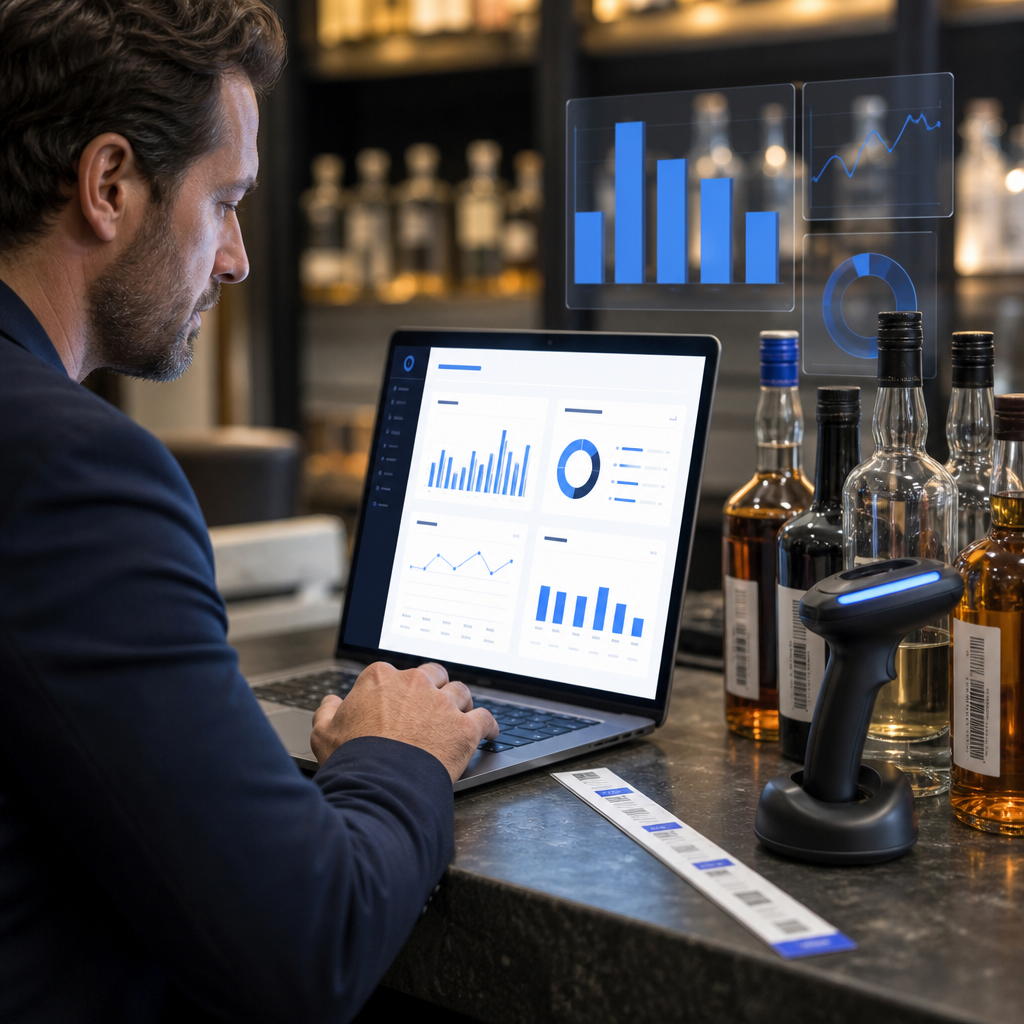
Hotel beverage manager reviewing inventory analytics dashboard beside scanned liquor bottles and barcode ruler

Data sitting in a spreadsheet nobody opens is worthless. Your team needs numbers they can read and respond to the same day. Scannabar generates variance reports, usage summaries, and cost-of-goods analyses that translate raw scan data into actionable numbers.

When a variance report shows that your rooftop bar consumed 18% more vodka than POS sales justify, your bar manager knows exactly where to look and what questions to ask.

Scannabar clients have reported reducing shrinkage to 1% to 3%, down from the 20% to 25% they experienced before implementation. Operators generally see a 25% to 50% reduction in beverage costs within weeks. Those are reported outcomes, not projections.

Reporting also supports the broader F&B strategy. When you can see which spirits move fastest and which outlets generate the most waste, your purchasing and staffing decisions improve. Scannabar turns bottle-level scans into property-level intelligence.

In Conclusion: How Hotel Bars Can Modernize Inventory in 2026

Hotel bars that still count by hand in 2026 are choosing to accept shrinkage, error, and inefficiency that barcode technology has already solved. The math is plain: 20% to 25% of your liquor revenue disappearing into untracked pours, miscounted transfers, and undocumented losses is not a cost of doing business. It is a problem with a fix.

Barcode-based inventory gives your team the speed, accuracy, and accountability that older methods cannot deliver. Scannabar provides that capability in a system built specifically for hospitality operators, backed by reported outcomes that include shrinkage reductions to as low as 1% and beverage cost savings of 25% to 50%.

If your hotel still relies on delayed counts and partial visibility, now is the time to tighten beverage control. Scannabar gives you Barcode Scanning Technology, Real-Time Visibility, and Actionable Insights that help your team count faster, investigate variances sooner, and protect margin across every outlet.

The business case is already there. The next step is putting a better system in place and using it consistently.

FAQs About Barcode Liquor Inventory for Hotel Bars

What is barcode liquor inventory and how does it work in a hotel bar?

Barcode liquor inventory uses a unique label on each bottle so a handheld scanner can record its identity and liquid level with every count. The Scannabar system pairs that label with a calibrated bar-coded ruler to measure contents to the ounce, giving hotel bars real-time visibility into every bottle across every outlet.

How does barcode scanning reduce hotel beverage shrinkage?

Every scan creates a time-stamped, bottle-specific record that links product movement to individual staff members and locations. Scannabar clients have reported shrinkage dropping to 1% to 3%, down from the 20% to 25% range common at properties relying on manual processes.

Can a barcode inventory system handle multiple hotel bar outlets?

Yes. A single Scannabar system tracks inventory across lobby bars, pool bars, rooftop lounges, banquet stations, and storage rooms simultaneously. Each outlet maintains its own stock profile while feeding data into one centralized dashboard for property-wide reporting.

How long does a barcode inventory count take compared to a manual count?

A trained staff member can scan and measure approximately 120 bottles in about 15 minutes using Scannabar. A manual count of the same number of bottles, with visual fill-level estimates, typically takes three to four hours and produces far less accurate results.

Does barcode inventory integrate with hotel POS and property management systems?

Scannabar integrates with point-of-sale systems and property management platforms, enabling closed-loop tracking that compares what was sold to what was actually consumed. That integration helps F&B directors pinpoint variances that would otherwise go undetected between manual count cycles.

What kind of reporting does a barcode liquor inventory system provide?

Scannabar generates variance reports, usage summaries, and cost-of-goods analyses that break down performance by outlet, product category, or individual SKU. These reports help hotel teams identify over-pouring patterns, flag missing bottles, and make purchasing decisions based on measured data rather than estimates.
Topics: liquor inventory, Bar inventory, managing liquor inventory cost, liquor inventory timing, Liquor Inventory savings, managing liquor costs, liquor inventory system, liquor management, liquor inventory app

What 15-Minute Bar Inventory Looks Like: A Faster Way To Count Full And Partial Bottles

Discover how modern bar managers are cutting inventory time from hours to just 15 minutes while maintaining accuracy and reducing liquor costs.

Why Traditional Bar Inventory Methods Are Costing You Time and Money

Every bar manager knows the dreaded feeling of inventory night. What should be a routine business task turns into a 3-4 hour ordeal of counting bottles, scribbling notes on clipboards, and second-guessing your math. Traditional manual inventory methods aren't just tedious—they're actively costing your business money in ways that might not be immediately obvious.

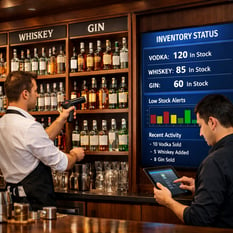
The most apparent cost is labor. When you're paying staff to spend hours counting bottles after closing, those wages add up quickly. But the hidden costs are even more damaging: the counting errors that lead to over-ordering, the theft that goes undetected because discrepancies get chalked up to 'human error,' and the missed opportunities to identify which products are actually profitable versus which are gathering dust on your shelves.Modern Bar Inventory System with Digital Display and Bartender-1

Manual counting is also inherently inconsistent. Different staff members use different estimation methods for partial bottles—one bartender's 'three-quarters full' might be another's 'half full.' This lack of standardization makes it nearly impossible to track actual pour costs or identify variance patterns. When your inventory data is unreliable, every business decision you make based on that data becomes a gamble.

The Smart System: How to Set Up Your Bar for Lightning-Fast Counts

The secret to 15-minute inventory isn't about counting faster—it's about organizing smarter. The foundation of rapid inventory begins with strategic bottle placement and consistent organization. Start by arranging your bar so that similar products are grouped together: all vodkas in one section, whiskeys in another, and so on. This might seem basic, but many bars have products scattered across multiple locations, forcing counters to hunt and potentially double-count or miss items entirely.

Next, implement a standardized shelving system where each product has a designated home. Label shelf edges with product names or SKU numbers so anyone conducting inventory knows exactly what should be in each spot. This visual system does double duty: it speeds up counting and immediately highlights when products are in the wrong place or running low.

Consider adopting the 'par level' approach used in professional kitchens. Establish minimum and maximum stock levels for each product based on your sales velocity. When these par levels are clearly marked in your inventory system, you're not just counting—you're making informed purchasing decisions in real-time. This prep work transforms inventory from a passive counting exercise into an active management tool that directly impacts your bottom line.

Mastering the Art of Speed Counting Full and Partial Bottles

Once your bar is organized, the actual counting technique becomes crucial. For full bottles, the fastest approach is the 'scan and verify' method. Instead of touching each bottle, train your eye to quickly count rows and columns, then multiply. A shelf with 4 rows of 6 bottles? That's 24 bottles in seconds. Only handle bottles when verification is needed or when recording serial numbers for high-end spirits.

Partial bottles require a different strategy. The key is standardization and speed over perfection. Most modern inventory systems use a simple scale: full, 3/4, 1/2, 1/4, or empty. Train all staff to use the same visual markers—for instance, when liquid is at the bottom of the label, it's roughly 1/4 full. This standardized approach might not be perfect to the ounce, but it's consistent, which is far more valuable for tracking trends and identifying variance over time.

Implement a two-person team approach for maximum efficiency. One person counts while the other records, creating a rhythm that prevents the stop-start pattern of solo counting. The counter calls out 'Grey Goose, 2 full, 1 half' and immediately moves to the next product while the recorder enters the data. This assembly-line method can reduce counting time by 40-50% compared to solo efforts while actually improving accuracy through the built-in verification of having two sets of eyes on the process.

Technology Tools That Turn Hours into Minutes

While good organization and technique can dramatically speed up inventory, technology is the real game-changer that makes 15-minute inventory possible. Barcode-based inventory systems have revolutionized the process by eliminating manual data entry—the slowest part of traditional inventory. With a simple smartphone or tablet equipped with a barcode scanner app, you scan each bottle's barcode, estimate the fill level, and move on. The system automatically logs the product name, size, and quantity, updating your inventory database in real-time.

Modern bar inventory apps do much more than just record counts. They automatically calculate your current inventory value, compare it against your POS sales data to identify variance, and can even generate purchase orders based on your par levels. Systems like BinWise, Partender, and AccuBar have intuitive interfaces designed specifically for the bar environment, with features like voice-to-text entry for partial amounts and offline mode for when you're in a basement bar with poor connectivity.

The most advanced systems integrate weight-based bottle sensors that continuously track inventory without any manual counting at all. While these require more upfront investment, they provide real-time inventory data and can detect theft or over-pouring as it happens. For high-volume venues, the ROI on these systems often pays for itself within months through reduced shrinkage alone. Even if full automation isn't in your budget, a basic barcode scanner system typically costs less than $100 to get started and will immediately slash your inventory time while improving accuracy.

From Chaos to Control: Real Results from Bars That Made the Switch

The proof is in the numbers. Consider the case of The Copper Still, a mid-sized cocktail bar in Portland that was spending approximately 4 hours every Monday conducting inventory with two staff members—that's 8 labor hours per week. After implementing a barcode-based system and reorganizing their back bar, they reduced inventory time to just 20 minutes with a single person. That's a savings of over 7.5 labor hours weekly, which at $15/hour translates to more than $5,800 in annual labor savings alone.

But the financial benefits extend far beyond labor costs. The Rusty Anchor, a beach-front bar in Florida, discovered they were losing approximately 15% of their inventory to undetected shrinkage—a combination of over-pouring, spillage, and theft. After switching to weekly 15-minute inventories using a mobile app, they could identify variance patterns quickly and address them immediately. Within three months, they reduced shrinkage to under 5%, recovering thousands in lost revenue monthly.

Perhaps most importantly, these bars report that frequent, fast inventory counts have transformed their purchasing decisions and cash flow management. Instead of large monthly orders based on vague estimates, they now order precisely what they need based on actual consumption data. This has reduced their tied-up capital in excess inventory by 30-40%, freeing up cash for other business needs. Bar managers consistently report that the detailed data from modern inventory systems has given them insights they never had before—like discovering that their premium gin actually sells faster than the well gin they were heavily stocking, or identifying slow-moving products that were taking up valuable shelf space. When inventory takes just 15 minutes, you can do it weekly or even multiple times per week, giving you the agile, data-driven control that separates thriving bars from struggling ones.

Topics: Bar inventory, liquor inventory timing, Liquor Inventory savings, liquor inventory system, liquor inventory app, Best Bar Inventory app, Best Liquor Inventory app, Cruise ship bar inventory, Country Club Liquor Inventory

The Best Sipping Tequila Brands for a Luxurious Experience

Discover the finest sipping tequila brands that will elevate your drinking experience to new heights. From rich flavors to smooth finishes, these luxurious tequilas are perfect for special occasions or treating yourself.

Exploring the Art of Sipping Tequilapexels-tara-winstead-6479543

Sipping tequila is not just about taking shots or mixing it in cocktails. It is an art that involves savoring and appreciating the flavors and aromas of this exquisite spirit. When you sip tequila, you allow yourself to fully experience the complexity and nuances that each brand has to offer. From the moment the liquid touches your lips to the lingering finish, sipping tequila is a journey of taste and enjoyment.

To truly explore the art of sipping tequila, it is important to take your time. Start by pouring a small amount of tequila into a tulip-shaped glass, allowing the aromas to develop. Swirl the liquid gently and take a moment to inhale the scents that rise from the glass. Notice the subtle hints of agave, oak, and other ingredients that contribute to the unique character of each tequila. Then, take a small sip and let the flavors dance on your palate. Pay attention to the sweetness, spiciness, and overall balance of the tequila. As you continue to sip, you may discover new flavors and aromas that unfold with each taste.

Exploring the art of sipping tequila is a journey that can be enjoyed alone or with friends. It is a chance to appreciate the craftsmanship and dedication that goes into creating each bottle of tequila. So, next time you pour yourself a glass of sipping tequila, take a moment to savor the experience and enjoy the artistry of this unique spirit.

Why Choose Sipping Tequila for a Luxurious Experience

Sipping tequila offers a luxurious experience that is unparalleled by other spirits. The carefully crafted flavors and smooth finishes of sipping tequilas make them perfect for special occasions or for simply indulging in a moment of luxury. Here are a few reasons why you should choose sipping tequila for a luxurious experience:

1. Rich Flavors: Sipping tequilas are known for their complex and rich flavors. From the earthy notes of cooked agave to the hints of vanilla, caramel, and spice, each sip is a symphony of flavors that will delight your taste buds.

2. Smooth Finishes: Unlike other spirits that can leave a harsh burn or aftertaste, sipping tequilas are renowned for their smooth finishes. The careful distillation and aging processes result in a velvety texture that glides across your palate and leaves a lingering warmth.

3. Craftsmanship and Tradition: Sipping tequila is the result of centuries-old traditions and craftsmanship. From the cultivation of agave plants to the distillation and aging processes, every step is carried out with precision and care. By choosing sipping tequila, you are not only indulging in a luxurious experience but also supporting the artisans and producers who dedicate their lives to creating this exceptional spirit.

Whether you are celebrating a special occasion or simply want to treat yourself, sipping tequila offers a luxurious experience that is sure to impress.

Factors to Consider When Selecting a Sipping Tequila

When selecting a sipping tequila, there are several factors to consider to ensure you choose the right brand for your preferences. Here are some key factors to keep in mind:

1. Age: Tequila can be categorized into different age statements, such as blanco (unaged), reposado (aged between 2-12 months), and añejo (aged for at least 1 year). Each age statement offers a different flavor profile, so consider your preferences when it comes to the aging process.

2. Production Method: The production method of tequila can also impact its flavor. Tequilas made from 100% blue agave tend to have a more authentic and robust taste compared to those that contain a mix of other sugars. Additionally, the method of distillation and the type of still used can also affect the final product.

3. Brand Reputation: Consider the reputation of the tequila brand you are considering. Look for brands that have a history of producing high-quality tequilas and have received recognition and awards for their craftsmanship.

4. Price: Sipping tequilas can vary in price range, so it's important to consider your budget when selecting a brand. Keep in mind that higher-priced tequilas often reflect the quality and craftsmanship that goes into producing them.

By considering these factors, you can make an informed decision and select a sipping tequila that suits your taste preferences and provides a luxurious drinking experience.

The Best Sipping Tequila Brands to Try

If you're looking to elevate your sipping tequila experience, here are some of the best brands to try:

1. Don Julio 1942: This añejo tequila is known for its smoothness and rich flavors of caramel, vanilla, and toasted oak. It is a favorite among tequila enthusiasts and is often considered a benchmark for sipping tequilas.

2. Patrón Añejo: Aged for at least 12 months, Patrón Añejo offers a balanced and complex flavor profile. It features notes of sweet agave, vanilla, and oak, with a smooth and velvety finish.

3. Casa Noble Reposado: This reposado tequila is aged for 364 days in French white oak barrels, resulting in a smooth and well-rounded flavor. It showcases notes of agave, oak, and hints of spice.

4. Clase Azul Reposado: Known for its stunning ceramic bottle, Clase Azul Reposado is equally impressive in taste. This tequila offers a silky texture, with flavors of cooked agave, vanilla, and caramel.

5. Fortaleza Añejo: Made using traditional production methods, Fortaleza Añejo is a tequila that embodies the rich heritage of the spirit. It has a complex flavor profile with notes of cooked agave, cinnamon, and dried fruit.

These are just a few examples of the best sipping tequila brands available. Each brand offers its own unique characteristics and flavors, so don't be afraid to explore and discover your personal favorites.

Remember, sipping tequila is all about enjoying the experience and savoring the flavors, so take your time and appreciate the craftsmanship that goes into each bottle.

Pairing Sipping Tequila with Exquisite Food

Sipping tequila is not only a delight on its own but can also be paired with exquisite food to enhance the dining experience. The complex flavors and aromas of sipping tequila can complement a wide range of dishes, from savory to sweet. Here are some ideas for pairing sipping tequila with exquisite food:

1. Cheese and Charcuterie: Tequila pairs wonderfully with a selection of artisanal cheeses and cured meats. The richness of the tequila can balance the flavors of the cheese, while the savory notes of the charcuterie can enhance the agave flavors in the tequila.

2. Grilled Meats: The smoky flavors of grilled meats, such as steak or barbecued ribs, can be enhanced by the bold and robust flavors of sipping tequila. The tequila can cut through the richness of the meat and provide a refreshing contrast.

3. Chocolate Desserts: The sweetness and complexity of sipping tequila can be a perfect match for rich chocolate desserts. Whether it's a decadent chocolate cake or creamy chocolate mousse, the tequila can elevate the flavors and create a harmonious pairing.

4. Spicy Cuisine: Sipping tequila can be a great accompaniment to spicy dishes, such as Mexican or Thai cuisine. The heat from the spices can be balanced by the smoothness of the tequila, creating a harmonious combination of flavors.

When pairing sipping tequila with food, consider the flavors and intensity of both the tequila and the dish. Look for complementary flavors or contrasting elements that can create a well-balanced pairing. Don't be afraid to experiment and discover new flavor combinations that excite your palate.

In conclusion, sipping tequila offers a luxurious experience that combines the artistry of the spirit with the pleasure of indulgence. Whether you're exploring the flavors, choosing the right brand, or pairing it with exquisite food, sipping tequila is sure to elevate your drinking experience to new heights. So, raise a glass and toast to the finest sipping tequila brands for a truly luxurious experience.

Topics: liquor theft, managing liquor inventory cost, liquor inventory timing, Liquor Inventory savings, liquor products, liquor inventory system, Tequila brands

Unleashing Success: Unlocking the Potential of the Best Liquor Inventory App and Bar Inventory App for Optimal Liquor and Bar Control

Unleashing Success: Unlocking the Potential of the Best Liquor Inventory App and Bar Inventory App for Optimal Liquor and Bar Control

Bar Inventory app-1In the fast-evolving landscape of bars and nightclubs, staying ahead of the competition requires a strategic embrace of technology. The quest for the Best Liquor Inventory App and the Best Bar Inventory App has become integral to achieving optimal liquor and bar control. This article delves into the importance of these apps in fostering efficiency, reducing losses, and establishing a robust foundation for success in the dynamic world of nightlife.

The Significance of the Best Liquor Inventory App

Achieving precise Liquor Control is a cornerstone of successful bar management. Manual inventory tracking methods are prone to errors and time-consuming, often leaving room for inefficiencies and losses. The Best Liquor Inventory App transforms this scenario by offering real-time tracking capabilities.

With the Best Liquor Inventory App, every drop of alcohol is meticulously tracked, reducing the risk of over-pouring and theft. This level of precision not only ensures accurate liquor control but also provides valuable data for strategic decision-making. Managers can analyze consumption patterns, identify top-performing products, and optimize purchasing strategies for enhanced profitability.

Unleashing Efficiency with the Best Bar Inventory App

Efficiency is the heartbeat of any well-run bar or nightclub, and the search for the Best Bar Inventory App is a crucial step toward achieving this efficiency. Traditional inventory management methods are labor-intensive and prone to errors, hindering the seamless operation of a bustling establishment.

The Best Bar Inventory App revolutionizes operations by eliminating manual stock counts and data entry. It provides real-time updates on inventory levels, empowering staff to quickly identify available drinks and reducing the risk of stockouts during peak hours. Automated alerts for low stock levels streamline the reordering process, saving time and ensuring a continuous flow of inventory.

Harmony in Optimal Liquor and Bar Control

The integration of the Best Liquor Inventory App and the Best Bar Inventory App creates a harmonious environment for optimal liquor and bar control. These apps work together to provide the highest level of precision and efficiency.

The Best Liquor Inventory App ensures every ounce of alcohol is tracked in real-time, preventing losses and providing valuable insights. Meanwhile, the Best Bar Inventory App streamlines operations, reduces the chances of errors, and ensures that the bar is well-stocked to meet customer demands.

**SEO Keywords: Best Liquor Inventory App, Best Bar Inventory App, Liquor Control, Bar Control**

For establishments aiming to dominate the nightlife scene, utilizing the Best Liquor Inventory App and Best Bar Inventory App is not just about modernization; it's a strategic move toward unleashing success. By curbing losses, streamlining operations, and fostering efficiency, these apps contribute to a more secure and accountable bar environment.

The data-driven insights provided by these apps empower managers to make informed decisions, from pricing strategies to product offerings, ultimately leading to enhanced profitability. In the competitive realm of nightlife, embracing the potential of the Best Liquor Inventory App and Best Bar Inventory App is the key to staying at the forefront of success. Establishments that invest in these innovative technologies are not just modernizing; they are positioning themselves for sustained excellence in the dynamic and competitive landscape of bars and nightclubs.

Topics: liquor inventory, Bar inventory, managing liquor inventory cost, liquor inventory timing, Best Bar Inventory app, Best Liquor Inventory app

Liquor Inventory Scheduling: How often should I do it?

Inventory scheduleIf we perform inventory in our establishment, the question of proper inventory scheduling is one that has certainly arisen. Inventory scheduling in the most part should be consistent with specific events that occur in your business. For instance, if your accountants prepare monthly profit and loss statements, inventory scheduling should reflect a need for monthly data collection and analysis.

If you feel that to place the proper and adequate supplies order to bring liquor, beer and wine inventories up to par require, inventory scheduling should be reflected before the order process commences. Your business will dictate how often inventory should be taken.

If you are a high volume nightclub and a majority of your sales are liquor, beer and wine inventory related versus a restaurant that mainly serves food, proper and more frequent inventory scheduling may be in order. What is also important to achieve proper inventory scheduling is to be able to foresee any specials events or holidays that may delay or increase the need for inventory taking. Another key is to stay the course; if your business does a full liquor, beer and wine inventory on a weekly basis, you should not skip a period.

Inventory scheduling involves planning of personnel thus it is important we can see and understand how many people we need and how many hours that are budgeted to make sure a proper inventory is done quickly, accurately and with consistency.

Topics: liquor inventory timing, inventory schedule