
The Basic Mathematics of Profitability
 A typical beverage operation generates a constant stream of data and information, endless columns of figures and daily records. But you'd be surprised how few managers actually do anything with these figures, let alone fully grasp their implications. So how can you tell if you're operating profitably? The answer is you can't, unless, of course, you get to grips with some basic mathematics. For a start, you'll need to know how to perform a few simple calculations, such as working out an item's cost percentage. You don't need to be a mathematician to figure the following straightforward formulas:
- Cost per ounce. This is the basic unit cost of a drink. For example, to calculate the cost per ounce of a liter bottle, divide the wholesale cost of the bottle by 33.8 ounces, or in the case of a 750ml bottle, by 25.4 ounces. The figure you arrive at is the cost per ounce.
- Cost per portion. To be able to price a certain drink, you must first calculate the base cost of the serving. Use the cost per ounce to work out the cost per portion. For example, if the cost per ounce is $0.60 and the recipe requires 1.5 ounces, then the portion cost is $0.90.
- Cost percentage. Master this formula. You cannot function without it! To calculate the cost percentage of an item, divide the product's cost (or portion's cost) by its sale price and then multiply by 100. This simple calculation gives you the cost percentage. Profitability hangs on this key calculation. This calculation is the most frequently used formula in the beverage industry. It indicates the profit margin of any drink and represents the difference between the cost of the item and the price for which it is sold. If cost percentage increases, profit margins decrease..
Measuring Bottle Yield
You know the theory: to obtain the cost per ounce, you must divide the cost of the bottle by the number of ounces in the bottle. Fine, so far. But sometimes, in practice, the final sales volumes and profits can seem disappointing. You're confused because you have done everything by the book, and now, somehow, the figures don't quite add up. Get wise.
- Consider evaporation and spillage. When calculating a bottle's cost per ounce, the secret is to deduct an ounce or two up front, before dividing, to allow for evaporation or spillage. Although this will slightly increase the cost per ounce, it will also give you a more realistic starting point.
- Calculation errors. Slight variations can easily creep into a calculation involving both liters and ounces. For example, assume a highball contains 1-1/2 ounces of spirit (or 45ml): using ounces, a liter bottle yields 22.54 measures, whereas, using milliliters, the bottle gives 22.22 measures. Tip: "round down" in the interests of reality.
- Maximize potential yield. You know that a bottle of liquor yields so many measures at a certain cost. However, you also know that sloppy pouring methods can wipe out potential profits. The best way to overcome this problem is to standardize portion serving as much as possible. You've paid for the liquor and want maximum returns.
- Buy big. High-turnover liquor, wines and spirits should always be purchased in larger bottles for better yield per measure.
Gross Profits: The Lowdown
There is no better indicator of a business's success than its gross profit figure. By definition, gross profit is the cash difference between an item or portion cost and its sales price. All attempts to reduce costs should focus on this gross profit figure. Get to grips with how to figure out some important calculations related to gross profits.
- Gross profit. To calculate a drink's gross profit, simply subtract its portion cost from its sale price.
- Gross profit margin. This figure represents the percentage amount of profit made by the sale. Divide the amount of profit by the sales price and then multiply by 100. The result is the gross profit margin.
- Sales percentage profits. To calculate the selling price (based on the required gross profit margin), divide the portion cost by the gross profit margin percentage "reciprocal," i.e., the figure you get from subtracting the target gross margin from 100.
- Cost multiplier. This calculation is often used in the beverage industry to figure out the target selling price for a drink based on its portion cost. Divide the cost percentage you require by 100 and then multiply the result by the portion cost of the product.
- Mixed-drink prime ingredient costing. A calculation used to determine the target sales price for a mixed drink that has only one main ingredient, such as gin and tonic or scotch on the rocks. All you have to do is divide the drink's portion cost by the target cost percentage.
This article is an excerpt from the Food Service Professional Guide to Controlling Liquor Wine & Beverage Costs, authored by Elizabeth Godsmark, published by Atlantic Publishing Company. This excerpt has been reprinted with permission of the publisher. To purchase this book go to:
 Sensitive pricing can make or break your operation. Pricing decisions should never, ever, be made arbitrarily. It is crucial to achieve that fine balance between pricing for optimum profits and making customers feel that they're getting value for money. Of course, you want to sell the drinks at their optimum sales volume, but if you tip the balance by raising the sales price too high, the sales volume will actually drop. So will the profits.
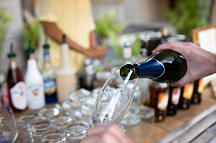 The service bar is an area of the bar dedicated to the servers only. If designed well it can greatly improve the flow of drinks from the bar to the customers. Alternately, if your service bar is not designed well, it can add yet another delay in an already-crowded process. When setting up a service bar, the things that should be considering are:
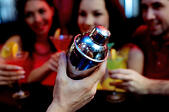 Simplicity over pretention. While bars that employ top-notch mixologists offering creative drinks will continue to attract more and more customers, you can also expect a trend towards simplicity. As David Wondrich put it in Nation’s Restaurant News, “The biggest trend I see is bringing mixology down to the fun/dive-bar level.” Expect to find well-made, “sophisticated” drinks in friendlier, “less sophisticated” surroundings.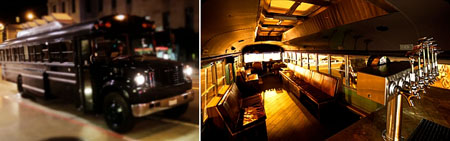
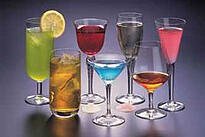 Making a good mixed drink isn't always a matter of A + B = C. In fact, there are numerous small details that can contribute to turning your creation into something just that little bit better than the norm and, more still, that can help you keep your ingredients at peak freshness and productivity. Consider the following:
 The difference between a good and great martini is very small, but very important. The quality of your cocktail menu should be of paramount importance to you. The methods by which those cocktails are prepared should be a point of pride for all concerned.
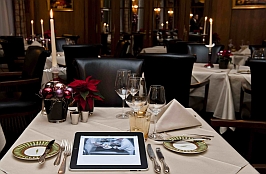 Going mobile. Google projects that mobile devices will overtake PCs as the most common Web-access device by 2013.The ubiquity of smartphones and tablets makes it imperative that Websites be mobile-friendly. As many of these devices either do not support or have trouble playing Flash content (which has become a staple of restaurant, nightclub and bar sites), you would be well-served to optimize your site to take advantage of the rapidly growing number of mobile users who rely on their iPhones and iPads to find where to go for a drink or a bite.
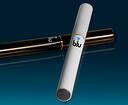 Electronic cigarettes. Electronic cigarettes are becoming more and more ubiquitous. These electrical devices, which produce a flavored aerosol mist that simulates tobacco smoke, have become popular both as a way of quitting tobacco and as a way for smokers to kinda feed their habit in places where actual smoking is prohibited. Expect e-cigarettes to become a more common sight in bars and nightclubs in 2012. Also expect them to be sold more widely in drinking establishments. Not only do these devices provide an added revenue stream, they may actually have the added benefit of keeping smokers inside and drinking.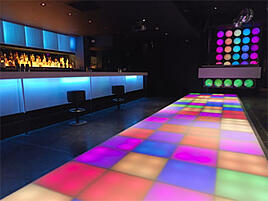
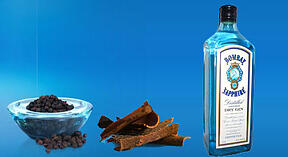 Herb-infused spirits. Whether they be whiskies, vodkas or gins are gaining herb-infused drinks are gaining in popularity. Expect gin, especially, to continue to make a splash as both large producers such as Bombay and a slew of new micro distilleries continue infuse this old stalwart with fresh and interesting botanicals.
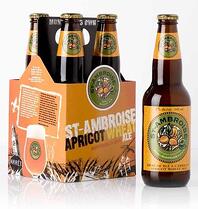 Seasonal and flavored beers. While nothing new, seasonal and/or flavored beers are starting to gain traction.
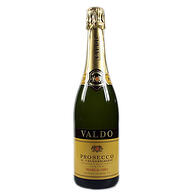 Value. After several years of economic recession, consumers have acquired a taste for value wines. They are seeking bang for the buck—not cheap inferior wines, but good, well-balanced, flavorful wines at an affordable price. With many of these wines coming from Spain and South America, expect Spanish, Chilean and Argentinian wines to continue to grow in popularity.
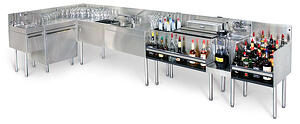 When you design your service area, it's important to realize that every step a bartender takes in the serving of a drink is costing you money and making your customers impatient. Where does your staff need to walk to get a clean glass? How far from there to the ice bins and then to the spirit dispenser? And where are your soda guns in relation to the bottles? Is the cash register yet another trip away from the customer? Even if your bartender has to take only four or five steps between each of these posts, consider how far that means your bartender has to walk in the course of serving 500 drinks a night! This is bad enough for a solo bartender, but when two or three people are working behind the same bar and sharing facilities, it can be an unproductive nightmare.
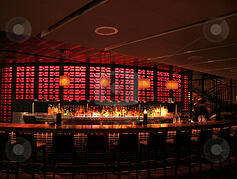 Have you ever sat under a blue neon light for an hour? While neon decor might look great when a bar is packed to capacity and the music is pumping, when business is slow it's like a power drill closing in on the center of your forehead. Certainly your customers should be impressed by your decor, but will the very look that draws them in end up driving them away early? Consider the following: