
Discover which liquor inventory method will save your bar thousands in lost revenue while cutting inventory time by up to 75%.
Why Your Liquor Inventory Method Can Make or Break Your Bottom Line
In the hospitality industry, liquor represents one of the highest-margin product categories—but also one of the most vulnerable to shrinkage, theft, and waste. Studies consistently show that bars and restaurants lose between 20-25% of their liquor inventory to over-pouring, spillage, theft, and untracked consumption. For a mid-sized establishment with $500,000 in annual liquor sales, that translates to $100,000 or more in lost revenue every single year.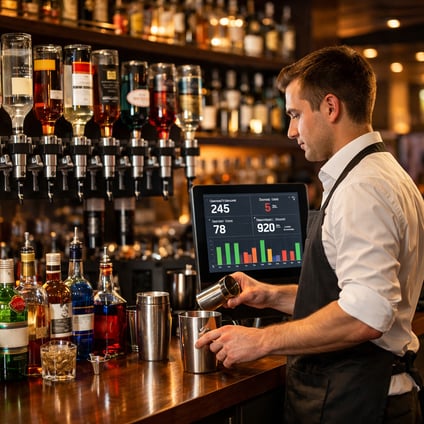
The inventory method you choose directly impacts your ability to identify and prevent these losses. A robust tracking system provides visibility into consumption patterns, helps you catch discrepancies before they become major problems, and ensures accurate pricing and ordering. On the other hand, an inadequate or inconsistent approach leaves you flying blind, unable to pinpoint where your profits are disappearing.
Beyond loss prevention, your inventory method affects labor costs, operational efficiency, and data accuracy. Manual counting might take your staff 4-6 hours per week, while automated systems can reduce that time to under an hour. The question isn't whether you can afford to invest in better inventory management—it's whether you can afford not to. With margins tightening across the hospitality sector, the right inventory method has become a competitive necessity rather than a luxury.
Manual Counting: The Traditional Approach That Still Has Its Place
Manual inventory counting remains the most common method in small bars and restaurants, and for good reason: it requires minimal upfront investment and works with any existing point-of-sale system. The process involves physically weighing or measuring each bottle, recording the quantities on paper or in a spreadsheet, and calculating usage based on the difference between counts. For establishments with limited budgets or relatively small liquor selections (under 50 SKUs), this approach can be sufficient to maintain basic control.
The advantages of manual counting extend beyond cost savings. It requires no specialized equipment, can be performed by any trained staff member, and provides hands-on familiarity with inventory levels. Many experienced bar managers argue that the physical act of handling each bottle gives them intuitive insights into consumption patterns and potential issues that automated systems might miss. There's also complete flexibility—you can count as frequently or infrequently as your operation demands, without being locked into a particular technology platform.
However, the drawbacks are significant and become more pronounced as your operation scales. Manual counting is time-intensive, typically requiring 3-6 hours for a full inventory depending on selection size. Human error is inevitable—studies show accuracy rates for manual counts rarely exceed 85%, with mistakes occurring in measurement, recording, or calculation. There's no real-time visibility, meaning you only discover shrinkage days or weeks after it occurs, making it nearly impossible to trace problems to specific shifts or employees.
Manual methods also create data management challenges. Spreadsheets become unwieldy with hundreds of entries, historical analysis is difficult, and generating actionable reports requires additional manual work. For bars doing less than $200,000 in annual liquor sales with stable, experienced staff, manual counting may suffice. But as volume increases or turnover rises, the limitations quickly outweigh the cost savings.
Automated Pour Systems: Real-Time Precision for High-Volume Operations
Automated pour systems represent the most technologically advanced inventory solution available to bars and nightclubs. These systems use spouts fitted with sensors that attach to each liquor bottle, automatically measuring and recording every ounce poured in real-time. The data syncs wirelessly to management software, providing instant visibility into consumption, variance, and potential theft. Premium systems can even integrate with POS terminals to verify that every pour corresponds to a sale.
The precision offered by pour systems is unmatched. They eliminate human measurement error entirely, tracking consumption down to the tenth of an ounce. This granular data reveals patterns invisible to other methods: which bartenders consistently over-pour, which drinks have the highest spillage rates, and exactly when discrepancies occur during service. High-volume nightclubs and hotel bars often see ROI within 6-12 months simply from reducing over-pouring, which these systems typically cut by 15-20%.
Real-time alerts are another powerful feature. If a bartender pours three shots without corresponding POS entries, managers receive immediate notifications, allowing them to address issues during the shift rather than discovering problems days later. This accountability dramatically reduces theft—simply having pour spouts visible acts as a deterrent. The systems also streamline inventory processes, automatically calculating quantities and generating orders based on par levels, reducing the time staff spend on inventory from hours to minutes.
Despite these advantages, pour systems come with substantial drawbacks. Initial costs range from $10,000 to $50,000+ depending on the number of bottles and feature set, plus ongoing subscription fees of $200-500 monthly. Installation and training require significant time investment, and some staff resist the technology, viewing it as surveillance rather than a management tool. The spouts can malfunction, require regular cleaning, and occasionally affect pour speed during busy periods, frustrating bartenders.
Perhaps most importantly, pour systems only work for bottles fitted with spouts. Beer, wine, and bottled products remain untracked, requiring a separate inventory method anyway. They're best suited for high-volume nightclubs, hotel bars, or establishments with serious theft problems where the 15-20% reduction in liquor costs justifies the substantial investment. For smaller operations or those with broader product mixes, the cost-benefit equation often doesn't add up.
Barcode Tracking: The Sweet Spot Between Control and Efficiency
Barcode tracking systems have emerged as the preferred inventory solution for many mid-sized bars and restaurants because they balance accuracy, efficiency, and affordability. Using handheld scanners or smartphone apps, staff scan bottle barcodes and enter remaining quantities, with the software automatically calculating usage, costs, and variance. Modern systems integrate seamlessly with POS platforms, comparing actual consumption against sales to identify discrepancies quickly.
The efficiency gains over manual counting are substantial. Scanning a barcode and entering a quantity takes seconds compared to the manual process of finding the item in a spreadsheet, recording the amount, and calculating differences. Most establishments report reducing inventory time by 50-75%, turning a 5-hour process into 90 minutes or less. This time savings becomes increasingly valuable as you scale—adding 50 more SKUs to a barcode system adds minimal time, while manual counting grows proportionally more burdensome.
Accuracy improvements are equally impressive. By eliminating transcription errors and automating calculations, barcode systems typically achieve 95%+ accuracy rates. The software flags unusual variances automatically, drawing attention to potential problems rather than burying them in spreadsheets. Historical data tracking enables trend analysis, helping you identify slow-moving inventory, optimize par levels, and make data-driven purchasing decisions that manual methods simply can't support.
Barcode tracking also offers flexibility that automated pour systems lack. It works for your entire inventory—liquor, beer, wine, mixers, garnishes—providing comprehensive visibility across all product categories. You can conduct partial counts of high-value items between full inventories, and the mobile nature of scanners allows staff to count efficiently throughout the bar rather than transporting bottles to a central scale.
Implementation costs are moderate, typically ranging from $1,000-5,000 for hardware and software, with monthly subscription fees of $50-200. Most systems are cloud-based, requiring no specialized IT infrastructure, and staff can be trained in under an hour. The main limitation is that barcode tracking still requires manual data entry for quantities—you're scanning bottles and inputting levels, not achieving the complete automation of pour systems. There's also a slight delay in identifying problems since you only discover variances during periodic counts rather than in real-time.
For the majority of bars and restaurants—particularly those doing $200,000-$2 million in annual liquor sales—barcode tracking offers the best combination of control, efficiency, and cost-effectiveness. It provides 80% of the benefit of fully automated systems at 20% of the cost, making it the pragmatic choice for operations that have outgrown manual methods but can't justify the investment in pour systems.
Choosing the Right Inventory Method for Your Hospitality Business
Selecting the optimal inventory method requires honest assessment of your operation's specific needs, constraints, and goals. Start by evaluating your annual liquor sales volume. Operations under $200,000 annually can often manage effectively with manual counting, particularly if they have experienced staff and limited SKU counts. Between $200,000 and $2 million, barcode tracking typically delivers the best ROI, providing substantial efficiency and accuracy improvements without breaking the bank. Above $2 million, particularly in high-volume nightclub or hotel settings, automated pour systems warrant serious consideration despite their higher costs.
Consider your existing pain points carefully. If you're experiencing significant theft or your variance consistently exceeds 5%, you need stronger controls than manual counting provides. If inventory is consuming excessive staff time—more than 2 hours weekly per $100,000 in liquor sales—upgrading to barcode or automated systems will pay for itself quickly in labor savings alone. If you lack visibility into which products are moving and which are gathering dust, you need the reporting capabilities that software-based systems deliver.
Operational complexity matters too. A craft cocktail bar with 300+ SKUs including rare spirits, house-made infusions, and extensive wine and beer lists needs the flexibility of barcode tracking to manage that diversity efficiently. A high-volume nightclub pouring primarily from a core selection of 75-100 bottles might benefit more from the precision and real-time monitoring of pour systems. Consider your product mix, service style, and whether you need to track just liquor or your entire inventory.
Staff considerations shouldn't be overlooked. Do you have high turnover, or a stable, experienced team? Automated systems provide tighter controls when staff changes frequently, while experienced teams with manual methods may already have effective informal tracking. What's your staff's comfort level with technology? A barcode system with intuitive smartphone apps typically faces less resistance than installing pour spouts that bartenders may view as surveillance.
Budget realities will ultimately constrain your options, but frame the decision as an investment rather than an expense. Calculate your current shrinkage percentage—if you don't know it, you're probably experiencing 15-25% losses. A $3,000 barcode system that reduces shrinkage by just 5% will pay for itself in months for most operations. Run the numbers specifically for your business: time savings × labor costs + shrinkage reduction × liquor costs = total annual benefit. Compare this against implementation and ongoing costs to determine your breakeven period.
Many successful operators adopt a hybrid approach, combining methods based on product categories. They might use pour systems for their top 30 highest-value spirits, barcode tracking for the broader liquor selection, and manual counts for beer and wine. This tiered strategy focuses technology investment where it delivers maximum impact while keeping costs reasonable. Whatever method you choose, consistency matters more than perfection—even manual counting performed reliably every week will outperform sporadic use of sophisticated systems. Start with your current resources, commit to regular execution, and upgrade as your operation grows and ROI becomes clear.