Discover how real-time inventory tracking can slash your bar and restaurant costs by up to 30% while eliminating waste and preventing theft.
The Hidden Money Drains in Your Bar Inventory
Running a bar or restaurant during times of high inflation presents unprecedented challenges. While most owners focus on menu pricing and labor costs, a silent profit killer lurks in plain sight: poor inventory management. Every day, bars lose thousands of dollars through over-pouring, theft, spoilage, and ordering inefficiencies that go unnoticed until they've already devastated your profit margins.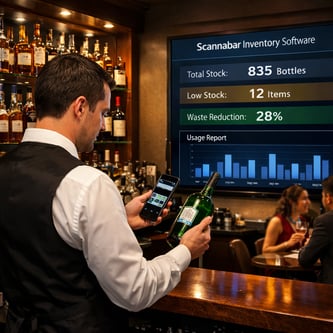
The typical bar loses between 20-25% of its inventory to various forms of shrinkage. That means for every $100,000 in liquor purchases, up to $25,000 simply vanishes. During inflationary periods when supplier costs are rising 10-15% annually, these losses compound exponentially. A bottle that cost $30 last year now costs $35, making each lost ounce even more painful to your bottom line.
Traditional manual inventory counts, performed weekly or monthly, create massive blind spots in your operations. By the time you discover discrepancies, it's too late to identify the cause or prevent future losses. Staff members may be inadvertently over-pouring during busy shifts, or worse, intentionally giving away free drinks. Products may be expiring on shelves while you continue ordering duplicates. Without real-time visibility, you're essentially operating in the dark while your profits leak away drop by drop.
How Real-Time Monitoring Transforms Your Bottom Line
Real-time inventory monitoring fundamentally changes the economics of bar operations by providing instant visibility into every bottle, keg, and ingredient. Instead of discovering problems weeks after they occur, you can identify and address issues immediately—often within the same shift. This immediacy transforms inventory management from a reactive accounting exercise into a proactive profit protection system.
When you know exactly what's being poured, sold, and remaining at any given moment, you gain unprecedented control over your cost of goods sold (COGS). Smart inventory systems automatically compare pour data against POS sales, instantly flagging discrepancies that might indicate theft, over-pouring, or unrecorded sales. This level of oversight doesn't require micromanaging staff; the system does the monitoring automatically, freeing managers to focus on customer service and business growth.
The financial impact is substantial and measurable. Establishments implementing real-time inventory monitoring typically reduce their liquor costs by 3-5 percentage points within the first few months. For a bar generating $500,000 in annual revenue with 25% liquor costs, that represents $15,000-$25,000 in recovered profit annually. During high inflation, these savings don't just improve profitability—they often mean the difference between staying competitive and going out of business.
Beyond theft prevention, real-time monitoring optimizes purchasing decisions. You'll never over-order slow-moving products or run out of popular items during peak periods. The system tracks consumption patterns and predicts needs based on historical data and upcoming events. This precision eliminates emergency orders at premium prices and reduces capital tied up in excess inventory, improving cash flow when it matters most.
Scannabar Technology: Your Digital Inventory Assistant
Scannabar represents the next generation of inventory management, combining mobile technology, barcode scanning, and cloud-based analytics to create a comprehensive solution specifically designed for bars and restaurants. Unlike generic inventory systems, Scannabar understands the unique challenges of beverage management—from tracking partial bottles to managing complex cocktail recipes with multiple ingredients.
The system works through an intuitive mobile app that turns any smartphone or tablet into a powerful inventory tool. Staff simply scan bottle barcodes to record inventory levels, receiving counts, and usage. The process that once took hours with clipboard and pen now takes minutes with pinpoint accuracy. Scannabar's database includes over 100,000 beverage products, automatically populating product information, pricing, and supplier details with each scan.
What sets Scannabar apart is its intelligent analytics engine. The platform doesn't just record numbers—it identifies patterns, predicts problems, and recommends actions. You'll receive alerts when inventory levels fall below optimal thresholds, when variance between usage and sales exceeds acceptable ranges, or when products are approaching expiration dates. These proactive notifications enable you to address issues before they become costly problems.
Integration capabilities make Scannabar even more powerful. The system connects with your existing POS system, accounting software, and supplier ordering platforms, creating a unified ecosystem that eliminates data entry redundancy and ensures accuracy across all systems. Recipe management features automatically calculate theoretical usage based on sales, providing the baseline against which actual usage is measured to identify discrepancies instantly.
From Chaos to Control: Implementing Smart Inventory Systems
Transitioning from manual inventory processes to a smart system like Scannabar requires planning, but the implementation is far simpler than most owners anticipate. The key to success lies in approaching the change systematically, starting with a complete baseline inventory count. This initial audit establishes your starting point and often reveals surprising insights about slow-moving stock, duplicate products, and organizational inefficiencies.
Staff training is critical but straightforward. Most team members become proficient with Scannabar within a single shift because the interface mirrors familiar smartphone apps they use daily. The scanning process is intuitive: point, scan, confirm. Start by training managers and lead bartenders who can champion the system and assist other staff members during the transition period. Create a culture where accurate inventory is viewed as a team responsibility rather than management oversight.
Establish clear protocols for when and how inventory is conducted. Many successful bars perform quick spot checks at shift changes, taking just 2-3 minutes to scan high-value items and verify counts match expectations. Comprehensive full inventories might occur weekly or bi-weekly, depending on volume and complexity. The real-time nature of Scannabar means you're always working with current data, not waiting for scheduled count days to understand your inventory position.
Resistance to change is natural, especially from long-tenured staff comfortable with existing processes. Address concerns directly by emphasizing how the system makes their jobs easier—no more manual counting, no more spreadsheet errors, no more guessing about par levels. Share success metrics early and often, celebrating improvements in accuracy, reduced waste, and recovered profits. When staff see tangible results, they become advocates for the system rather than skeptics.
Measuring Success: ROI and Performance Metrics That Matter
The return on investment for Scannabar inventory systems is both rapid and substantial. Most establishments achieve full ROI within 3-6 months through reduced shrinkage, optimized ordering, and labor savings. A mid-sized bar investing $200-300 monthly in Scannabar typically recovers $1,000-2,000 monthly through eliminated waste and theft alone—a 400-600% return that continues month after month, year after year.
Track specific key performance indicators to quantify your success. Your liquor cost percentage should decrease by 2-5 points as accuracy improves and losses decline. Inventory turnover ratios should increase as you optimize par levels and eliminate slow-moving stock. Variance between theoretical and actual usage—the gold standard metric for inventory control—should consistently remain below 3% once the system is fully implemented and staff are trained.
Labor efficiency provides another measurable benefit. Manual inventory counts that previously consumed 4-8 hours weekly now take 30-60 minutes with Scannabar's scanning technology. That's 15-30 hours monthly redirected toward revenue-generating activities like customer service, event planning, or staff development. At an average management labor cost of $25-35 per hour, that represents $375-1,050 in monthly labor savings alone.
Perhaps most importantly during inflationary periods, measure your gross profit per square foot and per labor hour. These efficiency metrics reveal whether you're truly becoming more profitable or simply maintaining margins while costs rise. Establishments using Scannabar typically see gross profit improvements of 15-30% within the first year—not from raising prices, but from eliminating the hidden drains that were silently eroding profitability all along. In an economic environment where every dollar counts, that kind of operational excellence isn't just nice to have—it's essential for survival and growth.