
Discover how modern bar managers are cutting inventory time from hours to just 15 minutes while maintaining accuracy and reducing liquor costs.
Why Traditional Bar Inventory Methods Are Costing You Time and Money
Every bar manager knows the dreaded feeling of inventory night. What should be a routine business task turns into a 3-4 hour ordeal of counting bottles, scribbling notes on clipboards, and second-guessing your math. Traditional manual inventory methods aren't just tedious—they're actively costing your business money in ways that might not be immediately obvious.
The most apparent cost is labor. When you're paying staff to spend hours counting bottles after closing, those wages add up quickly. But the hidden costs are even more damaging: the counting errors that lead to over-ordering, the theft that goes undetected because discrepancies get chalked up to 'human error,' and the missed opportunities to identify which products are actually profitable versus which are gathering dust on your shelves.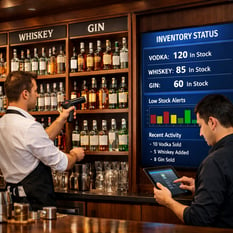
Manual counting is also inherently inconsistent. Different staff members use different estimation methods for partial bottles—one bartender's 'three-quarters full' might be another's 'half full.' This lack of standardization makes it nearly impossible to track actual pour costs or identify variance patterns. When your inventory data is unreliable, every business decision you make based on that data becomes a gamble.
The Smart System: How to Set Up Your Bar for Lightning-Fast Counts
The secret to 15-minute inventory isn't about counting faster—it's about organizing smarter. The foundation of rapid inventory begins with strategic bottle placement and consistent organization. Start by arranging your bar so that similar products are grouped together: all vodkas in one section, whiskeys in another, and so on. This might seem basic, but many bars have products scattered across multiple locations, forcing counters to hunt and potentially double-count or miss items entirely.
Next, implement a standardized shelving system where each product has a designated home. Label shelf edges with product names or SKU numbers so anyone conducting inventory knows exactly what should be in each spot. This visual system does double duty: it speeds up counting and immediately highlights when products are in the wrong place or running low.
Consider adopting the 'par level' approach used in professional kitchens. Establish minimum and maximum stock levels for each product based on your sales velocity. When these par levels are clearly marked in your inventory system, you're not just counting—you're making informed purchasing decisions in real-time. This prep work transforms inventory from a passive counting exercise into an active management tool that directly impacts your bottom line.
Mastering the Art of Speed Counting Full and Partial Bottles
Once your bar is organized, the actual counting technique becomes crucial. For full bottles, the fastest approach is the 'scan and verify' method. Instead of touching each bottle, train your eye to quickly count rows and columns, then multiply. A shelf with 4 rows of 6 bottles? That's 24 bottles in seconds. Only handle bottles when verification is needed or when recording serial numbers for high-end spirits.
Partial bottles require a different strategy. The key is standardization and speed over perfection. Most modern inventory systems use a simple scale: full, 3/4, 1/2, 1/4, or empty. Train all staff to use the same visual markers—for instance, when liquid is at the bottom of the label, it's roughly 1/4 full. This standardized approach might not be perfect to the ounce, but it's consistent, which is far more valuable for tracking trends and identifying variance over time.
Implement a two-person team approach for maximum efficiency. One person counts while the other records, creating a rhythm that prevents the stop-start pattern of solo counting. The counter calls out 'Grey Goose, 2 full, 1 half' and immediately moves to the next product while the recorder enters the data. This assembly-line method can reduce counting time by 40-50% compared to solo efforts while actually improving accuracy through the built-in verification of having two sets of eyes on the process.
Technology Tools That Turn Hours into Minutes
While good organization and technique can dramatically speed up inventory, technology is the real game-changer that makes 15-minute inventory possible. Barcode-based inventory systems have revolutionized the process by eliminating manual data entry—the slowest part of traditional inventory. With a simple smartphone or tablet equipped with a barcode scanner app, you scan each bottle's barcode, estimate the fill level, and move on. The system automatically logs the product name, size, and quantity, updating your inventory database in real-time.
Modern bar inventory apps do much more than just record counts. They automatically calculate your current inventory value, compare it against your POS sales data to identify variance, and can even generate purchase orders based on your par levels. Systems like BinWise, Partender, and AccuBar have intuitive interfaces designed specifically for the bar environment, with features like voice-to-text entry for partial amounts and offline mode for when you're in a basement bar with poor connectivity.
The most advanced systems integrate weight-based bottle sensors that continuously track inventory without any manual counting at all. While these require more upfront investment, they provide real-time inventory data and can detect theft or over-pouring as it happens. For high-volume venues, the ROI on these systems often pays for itself within months through reduced shrinkage alone. Even if full automation isn't in your budget, a basic barcode scanner system typically costs less than $100 to get started and will immediately slash your inventory time while improving accuracy.
From Chaos to Control: Real Results from Bars That Made the Switch
The proof is in the numbers. Consider the case of The Copper Still, a mid-sized cocktail bar in Portland that was spending approximately 4 hours every Monday conducting inventory with two staff members—that's 8 labor hours per week. After implementing a barcode-based system and reorganizing their back bar, they reduced inventory time to just 20 minutes with a single person. That's a savings of over 7.5 labor hours weekly, which at $15/hour translates to more than $5,800 in annual labor savings alone.
But the financial benefits extend far beyond labor costs. The Rusty Anchor, a beach-front bar in Florida, discovered they were losing approximately 15% of their inventory to undetected shrinkage—a combination of over-pouring, spillage, and theft. After switching to weekly 15-minute inventories using a mobile app, they could identify variance patterns quickly and address them immediately. Within three months, they reduced shrinkage to under 5%, recovering thousands in lost revenue monthly.
Perhaps most importantly, these bars report that frequent, fast inventory counts have transformed their purchasing decisions and cash flow management. Instead of large monthly orders based on vague estimates, they now order precisely what they need based on actual consumption data. This has reduced their tied-up capital in excess inventory by 30-40%, freeing up cash for other business needs. Bar managers consistently report that the detailed data from modern inventory systems has given them insights they never had before—like discovering that their premium gin actually sells faster than the well gin they were heavily stocking, or identifying slow-moving products that were taking up valuable shelf space. When inventory takes just 15 minutes, you can do it weekly or even multiple times per week, giving you the agile, data-driven control that separates thriving bars from struggling ones.