
Discover how automated beverage audits can eliminate costly liquor losses, reduce manual counting hours by up to 90%, and give your bar or restaurant unprecedented control over every pour.
The Hidden Costs of Manual Liquor Inventory Management
Manual liquor inventory control remains one of the most time-consuming and error-prone tasks in bar management. Many bar owners underestimate the true financial impact of traditional counting methods, which often require staff to spend hours each week physically counting bottles, measuring levels, and manually recording data on spreadsheets. This labor-intensive process not only diverts valuable employee time away from customer service but also introduces numerous opportunities for human error that can directly affect your bar profit margins.
The hidden costs extend far beyond wasted labor hours. Manual inventory systems create gaps in visibility that allow shrinkage, over-pouring, and theft to go undetected for weeks or even months. Industry research shows that bars using manual tracking methods typically experience beverage cost percentages 3-5% higher than those with automated systems. For a bar generating $500,000 in annual beverage sales, this difference translates to $15,000-$25,000 in lost profit—money that could otherwise contribute directly to your bottom line.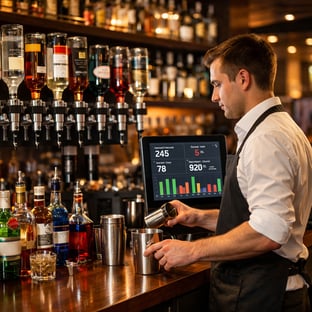
Additionally, manual processes often lead to inconsistent data collection, making it nearly impossible to identify trends, track pour costs accurately, or make informed purchasing decisions. Without real-time insights into which products are moving quickly and which are sitting on shelves, bars miss opportunities for beverage cost reduction through strategic menu engineering and optimized ordering. The delayed feedback loop means problems are discovered after significant losses have already occurred, rather than being prevented proactively.
How Automated Beverage Audit Systems Transform Bar Operations
Automated beverage audit systems revolutionize liquor inventory control by replacing manual counting with intelligent technology that tracks every bottle from delivery to disposal. Bar inventory software equipped with automation capabilities uses various methods—including wireless pour spouts, weight sensors, and barcode scanning—to capture real-time data on consumption patterns, pour accuracy, and stock levels. This transformation eliminates the guesswork from inventory management and provides bar managers with instant visibility into their most valuable asset: their liquor inventory.
The operational benefits are immediate and measurable. Bars implementing automated systems typically reduce inventory counting time by 85-90%, freeing up staff to focus on revenue-generating activities like customer engagement and upselling. What once took an entire evening can now be completed in 15-20 minutes, with far greater accuracy. These systems automatically calculate variance between theoretical and actual usage, flagging discrepancies that warrant investigation and helping managers identify whether losses stem from over-pouring, theft, spillage, or data entry errors.
Beyond time savings, automated audits provide unprecedented analytical capabilities that directly improve bar profit margins. Advanced bar inventory software generates detailed reports on product velocity, pour cost percentages by beverage category, and profitability by drink recipe. This granular data empowers bar managers to make strategic decisions about pricing adjustments, menu optimization, and staff training needs. Many operators discover that certain signature cocktails they believed were profitable are actually losing money due to inconsistent recipe execution—insights that would remain hidden without automated tracking.
The integration capabilities of modern automated systems create additional value by connecting inventory data with point-of-sale systems, accounting software, and supplier platforms. This connectivity eliminates duplicate data entry, ensures consistency across business systems, and enables automated reordering when stock levels reach predetermined thresholds. The result is a streamlined operation where inventory management becomes a strategic advantage rather than an administrative burden.
Key Features to Look for in Liquor Inventory Automation Technology
When evaluating bar inventory software for automated beverage audits, prioritize solutions that offer comprehensive tracking across all inventory stages. The most effective systems provide multiple data capture methods—including barcode scanning, RFID technology, and smart pour spouts—allowing you to choose the approach that best fits your operation's size and budget. Look for platforms that can track inventory at the bottle level rather than just product categories, as this granularity is essential for identifying specific sources of loss and maintaining tight liquor inventory control.
Real-time reporting capabilities are non-negotiable for meaningful beverage cost reduction. The system should generate instant variance reports that compare theoretical usage based on POS sales against actual consumption measured by the tracking technology. Advanced solutions offer customizable dashboards that display key performance indicators like pour cost percentage, inventory turnover rates, and potential loss by product or bartender. Mobile accessibility is equally important, enabling managers to check inventory levels, receive alerts, and review reports from anywhere rather than being tethered to a back-office computer.
Integration features significantly amplify the value of automated inventory systems. Ensure the software connects seamlessly with your existing point-of-sale system to automatically match sales data with consumption patterns. Supplier integration streamlines the ordering process by sending purchase orders directly to distributors and automatically updating inventory when deliveries are received. Accounting system integration eliminates manual data transfer and ensures your financial records accurately reflect inventory values. The more integrated your systems, the less time your team spends on administrative tasks and the more accurate your overall business intelligence becomes.
User-friendliness should never be overlooked when selecting automation technology. The most feature-rich system provides little value if your staff finds it too complex to use consistently. Look for intuitive interfaces with minimal training requirements, clear visual indicators for tasks requiring attention, and responsive customer support. Cloud-based solutions offer advantages in terms of automatic updates, data backup, and multi-location management for operators with multiple venues. Finally, consider scalability—choose a platform that can grow with your business, accommodating additional locations, expanded product catalogs, and evolving reporting needs without requiring a complete system replacement.
Preventing Shrinkage and Theft with Real-Time Beverage Tracking
Shrinkage and theft represent the most significant threats to bar profit margins, with industry estimates suggesting that 20-30% of revenue loss in bars stems from these issues. Real-time beverage tracking through automated systems creates an accountability framework that dramatically reduces both intentional theft and unintentional losses. When bartenders know that every pour is being monitored and automatically compared against POS transactions, behavior naturally becomes more conscientious. The mere presence of tracking technology serves as a powerful deterrent to intentional theft while simultaneously highlighting training gaps that lead to accidental over-pouring or incorrect recipe execution.
Automated liquor inventory control systems detect shrinkage patterns that would be impossible to identify through manual counting methods. For example, if a bottle of premium vodka shows 15 ounces missing but POS records indicate only 8 ounces sold, the system immediately flags this 7-ounce variance for investigation. Over time, these systems can correlate discrepancies with specific shifts, bartenders, or time periods, helping managers pinpoint exactly when and where losses are occurring. This level of granular visibility transforms inventory management from reactive damage control into proactive loss prevention.
The psychological impact of transparency should not be underestimated. When staff understand that automated tracking provides complete visibility into consumption patterns, several positive behavioral changes typically occur. Bartenders become more precise with measurements, following recipes more consistently and using jiggers rather than free-pouring. Comp drinks and employee beverages are properly recorded rather than poured off-the-books. After-hours access becomes more controlled, as managers can see exactly which products were accessed outside normal operating hours. These cultural shifts contribute to beverage cost reduction that extends beyond the immediate impact of the technology itself.
Real-time alerts add another layer of protection against shrinkage and theft. Advanced bar inventory software can be configured to notify managers immediately when specific conditions occur—such as a bottle being opened after closing time, consumption rates that deviate significantly from historical patterns, or inventory levels that drop below expected thresholds. This instant notification enables rapid response before small issues escalate into significant losses. Some systems even incorporate video surveillance integration, allowing managers to review security footage corresponding to flagged inventory events, creating an audit trail that supports accountability and, when necessary, disciplinary action.
Implementing Automated Audits: Best Practices for Hospitality Businesses
Successful implementation of automated beverage audits begins with thorough preparation and clear communication with your team. Before deploying any bar inventory software, conduct a comprehensive physical inventory to establish accurate baseline data. Document your current processes, identify specific pain points you aim to address, and set measurable goals for improvement—whether that's reducing inventory time by a specific percentage, decreasing beverage cost by two points, or eliminating monthly variances above a certain threshold. This preparation ensures everyone understands the purpose behind the change and provides benchmarks against which to measure success.
Staff buy-in is critical to successful adoption of liquor inventory control technology. Many bartenders and managers initially resist automated systems due to concerns about increased oversight or fear that technology might eliminate jobs. Address these concerns proactively by emphasizing how automation eliminates tedious manual counting, provides staff with better tools to succeed, and ultimately creates a more profitable operation that supports job security. Involve key team members in the selection process, soliciting their input on features and usability. When staff feel they've contributed to the decision, they become advocates rather than resistors during implementation.
Comprehensive training ensures your team can maximize the system's capabilities from day one. Schedule hands-on training sessions for all staff who will interact with the technology, from bartenders who may need to scan bottles to managers who will analyze reports. Focus on the 'why' behind procedures, not just the 'how'—when staff understand that consistent bottle scanning enables accurate tracking that protects everyone from false accusations, compliance improves dramatically. Create quick-reference guides for common tasks and designate 'super users' who receive advanced training and can support their colleagues during the transition period.
Take a phased approach rather than attempting to automate everything simultaneously. Many successful implementations begin by automating tracking for only the highest-value spirits—premium whiskeys, high-end tequilas, and craft cocktail ingredients that represent the greatest financial exposure. Once staff become comfortable with the technology and processes, gradually expand to include additional product categories. This staged approach reduces overwhelm, allows for process refinement based on real-world experience, and creates early wins that build momentum for broader adoption.
Continuous optimization is essential for long-term success with automated beverage audits. Schedule regular reviews of the data your bar inventory software generates, looking for trends, anomalies, and opportunities for improvement. Use variance reports to identify training needs—if a particular bartender consistently shows higher-than-average pour costs, they may benefit from recipe reinforcement rather than disciplinary action. Leverage consumption data to inform purchasing decisions, negotiating better prices on high-velocity products and eliminating slow-moving inventory that ties up capital. As your comfort with the technology grows, explore advanced features like recipe costing, predictive ordering, and integration with additional business systems. The goal is not simply to implement technology but to create a culture of continuous improvement where data-driven decisions become the norm, systematically improving your bar profit margins over time.