
Discover how a unique charcoal filtration method transforms bourbon into Tennessee whiskey and defines an entire regional spirit tradition.
What Makes Tennessee Whiskey Different From Bourbon
Tennessee whiskey and bourbon share many similarities, but one crucial step sets them apart: the Lincoln County Process. Both spirits must be made from at least 51% corn, aged in new charred oak barrels, and distilled to no more than 160 proof. However, Tennessee whiskey undergoes an additional filtration process that bourbon does not require, creating a distinct flavor profile that has become synonymous with the Volunteer State.
The primary distinction lies in the charcoal mellowing process that occurs before barrel aging. This extra step, known as the Lincoln County Process, involves filtering the freshly distilled spirit through sugar maple charcoal. This filtration removes impurities and harsh flavors, resulting in a smoother, mellower whiskey with subtle sweetness and complexity. While all Tennessee whiskey can technically meet the legal requirements to be called bourbon, the reverse is not true—bourbon does not undergo this signature filtration process.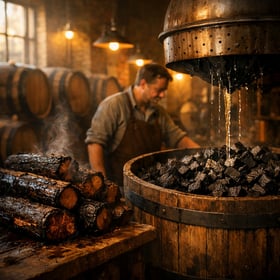
Geography also plays a role in the distinction. Tennessee whiskey must be produced in Tennessee to carry the name, similar to how champagne must come from the Champagne region of France. This regional designation, combined with the mandatory Lincoln County Process, creates a protected category that celebrates Tennessee's unique contribution to American whiskey heritage. The result is a spirit that stands proudly on its own, distinct from its Kentucky cousin while honoring shared roots in American distilling traditions.
The History Behind the Lincoln County Process
The Lincoln County Process traces its origins to the early 19th century in Tennessee, where distillers sought ways to create smoother, more refined spirits. The technique is believed to have been developed around 1825 by Alfred Eaton in Lincoln County, Tennessee, though the exact origins remain somewhat shrouded in distilling folklore. What is certain is that this innovative filtration method quickly gained popularity among Tennessee distillers who recognized its ability to produce a superior product.
The most famous practitioner of the Lincoln County Process was Nathan "Nearest" Green, an enslaved master distiller who perfected the technique and later taught it to a young Jasper Newton "Jack" Daniel. Green's expertise and mentorship were instrumental in establishing the foundation of what would become the Jack Daniel Distillery in Lynchburg, Tennessee. Despite the distillery's location in Moore County, the process retained its Lincoln County name, honoring its geographical origins. Green's contributions, long overlooked in historical accounts, have recently gained recognition as essential to the development of Tennessee whiskey.
By the late 1800s, the Lincoln County Process had become the defining characteristic of Tennessee whiskey production. Distilleries across the state adopted the method, recognizing that the charcoal mellowing process set their product apart in an increasingly competitive market. When Prohibition devastated the American whiskey industry in 1920, many distilleries closed permanently, but those that survived—most notably Jack Daniel's and George Dickel—continued the tradition when legal production resumed, ensuring that this unique Tennessee heritage would endure for future generations.
How Sugar Maple Charcoal Filtration Works
The Lincoln County Process begins with the creation of sugar maple charcoal, a meticulous undertaking that is crucial to the final product's quality. Distilleries stack sugar maple wood and burn it in carefully controlled conditions until it reduces to charcoal. This charcoal is then broken into small chunks and packed into large vats or mellowing tanks, creating a filtration bed that can be anywhere from 10 to 14 feet deep, depending on the distillery's specifications.
Once the charcoal bed is prepared, the freshly distilled whiskey—known as "white dog" or new make spirit—is slowly dripped through the charcoal. This process is not rushed; the whiskey may take anywhere from three to ten days to complete its journey through the charcoal, depending on the depth of the bed and the distillery's desired mellowing effect. Gravity pulls the clear spirit downward through the porous charcoal, which acts as both a physical and chemical filter, interacting with the alcohol at a molecular level.
The sugar maple wood is specifically chosen for its unique properties. Unlike other hardwoods, sugar maple imparts a subtle sweetness without adding overwhelming flavor. The charcoal's porous structure creates an enormous surface area for the whiskey to contact, maximizing the filtration effect. As the spirit passes through, the charcoal removes sulfur compounds, fusel oils, and other congeners that contribute to harsh flavors. At the same time, it allows desirable flavor compounds to pass through, resulting in a cleaner, smoother spirit that is then ready for barrel aging.
The Science of Mellowing: What Happens During Filtration
The Lincoln County Process is more than just physical filtration—it's a complex chemical interaction between the whiskey and the activated charcoal. When the new make spirit encounters the charcoal, a process called adsorption occurs. Unlike absorption, where substances are taken into the interior of a material, adsorption involves molecules adhering to the surface of the charcoal. The porous nature of sugar maple charcoal provides an immense surface area, estimated at hundreds of square meters per gram, allowing for extensive contact with the whiskey.
During this contact, the charcoal selectively removes certain compounds while allowing others to pass through. Heavier, more volatile compounds such as sulfur-based molecules, fusel alcohols, and fatty acids are trapped by the charcoal, while lighter alcohol molecules and desirable flavor compounds continue their journey. This selective filtration is key to understanding why Tennessee whiskey tastes different from bourbon. The process removes the sharp, biting notes that can characterize young spirits, replacing them with a rounder, more approachable character even before barrel aging begins.
The mellowing process also introduces subtle flavor changes beyond simple removal of undesirable compounds. The interaction between the spirit and the charcoal can generate new flavor molecules through chemical reactions, adding notes of vanilla, caramel, and a distinctive smoothness. Some experts believe the sugar maple charcoal imparts a faint sweetness and a hint of smokiness, though this is far more delicate than the peat smoke found in Scotch whisky. When the filtered spirit enters new charred oak barrels for aging, it does so with a cleaner, more refined base, allowing the barrel aging process to add complexity without having to overcome harsh initial flavors.
Legal Requirements and Modern Tennessee Whiskey Production
In 2013, Tennessee officially codified the definition of Tennessee whiskey into state law, establishing clear legal requirements that protect the designation. According to Tennessee law, a spirit labeled as Tennessee whiskey must be produced in Tennessee, made from at least 51% corn, distilled to no more than 160 proof, aged in new charred oak barrels, and filtered through maple charcoal before aging. The law also specifies that the whiskey must enter the barrel at no more than 125 proof and be bottled at a minimum of 80 proof, mirroring federal bourbon requirements while adding the distinctive Lincoln County Process mandate.
This legislation was not without controversy. Some smaller craft distillers argued that the law was too restrictive and favored established producers, while supporters maintained that it protected Tennessee's whiskey heritage and prevented inferior products from trading on the state's reputation. The law includes a clause allowing distillers to petition for exemptions, recognizing that innovation and tradition can coexist. Ultimately, the legislation reinforced Tennessee whiskey's identity as a distinct category within American whiskey, ensuring that the Lincoln County Process remains central to the definition.
Today, Tennessee whiskey production continues to honor traditional methods while embracing modern technology and quality control. Major producers like Jack Daniel's and George Dickel maintain their commitment to the Lincoln County Process, using sugar maple charcoal mellowing as a defining step in their production. Meanwhile, a new generation of craft distilleries has emerged across Tennessee, many of whom proudly employ the traditional charcoal filtration method while experimenting with different grain bills, barrel finishes, and aging techniques. Whether produced in large-scale operations or small craft distilleries, Tennessee whiskey remains distinguished by the patient, meticulous process that transforms good bourbon into something uniquely Tennessee—a smooth, mellow spirit that reflects the state's rich distilling heritage and its ongoing commitment to craftsmanship.