Expert Advice on Hospitality Topics

Waste Reduction Strategies to Boost Your Bar's Profit Margins

Posted by Nick Kaoukis on Mon, May, 11, 2026 @ 09:05 AM

Discover how cutting waste in your bar operation can transform spillage and spoilage into serious profits while creating a more sustainable business.

The Hidden Costs Draining Your Bar's Bottom Line

Every bar owner knows that profit margins can be razor-thin in the hospitality industry, but many don't realize just how much waste is silently eating away at their bottom line. From over-pouring and spillage to expired inventory and theft, the hidden costs of poor liquor inventory control can cost bars 20-25% of their total beverage revenue annually. These losses often go unnoticed because they happen in small increments throughout each shift, making them difficult to track without proper systems in place.

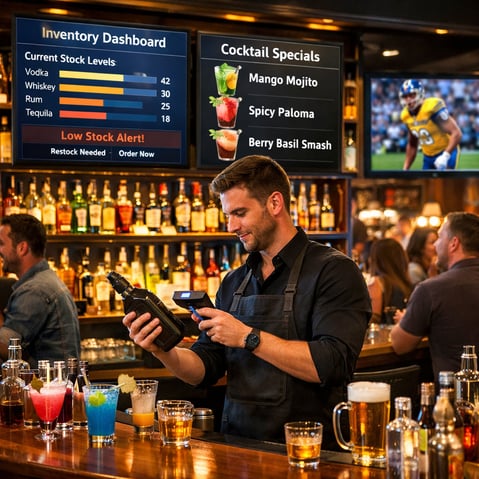
The most significant culprits include over-pouring by bartenders who eyeball measurements, spillage during busy service periods, spoilage from ingredients that expire before use, and unaccounted-for drinks that disappear through theft or unauthorized giveaways. When you consider that the average bar pours hundreds of drinks per week, even a quarter-ounce of excess per cocktail adds up to thousands of dollars in lost revenue over a year. Understanding these hidden costs is the first step toward implementing effective liquor inventory control and improving your bar profit margins.Modern Bar with TechIntegrated Cocktails and Vibrant Atmosphere
Beyond the direct financial impact, waste also affects your cost of goods sold (COGS), making it harder to accurately price your menu items and forecast purchasing needs. Many bar owners operate with beverage cost percentages that are 5-10% higher than they should be simply because they're not accounting for all the waste in their system. By identifying and quantifying these hidden costs, you can establish a baseline for improvement and set realistic targets for beverage cost reduction.

Smart Inventory Management Systems That Stop Money From Pouring Down the Drain

Implementing robust liquor inventory control through modern bar inventory software has become essential for bars serious about protecting their profit margins. These digital solutions replace outdated manual counting methods with streamlined systems that track every bottle from delivery to the last pour. Bar inventory software allows you to conduct regular inventory counts in a fraction of the time, compare actual usage against sales data, and quickly identify discrepancies that signal potential problems like theft, over-pouring, or recording errors.

The key to effective inventory management is consistency and frequency. Leading bars now conduct inventory counts at least weekly, with many high-volume establishments doing spot checks on premium bottles daily. Modern bar inventory software makes this practical by using barcode scanning or bottle weighing technology that reduces counting time by up to 75%. These systems automatically calculate variance reports, showing you exactly where your liquor is going and highlighting products with unusual depletion rates that deserve closer attention.

Beyond tracking, smart inventory systems help optimize your purchasing decisions and reduce over-ordering that leads to spoilage. By analyzing historical sales patterns and current stock levels, bar inventory software can generate suggested order lists that ensure you have enough inventory to meet demand without tying up excessive capital in bottles that sit on shelves. This targeted approach to purchasing is a powerful beverage cost reduction strategy that prevents both stockouts and waste from expired perishables.

Integration capabilities make modern inventory systems even more powerful. When your bar inventory software connects with your point-of-sale system, it creates an automatic feedback loop that tracks theoretical usage based on recipes against actual depletion. This variance analysis quickly reveals whether your staff is following standard recipes, whether theft is occurring, or whether your recipes need adjustment. The data-driven insights these systems provide transform liquor inventory control from guesswork into a precise science that directly improves bar profit margins.

Portion Control Techniques That Maintain Quality While Maximizing Profits

Consistent portion control is one of the most effective beverage cost reduction strategies available to bar owners, yet it's frequently overlooked or inconsistently applied. The difference between a 1.5-ounce pour and a 2-ounce pour might seem negligible on a single drink, but across hundreds of cocktails per week, that extra half-ounce represents significant profit loss. Implementing strict portion control measures ensures that every drink meets your cost targets while maintaining the consistency that keeps customers coming back.

Measured pourers and jiggers are the foundation of effective portion control. Free-pouring might look impressive, but even experienced bartenders can vary by 0.25 to 0.5 ounces per drink, especially during high-volume periods. Installing measured pourers on your liquor bottles guarantees that every shot is exactly the size you've designed your recipes around. For establishments that prefer the aesthetics of free-pouring, training bartenders to use jiggers consistently is essential. Regular pour tests, where managers check bartender accuracy with marked shot glasses, help maintain standards and identify team members who need additional training.

Recipe standardization goes hand-in-hand with portion control. Every cocktail on your menu should have a documented recipe with exact measurements for each ingredient. These standardized recipes become the foundation of your liquor inventory control system, allowing you to calculate theoretical usage and identify variances. When everyone follows the same recipe, you ensure consistent quality, accurate costing, and better inventory tracking. Many successful bars post laminated recipe cards at each station or use tablets with recipe apps to make it easy for bartenders to follow specifications exactly.

Portion control tools extend beyond pourers to include garnishes and mixers, which can also impact your bar profit margins. A heavy hand with expensive garnishes like fresh herbs or specialty bitters adds up quickly. Similarly, over-pouring mixers dilutes your cocktails and increases costs. By establishing clear standards for every element of your drinks and providing your team with the tools to execute consistently, you create a culture of precision that protects your margins while ensuring every guest receives the same high-quality experience.

Turning Food and Beverage Waste Into Creative Menu Opportunities

Progressive bar operators are discovering that effective liquor inventory control isn't just about preventing waste—it's also about creatively repurposing ingredients that might otherwise be discarded. This approach to beverage cost reduction transforms potential losses into profitable menu items while demonstrating environmental responsibility that resonates with modern consumers. By viewing surplus or aging inventory as an opportunity rather than a problem, you can create unique offerings that differentiate your bar from competitors.

Fruit and herb garnishes that are approaching the end of their freshness can be repurposed into house-made syrups, shrubs, and infusions that add complexity to your cocktail program. Citrus peels become oleo saccharum or dehydrated garnishes, while slightly wilted herbs can be muddled into specialty drinks or steeped into simple syrups. These value-added preparations not only reduce waste but also allow you to create signature ingredients that can't be easily replicated elsewhere, giving your bar a unique identity and justifying premium pricing.

Slow-moving spirits present another opportunity for creative menu development. Rather than watching premium bottles gather dust, feature them in limited-time cocktails or create a rotating "bartender's choice" program that highlights underutilized inventory. Many bars successfully use flight programs or tasting menus to introduce customers to slow-moving products, often discovering that certain items just need better promotion rather than being poor performers. This proactive approach to liquor inventory control prevents the write-offs that occur when bottles expire or become unsellable.

Consider implementing a zero-waste cocktail program that makes creative use of every ingredient. Juice pulp becomes ingredients in house-made sodas or is incorporated into food menu items. Coffee grounds from espresso martinis can be repurposed into coffee liqueur infusions. Even egg whites left over from yolk-forward dishes can be used in sours and fizzes. By systematically identifying waste streams and brainstorming creative applications, you engage your team in improving bar profit margins while building a reputation for innovation and sustainability that attracts environmentally conscious customers.

Training Your Team to Become Waste Reduction Champions

Even the most sophisticated bar inventory software and waste reduction systems will fail without buy-in from your team. The bartenders, barbacks, and servers who handle your inventory daily are your frontline defense against waste, and their habits directly impact your bar profit margins. Creating a culture where every team member understands the financial impact of waste and takes ownership of inventory control transforms your entire operation from reactive to proactive.

Start by making the business case transparent. Many bartenders don't realize that over-pouring a half-ounce on each drink in a busy Saturday night shift can cost the bar hundreds of dollars. Share the numbers with your team—show them how waste impacts profitability and, ultimately, their job security and tip potential. When staff understand that better liquor inventory control means a healthier business that can afford competitive wages and stay open long-term, they become invested in the outcome. Consider implementing incentive programs that reward teams for hitting variance targets or reducing beverage costs, creating positive motivation for careful inventory practices.

Comprehensive training programs should cover all aspects of beverage cost reduction, from proper pouring techniques and recipe adherence to inventory handling and storage procedures. Hands-on practice with jiggers and pourers helps bartenders develop muscle memory for accurate measurements. Role-playing scenarios where staff identify potential waste situations and discuss solutions builds problem-solving skills. Regular refresher training ensures that standards don't slip over time and gives you opportunities to introduce new techniques or address emerging issues. Documentation of all procedures creates a training resource for new hires and a reference for experienced staff.

Empowerment is the final piece of effective team training. Encourage staff to identify waste sources and suggest improvements—they often spot inefficiencies that management overlooks. Create a system where team members can easily report problems like leaking bottles, malfunctioning equipment, or recipe issues that lead to waste. Regular team meetings focused on inventory results foster accountability and allow for collaborative problem-solving. When bartenders feel like partners in the business rather than just employees, they naturally take more care with inventory and become genuine champions of waste reduction.

Tracking individual performance through your bar inventory software can also support training efforts. When you can show a bartender that their station has higher variance than others, it creates a concrete learning opportunity. Similarly, recognizing team members who consistently maintain tight inventory control reinforces positive behavior. By combining education, accountability, and recognition, you build a team culture where liquor inventory control becomes second nature, protecting your bar profit margins while elevating the professionalism of your entire operation.
Topics: Bar inventory, Hotel Inventory, wine inventory, managing liquor inventory cost, Liquor cost, Liquor Inventory savings, wine inventory app, wine inventory solution, wine inventory system, warehouse inventory

Hotel Lobby Cocktails: Classic Drinks in Nashville's Historic Hotels

Posted by Nick Kaoukis on Fri, Apr, 10, 2026 @ 09:04 AM

Discover the timeless elegance of Nashville's most iconic hotel bars, where legendary cocktails and Southern hospitality create unforgettable experiences in historic lobbies.

Where History Meets Mixology in Music City

Nashville's historic hotel lobby bars represent a fascinating intersection of Southern charm, musical heritage, and sophisticated cocktail culture. These elegant spaces have served as gathering places for country music legends, business titans, and travelers seeking authentic Nashville experiences for generations. The grand lobbies of Music City's most storied hotels offer more than just a place to drink—they provide a portal to the golden age of Southern hospitality, where every cocktail tells a story and every conversation echoes with history.

Walking into these historic establishments feels like stepping back in time. Original architectural details, from ornate crown molding to crystal chandeliers, create an atmosphere of refined elegance that modern establishments struggle to replicate. The bartenders in these spaces aren't just mixologists; they're custodians of Nashville's cocktail heritage, preserving recipes and techniques passed down through decades while honoring the traditions that made these venues legendary.

What sets Nashville's historic hotel bars apart is their authentic connection to the city's past. These aren't theme bars attempting to recreate history—they are history. The same mahogany bars that served drinks to early country music pioneers still stand today, polished by generations of hands and steeped in the stories of countless memorable evenings. This genuine connection to old Nashville creates an atmosphere that simply cannot be manufactured or replicated.

Signature Cocktails That Define Nashville's Golden Age

The cocktail menus at Nashville's historic hotel bars read like a greatest hits collection of American mixology, with Southern twists that pay homage to the region's distinctive flavors. Classic Old Fashioneds are elevated with locally-sourced Tennessee whiskey, while Mint Juleps showcase the state's bourbon heritage with fresh mint from nearby farms. These aren't trendy craft cocktails chasing the latest fad—they're time-tested recipes that have satisfied discerning drinkers for generations.

Many of these establishments feature signature drinks that have become synonymous with Nashville itself. The Hermitage Hotel's famous whiskey cocktails, for instance, have been perfected over decades of service, with each ingredient carefully selected to complement the bold flavors of Tennessee spirits. These signature creations often incorporate regional ingredients like sorghum syrup, local honey, and Tennessee peaches, creating cocktails that taste distinctly of place and time.

What makes these classic cocktails special isn't complexity—it's consistency and quality. The bartenders at these historic venues understand that a perfectly executed Manhattan or a flawlessly balanced Negroni requires exceptional ingredients, precise technique, and unwavering attention to detail. They use premium spirits, fresh juices, and house-made bitters to create drinks that honor traditional recipes while showcasing the finest ingredients available. Each cocktail is a liquid tribute to Nashville's commitment to excellence and hospitality.

The Art of Craft Cocktails in Grand Lobby Settings

The presentation and atmosphere of cocktail service in Nashville's historic hotel lobbies elevates drinking to an art form. These spaces were designed during an era when grandeur mattered, and the soaring ceilings, marble columns, and carefully curated art collections create a sense of occasion that makes every visit feel special. The bartenders work in full view, their movements deliberate and practiced as they muddle, shake, and strain with the confidence that comes from years of experience.

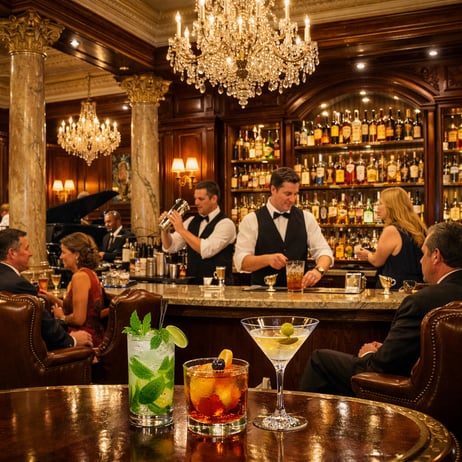
The lobby bar experience is as much about ambiance as it is about alcohol. Leather wingback chairs invite guests to settle in for extended conversations, while soft lighting and live piano music create a soundtrack that enhances rather than overwhelms. The service style reflects old Nashville's commitment to genuine hospitality—attentive without being intrusive, knowledgeable without being pretentious, and always delivered with a warm Southern smile.Nashville Hotel Bar with Crystal Chandeliers and Plush Chairs-1

These grand settings demand a certain level of craftsmanship behind the bar. The bartenders understand they're not just making drinks; they're creating experiences that guests will remember long after they've returned home. From the way a cocktail is garnished to the glassware it's served in, every detail is considered. Ice is hand-cut to the perfect size, garnishes are fresh and artfully arranged, and each drink is presented with pride. This dedication to craft ensures that every cocktail served in these historic spaces lives up to the grandeur of its surroundings.

Hidden Gems and Must-Visit Hotel Bars for Cocktail Enthusiasts

The Hermitage Hotel's lobby bar stands as perhaps the most iconic of Nashville's historic hotel drinking establishments. Operating since 1910, this Beaux-Arts masterpiece has served everyone from early Grand Ole Opry stars to modern music industry executives. The bar itself is a work of art, with its original marble and woodwork preserved to perfection. Their cocktail program honors tradition while incorporating subtle modern touches, making it essential destination for anyone seeking authentic old Nashville elegance.

The Union Station Hotel, housed in a magnificently restored 1900 train station, offers a lobby bar experience unlike any other in the city. The soaring barrel-vaulted ceiling and original stained glass create a cathedral-like atmosphere where cocktails feel almost ceremonial. This former railway hotel served as a gateway to Nashville for countless travelers during the city's golden age, and that sense of arrival and celebration still permeates every drink served beneath its historic arches.

For those seeking a more intimate historic experience, the Capitol Grille at the Hermitage Hotel provides a refined setting where classic cocktails are prepared with museum-quality attention to detail. Meanwhile, the Bobby Hotel, while more recently renovated, occupies a historic building and has thoughtfully incorporated elements of old Nashville into its modern lobby bar, creating a bridge between past and present that appeals to both traditionalists and contemporary cocktail enthusiasts.

Each of these establishments offers something unique, but they all share a commitment to preserving Nashville's cocktail heritage. Whether you're sipping a pre-prohibition era cocktail surrounded by original Art Deco fixtures or enjoying a Tennessee whiskey in a space where country music legends once gathered, these hotel lobby bars provide authentic connections to the Nashville that existed long before the city became today's booming tourist destination.

Planning Your Perfect Evening of Lobby Bar Hopping

Creating an evening itinerary around Nashville's historic hotel lobby bars requires some strategic planning to maximize your experience. Start earlier in the evening, around 5 or 6 PM, when these elegant spaces are less crowded and you can fully appreciate the architecture and ambiance. Many of these hotels are located within walking distance of each other in downtown Nashville, making it entirely feasible to visit two or three in a single evening without needing transportation between stops.

Consider beginning your journey at the Hermitage Hotel for an early evening cocktail, then making your way to Union Station for a drink under the magnificent ceiling before finishing at a third location for dinner and a nightcap. Dress appropriately for these refined establishments—while not all require formal attire, smart casual dress shows respect for the historic setting and ensures you feel comfortable in these elegant surroundings. Making reservations when possible can guarantee you the best seating, especially during peak times and weekends.

Budget accordingly for your evening, as drinks at these prestigious establishments typically reflect their quality and historic significance. However, the experience—the expert service, premium ingredients, historic ambiance, and connection to Nashville's past—justifies the investment for cocktail enthusiasts and history lovers alike. Many of these bars offer small plates or appetizers that pair beautifully with their cocktail menus, allowing you to create a full evening experience.

The best time to experience these historic spaces is during the week, when locals and business travelers outnumber tourists and the atmosphere feels more authentic. However, weekend evenings offer their own appeal, with live music often enhancing the ambiance. Whichever you choose, arrive with curiosity and an appreciation for tradition—these aren't just bars, they're living museums of Nashville's cocktail culture, and approaching them with that mindset will enrich your entire experience. Take your time, engage with the bartenders about the history and their craft, and savor the rare opportunity to drink where Nashville's legends once gathered.

Topics: Hotel Inventory, hotel supplies, drink recipe, hospitality jobs, Hospitality show, hotel parties, Hotel Bar Inventory, warehouse inventory, hotel staff

How Scannabar Streamlines Automated Inventory Audits for Retail

Posted by Nick Kaoukis on Wed, Feb, 25, 2026 @ 09:02 AM

Discover how Scannabar's innovative automated inventory audit solution is transforming retail operations by eliminating manual counting errors, reducing labor costs, and providing real-time stock visibility across your entire supply chain.

The Hidden Costs of Manual Inventory Management in Retail

Manual inventory management continues to drain retail resources in ways that often go unnoticed until the damage is alreadyThe image depicts a modern retail store interior featuring neatly arranged shelves stocked with various products from clothing to shoes Each item disp-1 done. Traditional counting methods require significant labor hours, with employees spending countless hours walking aisles, scanning items, and recording data by hand. This not only diverts staff from customer-facing activities but also introduces substantial room for human error that can cascade throughout your entire operation.


The financial impact extends far beyond just labor costs. Inaccurate inventory counts lead to overstocking, which ties up valuable capital in excess inventory, or understocking, which results in lost sales and disappointed customers. Research shows that inventory accuracy in retail typically hovers around 63% with manual processes, meaning nearly 40% of your stock data could be incorrect at any given time. These discrepancies create a domino effect that impacts purchasing decisions, fulfillment capabilities, and ultimately, your bottom line.

Scannabar addresses these challenges head-on by automating the entire inventory audit process. By eliminating the need for manual counts and reducing the time spent on inventory management by up to 90%, retailers can redirect their workforce toward more strategic, revenue-generating activities while ensuring accuracy rates that exceed 99%.

Smart Barcode Technology That Works Around the Clock

Scannabar's intelligent barcode scanning technology revolutionizes how retail stores monitor their inventory by providing continuous, automated surveillance of stock levels. Unlike traditional systems that require scheduled manual scans, Scannabar's technology operates autonomously, capturing data 24/7 without interrupting normal business operations. The system utilizes advanced scanning mechanisms that can read multiple barcodes simultaneously, processing thousands of items in the time it would take an employee to count just a handful.

The technology is designed with retail environments in mind, capable of reading barcodes from various angles and even in challenging conditions such as poor lighting or partially obscured labels. This adaptability ensures that your inventory tracking remains consistent and reliable regardless of how products are positioned on shelves or in storage areas. The smart sensors can distinguish between different product variations, sizes, and SKUs, providing granular detail that manual counting simply cannot match.

What sets Scannabar apart is its ability to learn and adapt over time. The system's algorithms recognize patterns in your inventory movement, identifying fast-moving products, seasonal trends, and potential stockout situations before they become critical. This predictive capability transforms inventory management from a reactive process into a proactive strategy, allowing retailers to stay ahead of demand and optimize their stock levels continuously.

Real-Time Data Synchronization Across Multiple Locations

For retail chains operating across multiple locations, maintaining consistent and accurate inventory data has traditionally been a nightmare. Scannabar's cloud-based platform solves this challenge by providing instant synchronization of inventory data across all your retail locations. The moment an item is scanned, sold, or restocked at any location, that information is immediately updated in the central system and reflected across your entire network.

This real-time visibility transforms how multi-location retailers manage their supply chain. Store managers can instantly check inventory levels at other locations to fulfill customer requests, preventing lost sales due to local stockouts. District and regional managers gain a comprehensive bird's-eye view of inventory distribution, enabling them to identify opportunities for inventory transfers between locations to optimize stock levels and reduce waste. The centralized dashboard provides actionable insights that help decision-makers understand inventory health across the entire organization at a glance.

The synchronization capabilities extend beyond just inventory counts. Scannabar tracks inventory movement patterns, turnover rates, and location-specific trends, providing valuable data that helps retailers make informed decisions about product placement, ordering quantities, and distribution strategies. This level of coordination ensures that each location maintains optimal stock levels while minimizing the total inventory investment across the chain.

Reducing Shrinkage and Improving Stock Accuracy

Inventory shrinkage remains one of the most significant challenges facing retailers today, costing the industry billions of dollars annually through theft, damage, administrative errors, and supplier fraud. Scannabar's automated audit system creates a powerful deterrent against shrinkage by establishing a comprehensive tracking system that monitors every item from receipt to sale. The continuous monitoring capability means that discrepancies are identified immediately rather than months later during annual physical counts, allowing retailers to address issues while the trail is still warm.

The system's precision dramatically improves stock accuracy by eliminating the counting errors that plague manual inventory processes. Every scan is recorded with a timestamp, location marker, and user identification when applicable, creating an audit trail that provides complete accountability. When variances occur, managers can quickly drill down into the data to identify exactly when and where the discrepancy originated, whether it was a receiving error, a point-of-sale mistake, or potential theft.

Beyond detection, Scannabar's analytics help retailers understand shrinkage patterns and implement targeted prevention strategies. The system can identify high-risk products, times of day when discrepancies are most likely to occur, and locations that experience higher-than-average shrinkage rates. Armed with this intelligence, retailers can deploy resources more effectively, adjust security measures, improve training programs, and implement policies that address the root causes of shrinkage rather than just treating the symptoms.

Seamless Integration with Existing Retail Management Systems

One of the biggest concerns retailers have when considering new technology is the disruption it might cause to existing operations. Scannabar eliminates this worry with its flexible integration capabilities designed to work harmoniously with virtually any retail management system, POS platform, or ERP solution. The platform features pre-built connectors for major retail software providers and an open API architecture that allows custom integrations for proprietary systems.

Implementation is straightforward and minimally disruptive. Scannabar's team works closely with your IT department to map data fields, establish synchronization protocols, and test the integration thoroughly before going live. The system can be deployed in phases, starting with a pilot location to validate the process before rolling out across your entire retail network. Most retailers find that they can complete full implementation within weeks rather than months, with minimal downtime or disruption to daily operations.

Once integrated, Scannabar functions as a seamless extension of your existing retail infrastructure. Inventory data flows automatically between systems, eliminating the need for manual data entry or file transfers. The platform enhances your current systems rather than replacing them, adding a powerful automated audit layer that improves the accuracy and reliability of the data flowing through your entire retail ecosystem. Updates and maintenance are handled automatically through the cloud, ensuring that your system stays current with the latest features and security protocols without requiring IT intervention.

Topics: Scannabar Inventory system, retail inventory, clothing store inventory, clothing inventory, retail purchasing, Scannabar inventory app, Scannabar Inventory Software, shoe Inventory, warehouse inventory