Most bar operators know shrinkage exists. Fewer know how much profit it drains every week, or how long their counting method delays the moment they catch it. For a bar generating $500,000 in annual beverage revenue, a shrinkage rate of 20% to 25% translates to $100,000 to $125,000 walking out the door every year.
This guide breaks down what purpose-built bar inventory software should do, where generic tools fall short for hotels and multi-location hospitality groups, and how to evaluate monthly costs against the real return: faster counts, earlier variance alerts, and tighter liquor control across every bar you operate.
Key Takeaways: Bar Inventory Software for Hotels and Hospitality Groups
- Generic inventory tools miss bottle-level tracking, leaving variance undetected until thousands of dollars have already disappeared.
- Serialized bottle tracking ties every ounce to a specific location, shift, and bartender for precise accountability.
- POS integration closes the loop between what you sold and what you poured, exposing heavy pours and theft in real time.
- Scannabar reduces shrinkage to 1% to 3% from industry averages near 25%, with clients reporting 25% to 50% beverage cost reductions.
- Evaluating monthly software cost requires measuring labor savings, variance reduction, and faster decision-making alongside the subscription price.
Why Generic Inventory Tools Miss the Real Cost of Liquor Variance
Standard inventory platforms track quantities at the SKU level. They can tell you that you have 14 bottles of a particular bourbon on hand. They cannot tell you that three of those bottles are 60% depleted, one has been open for six weeks, and another has moved to the banquet prep area without a transfer record.
That gap matters because liquor variance hides in the details. A bottle that goes unaccounted for at a single-unit bar is a nuisance. A bottle that goes unaccounted for across 12 hotel bars, two banquet stations, and a rooftop lounge is a systemic blind spot that compounds every week you fail to catch it.
How Slow Counts Delay Variance Detection
Counting by hand is still the default at most bars. The math is brutal. A well-stocked bar carrying 80 to 120 open bottles takes 45 minutes to an hour to count by hand. Multiply that across multiple bars in a hotel property, and you are looking at a full shift dedicated to counting rather than serving.
The bigger problem is frequency. When counting takes that long, operators push it to once a month or once a quarter. That delay means variance builds silently. heavy pours, spillage, theft, and breakage accumulate for weeks before anyone sees the numbers.
By the time a monthly count reveals a $4,000 discrepancy, the damage is done. You have no way to trace which shift, which bartender, or which bar station contributed to the loss. The money is gone. The behavior that caused it has been repeating unchecked for 30 days.
Why Bars, Hotels, and Multi-Location Groups Need Different Controls
A standalone neighborhood bar and a 300-room hotel with four beverage outlets have fundamentally different control requirements. The bar owner needs speed and accuracy for a single location. The hotel F&B director needs centralized visibility across bars, banquet stations, minibars, and poolside service points, each with different par levels, different product mixes, and different staff rotations.
Multi-location hospitality groups add another layer. They need standardized processes across properties so that variance data is comparable, purchasing is aggregated, and a new bar manager in Miami follows the same counting protocol as the veteran in Nashville. Generic tools rarely offer that kind of operational standardization.
What Bar Inventory Software Should Include
Not every platform calling itself bar inventory management software delivers the controls that hospitality operators need. The features below separate purpose-built hospitality tools from adapted warehouse or retail inventory systems.
What Serialized Bottle-Level Tracking Changes
Serialized tracking assigns a unique identity to every bottle the moment it enters your building. This approach is what makes liquor inventory precise at the bottle level.
When that bottle is scanned during receiving, the software creates a profile containing brand, volume, cost, and dimensional data. From that point forward, every measurement and every transfer is logged against that specific bottle.
If a bottle disappears from a service well between Tuesday's close and Wednesday's open, the system flags exactly which bottle is missing and where it was last recorded. That specificity separates precise liquor control from general-purpose inventory management.
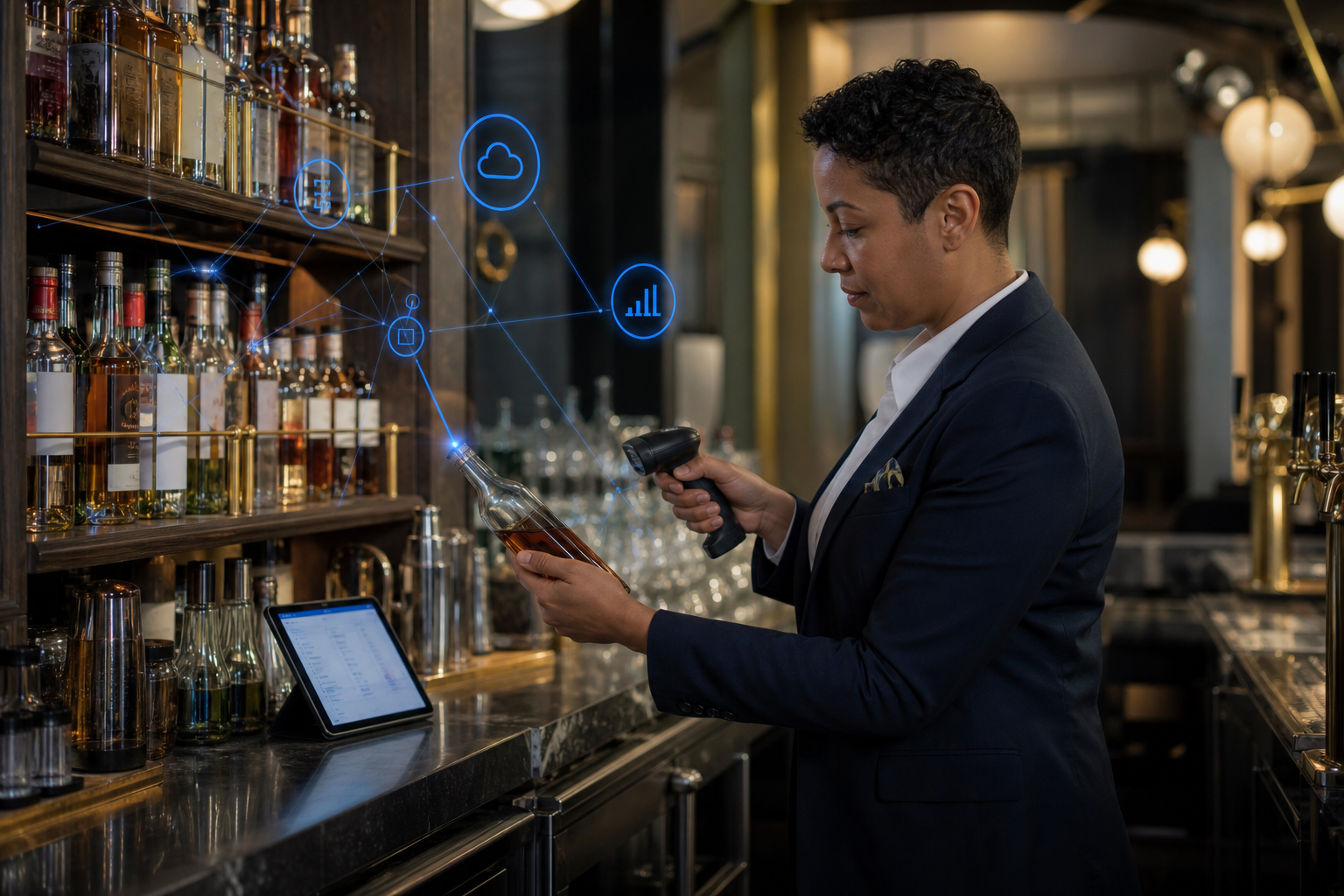
Scannabar builds its entire system around this principle. Each bottle receives a bar-coded tracking label at receiving, and the software monitors its contents from the first pour to the final drop. The result is perpetual inventory that tracks every ounce, not just every case.
Why POS Integration Matters for Liquor Control
Inventory data without sales data is only half the picture. You know what you had and what you have now, but you do not know what should have been consumed based on actual register activity.
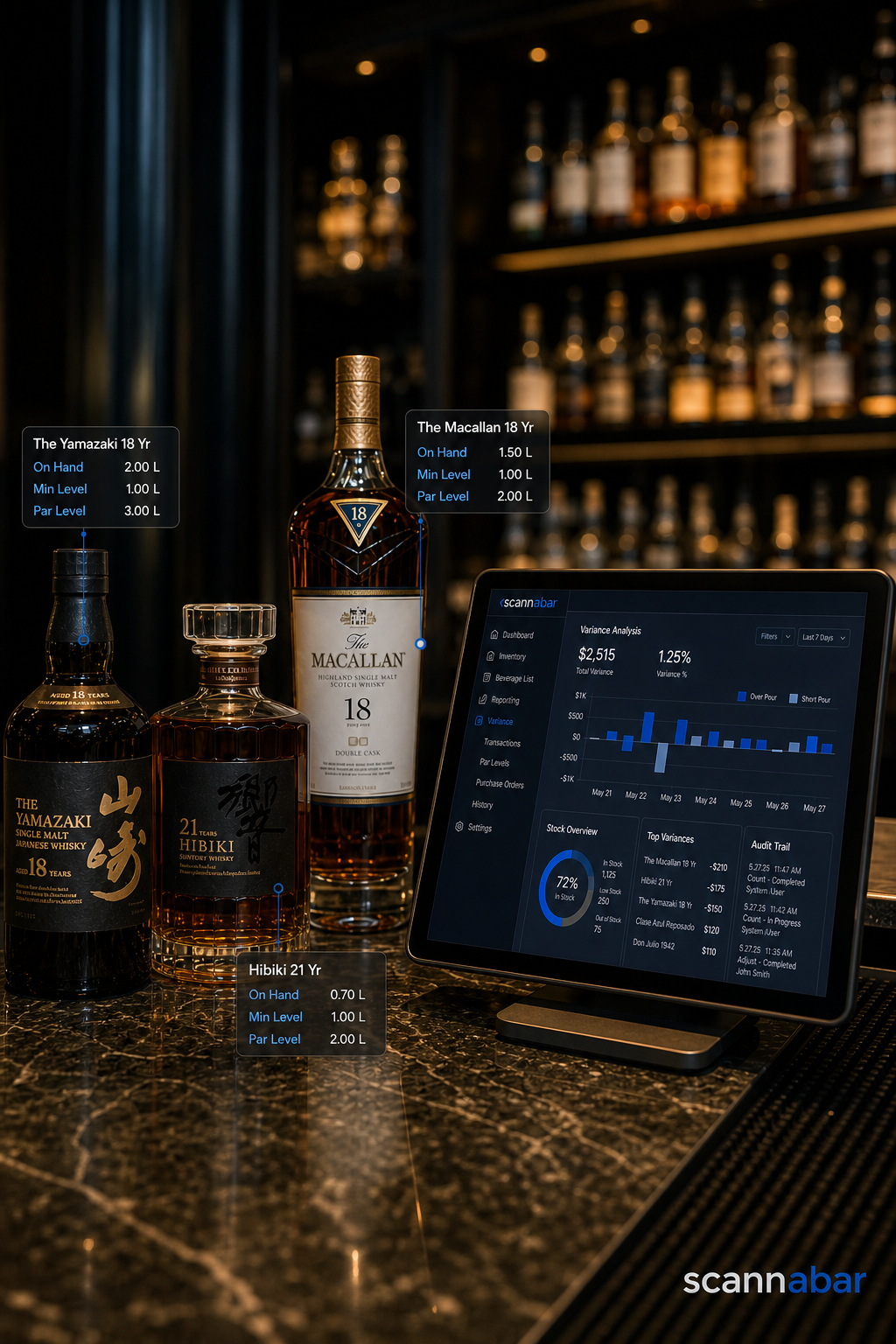
POS integration closes that gap. The software compares theoretical consumption (what your recipes say you should have poured) against actual consumption (what the count shows). The difference is your variance, and it points you exactly where to look.
A bar running 5% variance on well vodka might seem acceptable until you calculate the dollars. On a product moving 15 bottles a week at $18 per bottle, that variance costs roughly $700 a year on one SKU. Multiply across your full product line and the total adds up fast.
Scannabar integrates with POS platforms including Aloha, Micros, and InfoGenesis, creating a closed-loop system where counts, sales, and variance reports feed from the same data source.
How Barcode and Bottle-Based Counts Reduce Labor
Speed is not a luxury when you are managing inventory across multiple bars. Barcode scanning eliminates the clipboard-and-calculator process that eats hours every count cycle. Instead of reading labels, estimating fill levels, and writing numbers on a spreadsheet, your staff scans each bottle and lets the software calculate contents automatically.
Scannabar's system measures the contents of 120 bottles in roughly 15 minutes. A property running four bars can complete a full-property count during a single shift, which means you can count daily or after every shift without pulling staff away from revenue-generating work.
That frequency changes everything. Daily counts catch variance within 24 hours instead of 30 days. Weekly counts give you trend data that exposes patterns such as a particular bartender consistently running higher variance on premium spirits during Friday night shifts.
How Scannabar Fits Hospitality Operations
Scannabar was built for hospitality operators. It was not adapted from a warehouse platform or bolted onto a POS system as an afterthought. The system serves bars, restaurants, hotels, nightclubs, golf and country clubs, and cruise ships across the U.S. and Canada.
How Scannabar Supports Bar Operators
For independent bar owners and managers, Scannabar delivers bottle-level tracking without the overhead of enterprise software. The hand-held scanning unit is simple enough that any staff member can perform a count after minimal training.
The system flags missing bottles, calculates variance, and generates reports that show you exactly where your dollars are going. You can read more about how inventory tracking improves profitability across bar operations.
The practical result is a culture of accountability that protects both your profits and your staff. When bartenders know that every bottle is individually tracked, heavy pours and unrecorded drinks decline without you needing to stand behind the bar watching every pour. Staff members are protected from false accusations because the data is precise and defensible.
How Scannabar Supports Hotel Beverage Teams
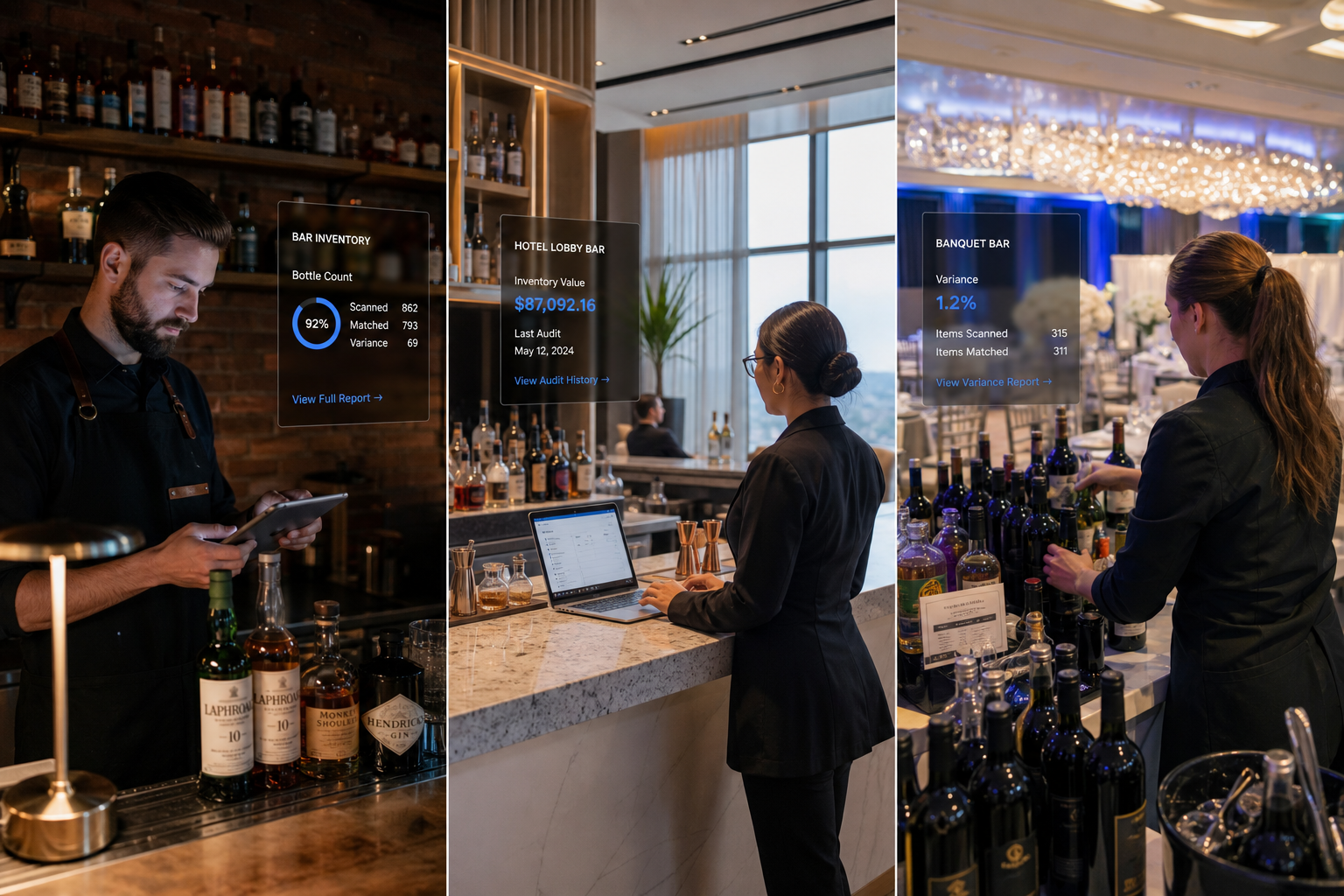
Hotels present unique inventory challenges. A single property may operate a lobby bar, a rooftop lounge, a pool bar, a restaurant bar, and multiple banquet and event stations. Product moves between these locations constantly, and each outlet may carry a different product mix with different par levels.
Scannabar handles multi-outlet properties with a single system. Inventory transfers between bars are tracked on the portable hand-held device, so the F&B director always knows which bottles are at which location. The system works at fixed bars, portable bars, and outdoor event stations, giving hotel teams centralized visibility from one process.
Properties operating under brands like Ritz Carlton, Hyatt, Sheraton, and Intercontinental already rely on Scannabar for this kind of hotel-wide liquor control.
How Scannabar Supports Multi-Location Groups
Hospitality groups managing multiple properties need two things generic tools rarely deliver: standardized counting processes and cross-location performance comparison. If every location counts differently, your variance data is not comparable and your purchasing decisions are based on inconsistent information.
Scannabar standardizes the entire process. Every location uses the same scanning hardware, the same software, and the same measurement methodology. That means a 3% shrinkage reading at your Nashville property and a 7% reading at your Miami property are directly comparable, and you can investigate the difference immediately.
Aggregated purchasing data across locations also strengthens your position at the distributor table. When you can show a supplier exact consumption volumes across 10 or 20 properties, you are negotiating from hard numbers, not estimates.
How to Compare Monthly Software Costs the Right Way
Price comparison is where most buyers go wrong first. They line up monthly subscription fees on a spreadsheet and pick the lowest number. That approach ignores the biggest cost of all: what each platform fails to catch.
What to Measure Beyond Subscription Price
Start with labor. How many hours does your team currently spend counting inventory each month? Multiply those hours by your loaded labor rate. If a platform cuts counting time by 75%, that labor savings alone may cover the subscription several times over.
Next, measure variance detection speed. A system that catches a $200-per-week loss in the first week saves you $800 compared to a system that catches it at the end of the month. Over a year, faster detection on just a handful of products can represent thousands of dollars.
Then look at integration costs. Some platforms charge separately for POS integration, for additional locations, or for report customization. Scannabar includes software support and upgrades at no additional charge, with no yearly or monthly licensing fees beyond the initial system cost. That pricing structure eliminates the hidden costs that inflate the total expense of subscription-based alternatives.
How Faster Counts and Earlier Alerts Affect ROI
If your current counting method takes 8 hours per month across all locations and a barcode-based system reduces that to 2 hours, you recover 6 hours of labor every month. At $25 per hour loaded, that is $150 in direct monthly savings.
Many Scannabar clients report reducing shrinkage to 1% to 3% from previous levels near 25%. For a bar doing $500,000 in annual beverage sales, dropping from 25% to 3% recovers $110,000 per year. A more conservative improvement to 10% still recovers $75,000.
The ROI timeline for most operators is weeks, not months. According to the National Restaurant Association's 2025 cost analysis, keeping beverage cost ratios in check remains a top priority across the industry.
Scannabar clients generally see a 25% to 50% reduction in beverage costs within the first few weeks. That rapid payback should anchor your cost comparison, not the subscription line item.
What Questions to Ask Before Choosing a Bar Inventory Platform
Before signing a contract, put each vendor through questions that reveal whether their platform was built for hospitality or adapted from another industry.
Does the System Track Individual Bottles or Only SKU Quantities?
SKU-level tracking tells you totals. Bottle-level tracking tells you where every ounce went. If you need to identify a missing bottle at a specific bar station, only serialized tracking delivers that answer.
How Does the System Measure Partial Bottles?
Estimating fill levels by eye introduces the same human error you are trying to eliminate. Look for calibrated measurement tools, whether that is a bar-coded ruler, a scale, or another precision method.
What POS Systems Does the Platform Integrate With?
Confirm that your current POS is supported natively. A third-party middleware layer adds cost, extra configuration, and potential points of failure.
Can the System Handle Multi-Location Operations?
Ask how variance data is standardized across properties. Can you compare shrinkage rates between locations using the same methodology? Can you aggregate purchasing data for distributor negotiations?
What Is the Total Cost of Ownership?
Ask about licensing fees, per-location charges, integration fees, and upgrade pricing. Some platforms advertise low subscriptions but add charges for features that should be standard. Scannabar includes support, upgrades, and toll-free customer service 7 days a week at no extra charge.
How Quickly Can Staff Learn the System?
A system that requires days of training slows your rollout and increases labor costs. Scannabar's hand-held device is simple enough that staff can begin performing counts within a single shift.
In Conclusion: How to Choose Bar Inventory Software That Protects Your Margins
The real cost of bar inventory is not the software subscription. It is the money you lose every week that your current system fails to detect. Variance, heavy pours, missing bottles, and delayed counts create a cascade of hidden costs that compound across every bar and every location you operate.
Purpose-built bar inventory software with serialized bottle tracking, POS integration, and barcode-based counts closes the gap between what you think you are losing and what you are actually losing.
Scannabar delivers that level of control for independent bars, hotel properties, and multi-location groups. The track record speaks for itself: shrinkage reduced to 1% to 3%, beverage costs cut by 25% to 50% within weeks of implementation.
The question is not whether you can afford to invest in better liquor control. It is whether you can afford to keep making decisions with delayed inventory data.
FAQs About Bar Inventory Software
What is bar inventory software and why do hospitality operators need it?
Bar inventory software automates the process of counting, tracking, and analyzing your beverage stock. It replaces hand counts with barcode scanning and digital measurement, giving you accurate data on what you have, what you sold, and what went missing. Scannabar tracks every bottle individually from receiving to depletion, so operators catch variance within hours instead of weeks.
How does POS integration improve liquor inventory control?
POS integration compares what your register says you sold against what your physical inventory shows you actually poured. The difference is your variance, and it points directly to heavy pours, theft, or waste. Scannabar connects with POS platforms like Aloha, Micros, and InfoGenesis to create a closed-loop system that flags discrepancies automatically.
Can bar inventory software work across multiple hotel bars and banquet stations?
Yes. Purpose-built hospitality inventory systems handle multi-outlet properties by tracking bottles across fixed bars, portable bars, and event stations. Scannabar manages transfers between locations on a portable hand-held device, giving F&B directors centralized visibility into every outlet from one system.
How long does a full bar inventory count take with scanning technology?
With barcode-based scanning, a bar stocked with 80 to 120 bottles takes roughly 15 minutes to count. That speed allows operators to count after every shift or daily, catching variance far earlier than monthly hand-counts. Scannabar processes all calculations automatically during the scan, so reports are ready the moment you finish.
What should I look for when comparing bar inventory software pricing?
Look beyond the monthly subscription. Factor in labor savings from faster counts, revenue recovered through earlier variance detection, and hidden costs such as per-location charges, integration fees, and support contracts. Scannabar includes toll-free support, software upgrades, and ongoing service at no additional charge, with no recurring monthly or yearly licensing fees.
How does serialized bottle tracking differ from standard SKU-level inventory?
SKU-level tracking tells you how many bottles of a product you have on hand. Serialized tracking assigns a unique identity to each individual bottle and monitors its contents through every scan. Scannabar's serialized approach means you know exactly which bottle is missing and exactly where it was last recorded, giving you accountability at the individual bottle level.