
When inventory handling changes from shift to shift, your hotel bar loses control of its margins. One bartender counts by weight, the next estimates by eye, and the third skips the count entirely. The result: shrinkage that nobody can explain. For a hotel doing $800,000 in annual beverage sales, even a 15% loss rate means $120,000 vanishing with no paper trail.
A written bar inventory management SOP removes that ambiguity. It defines who counts, when they count, how they record every bottle, and what happens when the numbers do not match. Scannabar standardizes hotel inventory procedures across every outlet, making the SOP enforceable rather than aspirational.
This guide walks you through seven steps to build a repeatable inventory SOP for your bars, banquet areas, and beverage outlets.

Quick Guide: How to Build a Hotel Bar Inventory SOP in 7 Easy Steps
- Set the scope and count window: Define which outlets, products, and time periods each count covers.
- Standardize receiving and delivery checks: Verify every shipment against the purchase order before signing off.
- Organize storage and bottle labeling: Assign bin locations and label every bottle for fast, accurate counts.
- Define how full and open bottles are counted: Pick one measurement method and apply it to every open container.
- Document transfers, breakage, and comps: Log every bottle that moves, breaks, or leaves inventory as a comp.
- Reconcile counts against sales and usage: Use Scannabar to compare physical counts with POS data automatically.
- Assign ownership, review cadence, and follow-up: Name who runs the process and how often results are reviewed.
How to Build Your Hotel Bar Inventory SOP
1. Set the scope and count window
Your SOP starts by answering three questions: what do you count, where do you count it, and when does each count happen? In a hotel, "what" typically means all liquor, wine, beer, and high-value dry goods across every revenue-producing outlet.
"Where" means naming each location individually: lobby bar, pool bar, restaurant bar, banquet prep area, wine cellar, and any service bar. Lumping outlets together destroys accountability because nobody can trace a variance to a specific room.
Set a fixed count window. Weekly counts for your top 20 highest-value products and monthly counts for everything else is a practical starting point. For a deeper look at weekly inventory benefits, the data is clear. Lock the day and time so the count always happens at the same point in the operating cycle.
2. Standardize receiving and delivery checks
Every SOP needs a receiving protocol that catches errors at the loading dock, not at month-end. When a delivery arrives, one designated person should match every line on the invoice to the actual cases and bottles on the pallet. Short shipments, wrong brands, and damaged goods get flagged before anyone signs off. For more on building a reliable receiving process, the fundamentals apply to every hotel.
Record the receiving data immediately: product name, SKU, quantity received, supplier, and the name of the person who verified the order. If your hotel uses a property management system or an inventory platform, that data should enter the system the same day.
An unverified delivery is an uncontrolled entry point. Shrinkage starts at the loading dock, not behind the bar.
3. Organize storage and bottle labeling
A disorganized storeroom makes every count slower and less accurate. Assign a fixed bin location for each SKU. Group products by category: spirits on one shelf, wines in a designated cooler or cellar, beer and draft supplies in a separate area.
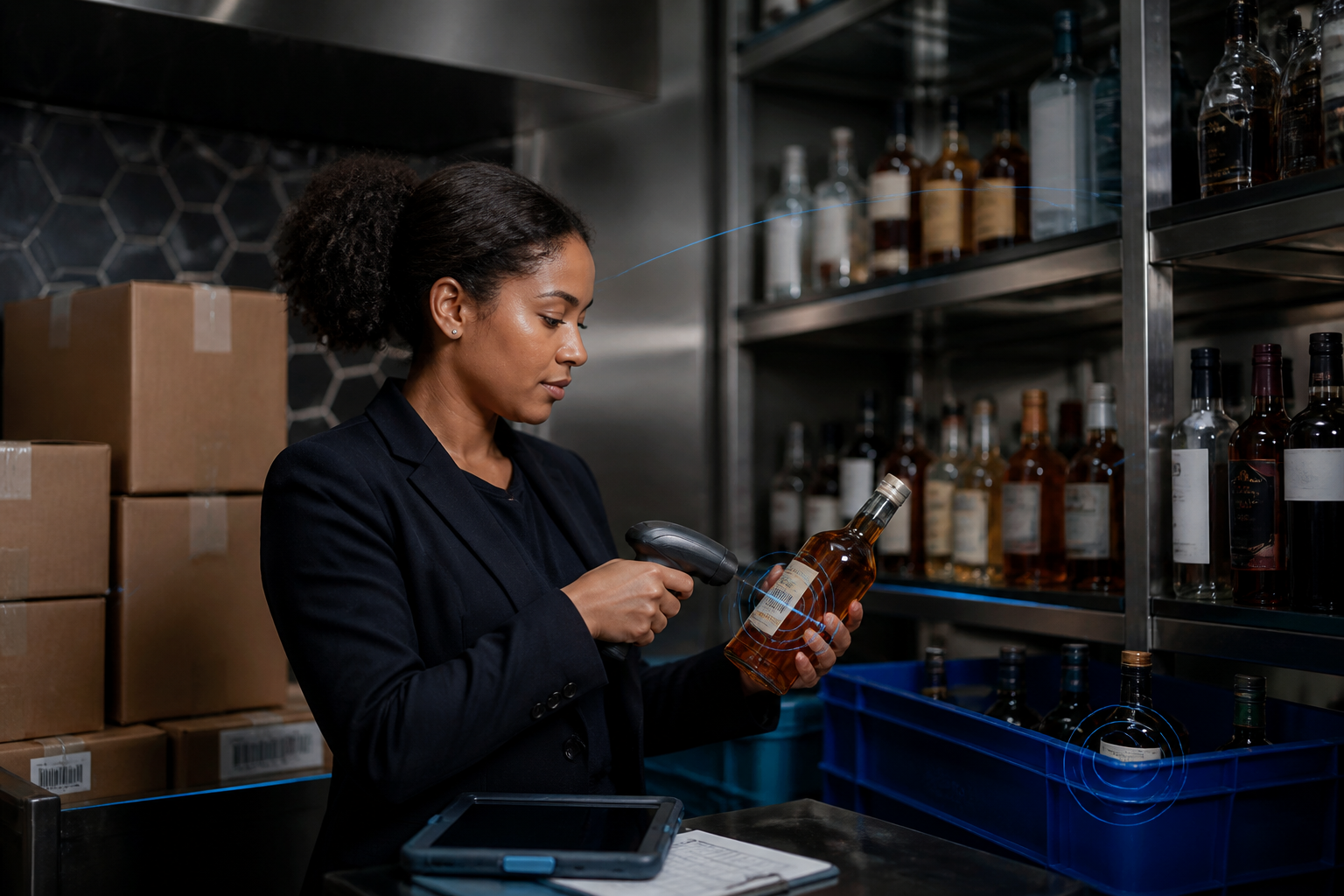
Label every bottle that enters your inventory. Barcode labels are ideal because they remove the need for handwritten tags and eliminate identification errors during counts. Scannabar uses barcode scanning to identify each bottle instantly, so a full count of 120 bottles takes about 15 minutes.
Enforce a first-in, first-out rotation rule. Bottles received first should be pulled first. This prevents dead stock, keeps product fresh, and makes it easier to spot when something goes missing.
4. Define how full and open bottles are counted
Sealed bottles are simple: count each unit. Open bottles are where most SOP breakdowns happen. If one person estimates by eye and another uses a ruler, your data will never be consistent enough to detect real variance.
Pick one method and document it in the SOP. Bottle-level measurement using a barcode-enabled scale or ruler provides the most precise data and removes human estimation from the process. Scannabar measures the exact contents of every open bottle, so your variance analysis starts from verified figures rather than rounded guesses.
Whatever method you choose, train every person who touches a count on the same technique. A consistent method with a small margin of error beats an inconsistent one with no margin at all.
5. Document transfers, breakage, and comps
In a hotel, bottles move between outlets constantly. The banquet team borrows vodka from the lobby bar. The pool bar sends leftover wine back to the cellar. Without documentation, those movements create phantom variances that make your data useless.
Build a transfer log into the SOP. Every inter-outlet movement needs a record: the product, the quantity, the origin, the destination, and the name of the person who authorized it. The same log should capture breakage, spoilage, and complimentary pours with a reason code attached.
Unrecorded comps are invisible shrinkage. A simple daily log signed by a manager keeps these losses visible and accountable.
6. Reconcile counts against sales and usage
Counting inventory is only half the process. The SOP must also define how your team compares what you counted against what the POS system says you sold. The difference between the two is your variance, and it tells you where profit is disappearing.
Scannabar automates this reconciliation by pulling sales data directly from your POS and comparing it against physical counts. The resulting variance report breaks down discrepancies by product, outlet, and time period, so your food and beverage director can identify exactly where losses originate.
Without reconciliation, a count is just a number. With it, a count becomes a diagnostic tool.
7. Assign ownership, review cadence, and follow-up
Every SOP needs a named owner. In most hotels, that is the bar manager or the F&B controller. This person is responsible for ensuring the count happens on schedule, the data gets recorded, and variances get investigated.
Set a review cadence. Weekly variance meetings for high-risk items and monthly reviews for the full inventory keep the SOP alive. A process that generates reports nobody reads is a recipe for failure within a quarter.
Define follow-up actions for variance thresholds. If any product exceeds a 3% variance, the SOP should trigger a specific response: re-count, investigate transfers, review POS data, and document findings. That follow-up loop is what turns a written SOP into an operational control system.
What Should a Hotel Bar Inventory SOP Include?
A complete hotel bar inventory SOP should cover six core elements: scope and frequency of counts, receiving and verification procedures, storage and labeling standards, counting methods for both sealed and open containers, transfer and write-off documentation, and a reconciliation and review process.
Each element needs named responsibilities. The SOP should specify who performs each task, who reviews the results, and who has authority to approve write-offs or investigate variances.
Include a training section that defines how new hires learn the process. If the SOP lives only in one manager's head, it breaks the moment that manager calls in sick or transfers to another property.
How Often Should a Hotel Update Its Inventory SOP?
Review your inventory SOP at least twice a year, and update it immediately whenever your operation changes. New outlets, new POS integrations, staff restructuring, and seasonal menu swaps all create gaps in an outdated SOP. According to FSM.How's guide to beverage control, consistent standardization of recipes, measurement, and storage is the foundation of any effective beverage control system.
The review should include a performance check: are variances trending down since the last revision? If not, the SOP itself may need tighter controls on the specific step where losses concentrate.
Assign the SOP review to the same person who owns the weekly count. That person sees the data most frequently and is in the strongest position to identify where the document no longer matches reality.
How Scannabar Helps You Enforce a Hotel Bar Inventory SOP

Scannabar turns a written SOP into a system your team can execute in minutes rather than hours. The Scannabar Inventory Control System uses barcode scanning to measure the exact contents of every bottle, removing the estimation errors that undermine consistency across shifts and outlets.
Because Scannabar integrates with your POS and property management systems, it automatically reconciles physical counts against sales. Variance reports break down discrepancies by product, outlet, and time period, giving your F&B director the data to act on findings the same week they appear.
Hotels running Scannabar routinely operate at 1% to 3% shrinkage, down from the 20% to 25% industry average. You can read more about lowering beverage costs in hotel environments. The system handles receiving logs, transfer records, and open-bottle measurements inside one platform, so every element of your SOP feeds a single source of truth.
Ready to make your SOP enforceable? Call 1-800-939-8960 to talk to someone who has been building hotel inventory systems since 1998.
FAQs About Hotel Bar Inventory SOPs
What is a hotel bar inventory SOP?
A hotel bar inventory SOP is a written procedure that defines how your team receives, stores, counts, and reconciles beverage inventory across every outlet. It standardizes the process so results are consistent regardless of who runs the count or which shift is on duty.
Who should be responsible for the inventory SOP in a hotel?
The bar manager or F&B controller typically owns the SOP. This person ensures counts happen on schedule, reviews variance data, and initiates follow-up when numbers fall outside acceptable thresholds. Scannabar gives that owner real-time visibility into every count across the property.
How long does it take to implement a bar inventory SOP?
Most hotels can draft and deploy a working SOP within two to four weeks. The timeline depends on the number of outlets, the level of staff training required, and whether you are integrating inventory software. Scannabar reduces counting time by up to 75%, which accelerates adoption.
Can a bar inventory SOP prevent theft?
An SOP creates a culture of accountability that makes theft harder to hide. When every bottle is logged at receiving, tracked through transfers, and measured at each count, unexplained losses surface quickly. Scannabar identifies missing bottles at any location within the property, giving managers the data to investigate gaps before they grow.
How does an inventory SOP differ for hotels with banquet operations?
Hotels with banquets need an SOP that accounts for large-volume transfers between storage and event areas. The SOP should include a pre-event pull sheet, a post-event return count, and a reconciliation step that isolates banquet variance from regular bar operations. This prevents event-driven movement from distorting your day-to-day data.