
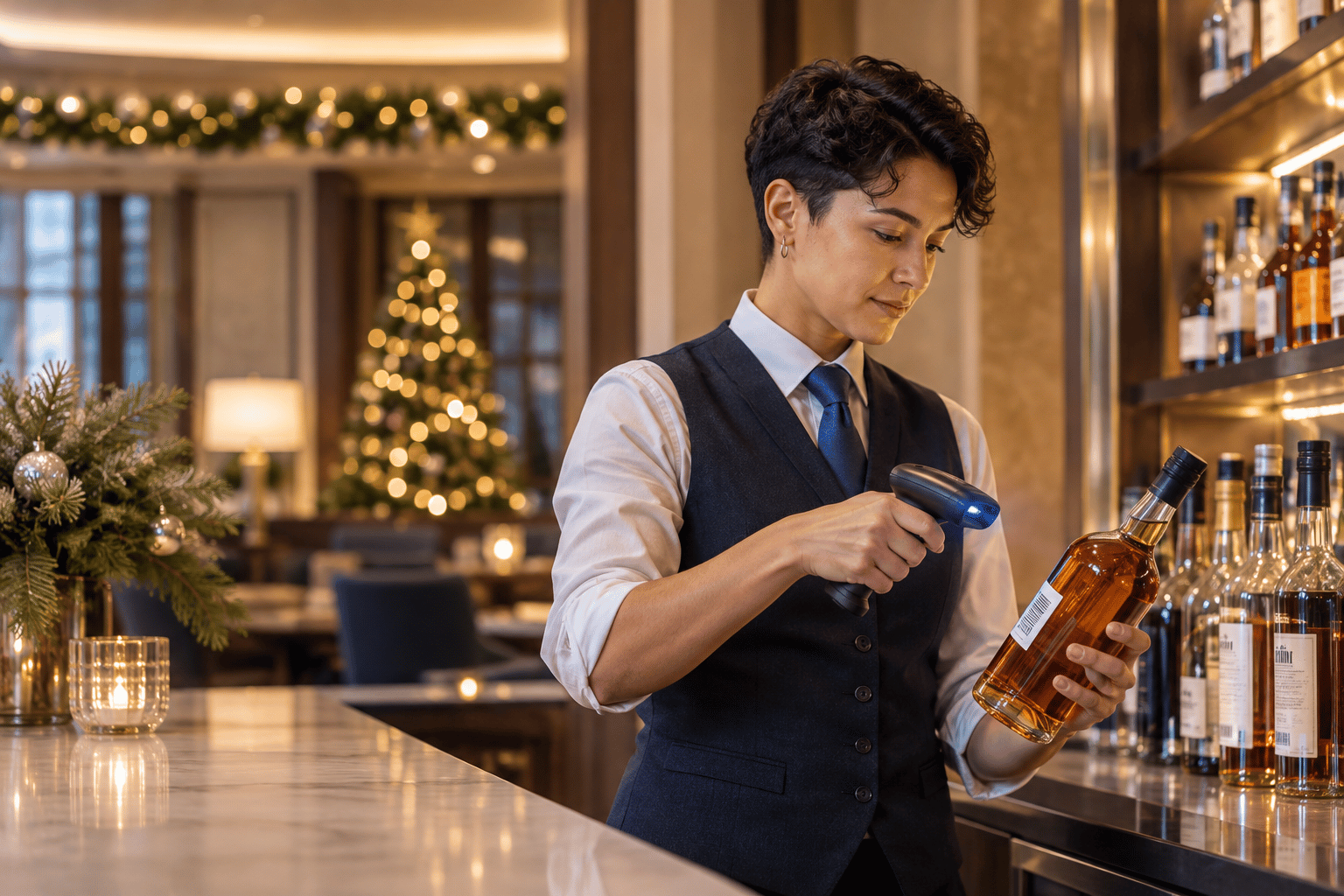
Holiday inventory theft prevention starts with reliable counts, controlled access, documented bottle movements, and prompt reconciliation against sales. When parties add temporary bars and extra handoffs, a missing record can hide a real loss or make legitimate usage look like theft.
Missing stock costs you twice operationally: you must replace the product, then spend management time explaining the shortage. Inaccurate balances can also trigger unnecessary orders or leave an event bar short of its advertised spirits.
Scannabar supports inventory theft prevention through bottle-level tracking and variance reporting. Use the seven controls below to build a culture of accountability that protects your stock and honest employees during the holiday season.
Quick Guide: Seven Controls for Holiday Inventory Theft Prevention
- 1. Establish Your Opening Inventory Baseline: Count every bottle and record exact levels before the holiday rush begins.
- 2. Verify Every Delivery Against Your Purchase Order: Check weights, case counts, and bottle quantities at the door before signing.
- 3. Restrict Stockroom Access to Named Personnel: Limit keys and codes to managers who sign bottles in and out.
- 4. Record Every Bottle Transfer Between Outlets: Document product moving between bars, banquet areas, and storage with both sides confirming.
- 5. Document Waste and Complimentary Drinks in Real Time: Log breakage, spills, and comps the moment they happen, not at the end of the night.
- 6. Reconcile Consumption Against Sales After Every Shift: Compare what you poured with what your POS says you sold.
- 7. Review Exceptions After Each Event or Holiday Night: Investigate outlier variances by product, outlet, and shift window while the data is fresh.
How to Protect Your Bar Inventory During the Holiday Season
1. Establish Your Opening Inventory Baseline
Establish a dated opening count before your next holiday event. If the season has already started, count now rather than reconstructing an earlier balance. Include full and partial bottles, kegs, cases, and event stock. Use consistent measurement units so later comparisons have a reliable starting point.
This baseline becomes your anchor for every variance calculation through New Year's. Without it, you are comparing future counts against an assumption. Count storage, every back bar, service wells, banquet staging areas, and any portable bars you plan to use for private events.
Count each outlet separately. A hotel lobby bar, banquet bar, and stockroom need distinct balances. Combining them hides where a discrepancy arose. Scannabar supports location-based records; your inventory procedures should define who counts and who verifies unusual differences.
2. Verify Every Delivery Against Your Purchase Order
Verify deliveries against the order and invoice before accepting them as complete. Assign a trained receiver and, where staffing allows, separate receiving from ordering and payment approval. A second reviewer can check exceptions when full separation is impractical.
Check quantities, brands, bottle sizes, damage, and substitutions. An order for liter bottles does not balance if the shipment contains 750 ml bottles, even when the case count matches. Record shortages and follow up until the supplier correction or credit is confirmed.
Document accepted quantities promptly as part of inventory cost control. Do not enter the full order when only part arrived. Otherwise, your records create a shortage before a single drink is served.
3. Restrict Stockroom Access to Named Personnel
Limit stockroom access to authorized personnel and identify who approves replenishment during each shift. Keep a documented handoff when responsibility changes. Secure storage when unattended without obstructing required exits. Build coverage for breaks so service pressure does not become a reason to bypass the procedure.
Clear access rules protect honest staff from unsupported accusations. Apply the same process to managers and frontline employees. Restricted access helps narrow an investigation, but an access record alone does not establish who caused a loss.
Review keys, codes, and account access before peak events. Remove access that is no longer authorized and set an end date for seasonal assignments.
4. Record Every Bottle Transfer Between Outlets
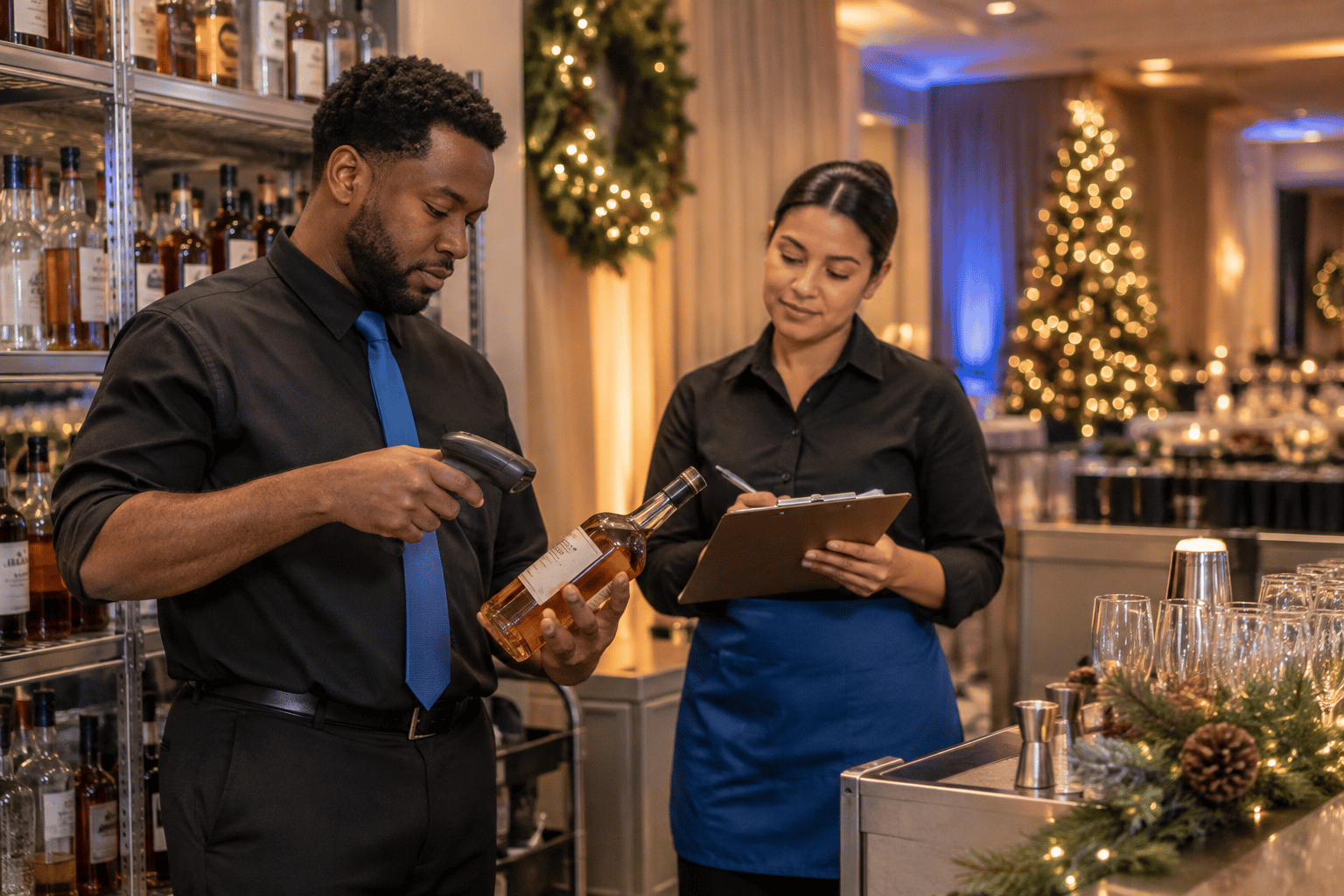
Bottles move constantly during holiday events. The banquet team borrows vodka from the main bar. The portable event bar pulls rum from storage. Room service returns an unopened wine bottle. Each of those movements changes two inventory counts, and if only one side records the transaction, both reports become unreliable.
Use a transfer log that captures product, quantity, sending location, receiving location, and authorization from both sides.
For illustration, sending four bottles while recording only three leaves the sending and receiving records inconsistent. Reconcile both sides before treating the difference as product consumed. Scannabar supports bottle-level movement records. Documented beverage transfers help separate movement errors from genuine losses.
Treat returns the same way. Product that comes back from an event still needs documentation confirming it re-entered the original location's inventory.
5. Document Waste and Complimentary Drinks in Real Time
Record waste and authorized complimentary drinks when they occur. Broken bottles, spills, and approved guest recovery all consume stock. Without records, legitimate usage becomes unexplained variance and can expose honest employees to suspicion.
Place a waste log at every bar station. Record the item, quantity, reason, and who logged it while the details are available.
Use your approved POS workflow to record complimentary drinks with the correct recipe quantities and authorization. Keep waste distinct from sales and comps, and avoid counting the same usage twice. Make the recording method accessible during busy service.
Review waste records alongside stock differences. Repeated entries for one spirit or incomplete logs merit a process check. Neither a blank log nor a high waste total proves misconduct. Confirm what happened before drawing conclusions.
6. Reconcile Consumption Against Sales After Every Shift
Calculate actual usage as opening stock plus receipts and transfers in, minus closing stock, supplier returns, and transfers out. Compare that usage with recipe-based POS consumption and documented non-sale usage. The unexplained remainder is your beverage variance. Keep periods and units aligned.
Reconcile after high-volume events and use targeted checks between full counts. Scannabar supports comparing measured consumption with recorded sales. The review period determines how precisely you can investigate timing; a weekly count cannot establish the exact moment a shortage occurred.
Prioritize differences by product cost and repeated patterns, rather than percentage alone. For illustration, half a bottle costing $60 represents a $30 product-cost difference, while a full bottle costing $12 represents $12. Both matter, but the larger dollar exposure deserves prompt attention.
7. Review Exceptions After Each Event or Holiday Night
Review exceptions after each holiday event and assign a person to investigate unresolved differences. Set tolerances using your measurement method, product value, and operating history rather than assuming one percentage fits every bar. Recount unexpected balances and check the underlying records.
Compare the exception list against your transfer log, waste log, and POS comps. Many variances resolve once you account for a transfer that one side forgot to confirm, a comp that was served but never rung in, or a delivery that arrived after your opening count. Resolve the accounting difference before considering personal responsibility.
When an outlier cannot be explained by documentation, escalate it to a conversation with the manager who supervised the shift. Approach the conversation with the data: "We used 22 ounces more house vodka than the POS shows we sold on Saturday night. The waste log shows no recorded breakage. Help me figure out what happened."
Document the finding, the action owner, and the follow-up date. Retain unresolved differences for the next review rather than changing records merely to make them balance.
What Does Missing Holiday Inventory Cost Your Bar?
Holiday inventory loss has a measurable replacement cost and can reduce potential sales. Calculate these separately: menu-price sales opportunity is not the same as realized revenue or net profit.
In a hypothetical example, 10 missing 750 ml bottles costing $25 each represent $250 in product cost. At 25.36 US fluid ounces per bottle and a 1.5-ounce recipe portion, each bottle contains about 16.9 theoretical servings before service losses.
Across 10 bottles, that is approximately 169 theoretical servings. At an illustrative $10 selling price, the potential gross sales opportunity is about $1,690, assuming demand existed. Do not add that amount to the $250 product cost or describe the difference as guaranteed lost profit.
Unexplained loss also distorts stock records. Replacing missing product can inflate purchasing while inaccurate balances conceal stockouts. Review product-cost variance separately from pour cost, sales opportunity, and investigation time.
The illustrative figures above are hypothetical and will differ based on your venue's pricing and product mix. Run the same calculation with your own wholesale costs and menu prices to see the real exposure for your operation.
How Do You Investigate an Inventory Shortage Fairly?
Variance does not prove theft. It proves that the numbers do not match. Treating every shortage as stealing damages trust and misses the real fix. Before pointing at a person, work through the process.
Check alternative explanations first: count errors, missing receipts, undocumented transfers, unrecorded comps, and incorrect recipe quantities. Each can create unexplained variance. Keep records of what you verified instead of treating an unexplained balance as an accusation.
When the documentation cannot explain the shortage, narrow the window. Count the specific product daily for the next two weeks and compare against POS data for each shift. See whether the gap follows a particular day, time window, or staffing pattern.
If you are tracking liquor shrinkage at the bottle level, you can identify which specific bottles are losing product faster than the register supports.
If a conversation with an employee becomes necessary, hold it privately with a second manager present. Present the data, not an accusation. Explain what the numbers show and ask for the employee's help understanding the gap.
Seek qualified HR or employment-law guidance before discipline, searches, or wage deductions. Applicable rules vary. Keep your review confidential and retain factual records rather than assumptions about an employee.
Mark Scovera and Amanda Kellerman of accounting and advisory firm Plante Moran recommend separating duties, checking received goods against records, and training staff in their restaurant internal-controls checklist. Apply those safeguards consistently, including during holiday service.
Fair investigations protect employees from false accusations and help managers fix the process that allowed a discrepancy. Record the outcome and verify that corrective actions are being followed.
How Scannabar Helps You Prevent Holiday Inventory Loss
Scannabar supports holiday loss prevention with barcode-enabled receiving, bottle identification, inventory measurement, and reporting. Record stock entering the building, document movements to event bars, and compare later measurements with the opening balance. These records give managers specific discrepancies to investigate instead of a single unexplained cost total.
Scannabar provides bottle history and variance analysis to connect measurements, movements, and recorded sales. Confirm the POS interface and recipe setup for your operation. Physical checks still matter: the system needs accurate inputs and cannot establish that an employee stole product.
Scannabar supports multi-outlet inventory, helping managers review banquet bars, permanent bars, and storage separately. Documented transfers reduce avoidable discrepancies and support consistent replenishment. Frame the system as a way to reduce repetitive administrative work and protect staff through clear records.
Request a Scannabar demonstration using your holiday event workflow. Ask to review receiving, bottle transfers, inventory checks, and variance reporting against the procedures your team needs.
FAQs About Preventing Holiday Inventory Theft
How often should I count bar inventory during the holidays?
Choose a counting schedule based on event volume, product value, and your ability to investigate differences promptly. Count before and after major events and spot-check priority products between full counts. Scannabar supports repeatable inventory checks, but your team must still verify measurements.
What variance rate should trigger a bar inventory review?
There is no single variance percentage that proves normal performance or theft. Define tolerances using measurement precision, recipe accuracy, and your operating history. Scannabar helps you identify repeated differences through variance reports; check the underlying records before deciding what caused them.
Can I fire an employee based on inventory shortage data alone?
Do not treat inventory shortage data as proof of employee wrongdoing. Document the count, review receipts and transfers, check recipes and authorized usage, and obtain qualified HR or legal advice before employment action. A variance report identifies a discrepancy, not personal responsibility.
Should I install cameras to prevent bartender theft?
Cameras can serve as a deterrent, but they are not a substitute for inventory controls. A camera shows you that a bottle was picked up. It does not tell you whether the drink was rung in, comped, or wasted.
Scannabar supports inventory reconciliation by comparing measured usage and recorded sales. Combine those records with receiving, transfer, and waste documentation. Neither camera footage nor a stock difference alone explains every cause of loss.
How do I handle holiday temporary staff and inventory access?
Give temporary staff the minimum access they need to do their jobs. Restrict stockroom entry to permanent managers, require manager authorization for any bottle pulls, and assign personal POS logins so every transaction is traceable.
Brief temporary hires on your waste-logging and comp procedures during their first shift. Clear rules applied equally to everyone protect your holiday team from ambiguity.